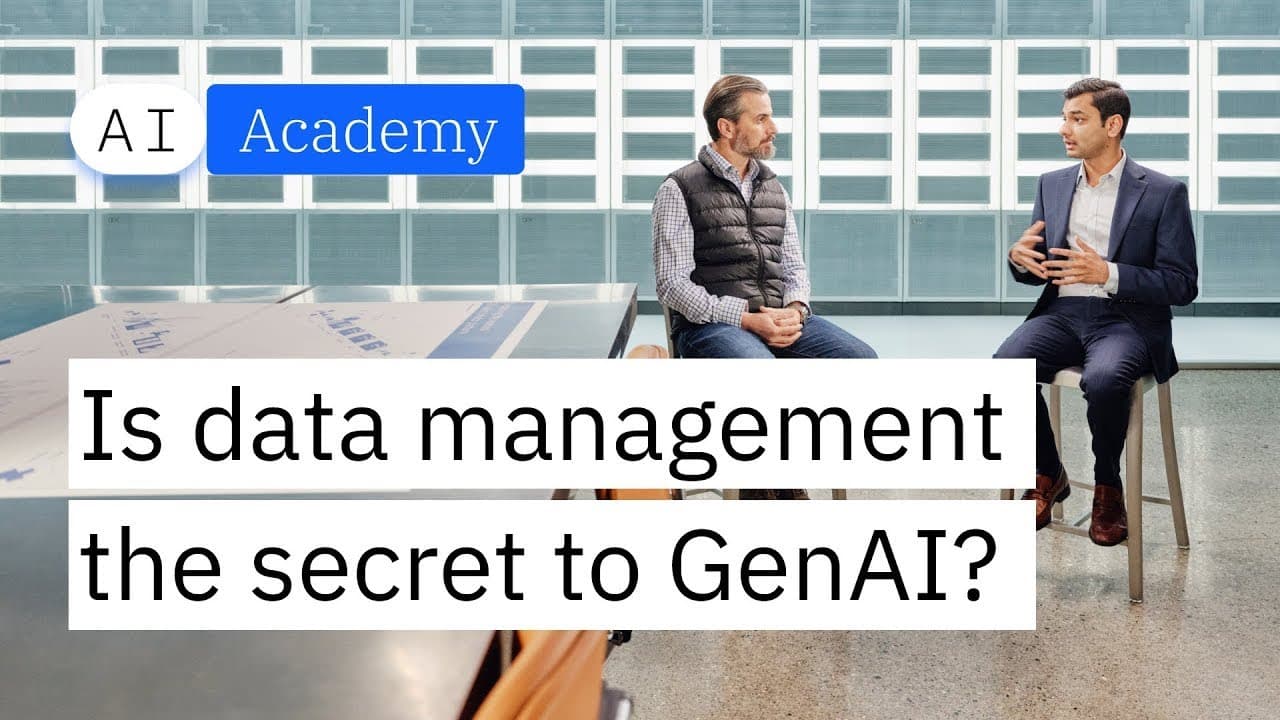
How Does Data Management Improve Generative AI?
TL;DR
High-quality, governed enterprise data is the foundation for deploying generative AI effectively and gaining a competitive advantage. Companies can improve results by organizing data, breaking down silos, controlling access, monitoring models, and using tuning or retrieval-augmented generation. Open data lakehouse architectures can further support scalable, flexible, and cost-effective AI workflows.
Transcript
Patterns and relationships and vast amounts of data unlock entirely new possibilities. Sometimes we learn about our past, or we discover something that helps us predict the future. For some time, we’ve been collecting data without even knowing what might come of it. And then the volume just becomes overwhelming. And that’s when the relationship ... Read More
Key Insights
- High-quality enterprise data is a sustainable source of competitive advantage because organizations generally have access to similar generative AI technology. Differentiation comes from customizing models with proprietary data and embedding AI into enterprise applications and workflows to improve productivity and business performance.
- Generative AI is effective with unstructured data because it can process large volumes of documents and software code, identify patterns, and connect related information with limited preparation or supervision. This capability helps enterprises extract value from the majority of newly created data.
- Generative AI can improve data management by organizing, refining, and enriching information. It can interpret inconsistent formats, dates, names, initials, columns, and headings across legacy applications, then help reveal relationships among data stored in separate systems.
- Data silos are a pervasive architectural obstacle because enterprise information may be inaccessible across on-premises and cloud environments. Organizations can address this through a virtual data layer that queries multiple sources or by consolidating information on an open, cost-effective data lakehouse.
- Effective governance requires data quality practices, thoughtful access policies, and continuous enforcement. Enterprises should catalog data, create a business glossary, restrict or redact sensitive information, and monitor model inputs and outputs for policy effectiveness and changes caused by real-world interactions.
- Model tuning adapts generative AI by using strong examples from enterprise data to demonstrate how the model should answer prompts. These examples help the model incorporate the language and structure of the business, allowing it to fit more naturally into enterprise systems.
- Retrieval-augmented generation improves responses without customizing the underlying model. It connects the model to a knowledge base of quality enterprise data, increasing factual accuracy, constraining responses to known information, and reducing the risk that the model produces unsupported answers.
- An open data lakehouse combines the flexibility, scalability, and cost advantages of data lakes with the performance and functionality of data warehouses. Its interoperable design allows enterprises to select different engines for transformation, interactive queries, and document vector embeddings while governing the complete lifecycle.
Install to Summarize YouTube Videos and Get Transcripts
Explore YouTube Video Summarizer or Get YouTube Transcript Extractor
Questions & Answers
Q: Why is data management important for generative AI?
Data management determines whether generative AI can reliably use enterprise information. High-quality, accessible, organized, and governed data supports model customization, accurate retrieval, application integration, and improved business performance. Poorly connected silos, inconsistent formats, weak access controls, and missing lineage make it harder to move beyond isolated experiments and deploy AI safely across an enterprise.
Q: How can generative AI improve enterprise data management?
Generative AI can help organize, refine, and enrich enterprise data so it becomes easier to understand and consume. It can interpret different formats, dates, names, initials, column structures, and headings used by legacy applications. It can also examine siloed systems, identify what their data represents, and reveal relationships that support more holistic and efficient use.
Q: How does enterprise data create a competitive advantage in AI?
Enterprise data creates differentiation because many organizations can access essentially the same generative AI technology. Competitive advantage comes from tuning models with proprietary information, grounding responses in trusted knowledge, and integrating AI into existing and new applications. These uses can drive productivity gains, improve business performance, and turn well-managed data into valuable intellectual property or a marketable product.
Q: How can companies solve data silos for generative AI?
Companies can address data silos by connecting or consolidating information without creating another isolated repository. One approach is a virtual data layer that allows queries across multiple sources. Another is moving data onto an open, cost-effective lakehouse platform. Both approaches aim to make information across on-premises and cloud environments accessible for holistic analysis, AI customization, and governed enterprise use.
Q: What data governance practices are needed for generative AI?
Generative AI governance requires established data-quality practices, a catalog or business glossary, thoughtful access policies, and ongoing monitoring. Organizations must decide what information AI may access and what should be removed or redacted, including personally identifiable information. Policies should be set centrally, enforced locally, and tested by monitoring model inputs, outputs, and behavioral drift during real-world use.
Q: What is the difference between model tuning and RAG?
Model tuning instructs or partially retrains a model using strong examples from enterprise data that show how it should respond to prompts. This helps it adopt business-specific language and structure. Retrieval-augmented generation, or RAG, does not customize the model itself. Instead, it supplies a quality-controlled knowledge base that improves accuracy, limits responses to known facts, and mitigates hallucinations.
Q: Why use a data lakehouse for enterprise generative AI?
A data lakehouse combines the flexibility, scalability, and cost advantages of a data lake with the performance and functionality of a data warehouse. It can support sourcing, cataloging, filtering, transforming, training, testing, tuning, and governing data and models. An open architecture also lets enterprises select specialized engines for ingestion, interactive queries, and vector embedding while maintaining lifecycle lineage.
Q: When should AI governance be added to a generative AI project?
Data and AI governance should be implemented from the beginning rather than added after experimentation. Governance depends on managing and tracking the complete lifecycle, including datasets, pipelines, model inputs, outputs, policies, and regulatory risks. Early governance makes it more likely that successful prototypes can be assessed properly, integrated with enterprise IT, and eventually approved for production deployment at scale.
Summary & Key Takeaways
-
Generative AI changes data management in two directions. It extracts patterns and relationships from large volumes of unstructured documents and software code with limited preparation or supervision. It can also help organize, refine, enrich, and connect inconsistently formatted information scattered across legacy applications and siloed systems.
-
Enterprise advantage comes from applying broadly available generative AI technology to proprietary, high-quality data. Organizations can customize models, integrate AI into applications, and improve productivity and business performance. Success depends on resolving architectural barriers, making distributed data accessible, and treating managed data as valuable intellectual property.
-
Production deployment requires data quality, access controls, governance, and lifecycle monitoring from the beginning. Enterprises can customize AI through model tuning or ground responses through retrieval-augmented generation. An open data lakehouse can support data preparation, training, testing, tuning, lineage, governance, and specialized processing tools within one interoperable architecture.
Read in Other Languages (beta)
Share This Summary 📚
Summarize YouTube Videos and Get Video Transcripts with 1-Click
Try YouTube Summary with ChatGPT & Claude or YouTube Transcript Generator
Explore More Summaries from IBM Technology 📚



Summarize YouTube Videos and Get Video Transcripts with 1-Click
Try YouTube Summary with ChatGPT & Claude or YouTube Transcript Generator