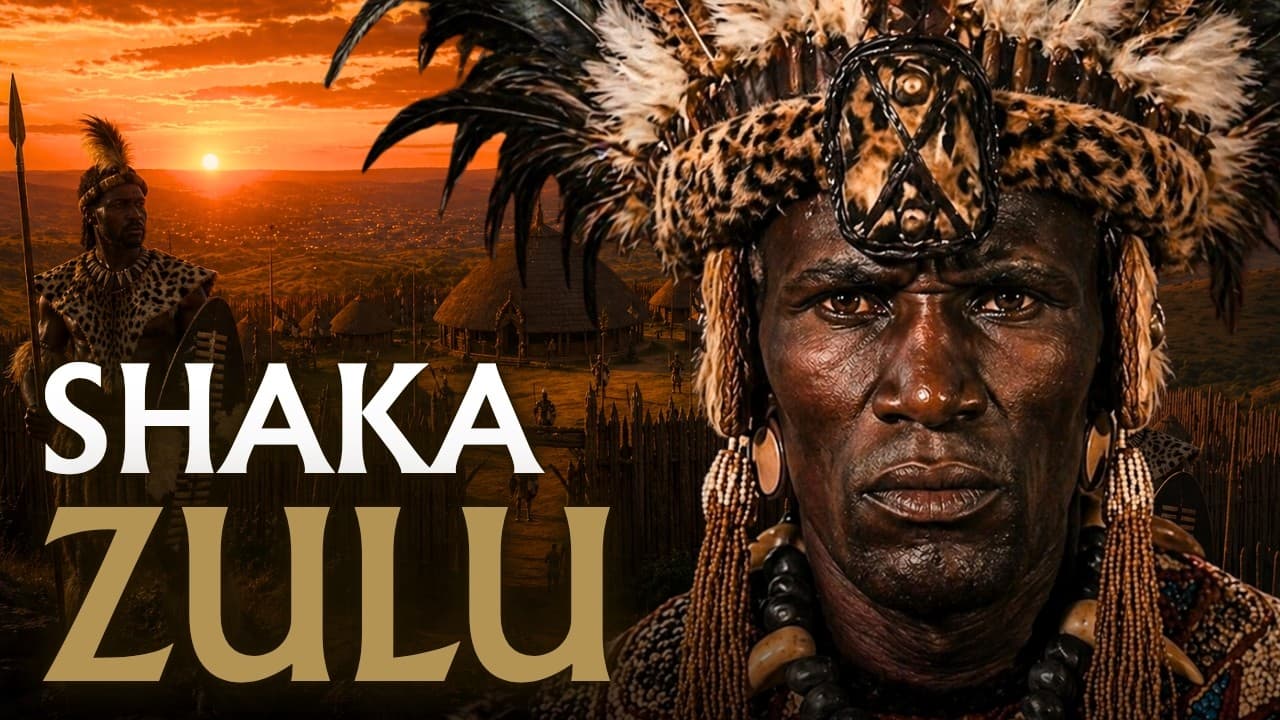
How did Shaka Zulu build the Zulu Kingdom
TL;DR
Shaka rose to power in 1816 with the help of the Mthethwa under Dingiswayo, then expanded Zulu influence through military innovations and strategic tactics. The pivotal Battle of Gqokli Hill in 1818 solidified his reputation and established the Zulu as a dominant force in southeastern Africa.
Transcript
The man known to history as Shaka Zulu was born at some indeterminate time in the summer of 1787 in the heartland of the Zulu kingdom, largely encompassing Natal province in the northeast of modern-day South Africa, his name at birth was Shaka kaSenzangakhona. His father was Senzangakhona, the chieftain of the Zulu clan in modern-day Natal into whi... Read More
Key Insights
- Shaka becomes king in 1816 after arranging the assassination of Sigujana with Mthethwa support, demonstrating early ruthlessness as a political tool.
- The alliance with the Mthethwa under Dingiswayo is crucial for Shaka to override traditional succession and establish a Zulu led confederation.
- Dingiswayo’s capture and execution in 1817 shifts leadership, placing Shaka in sole command and intensifying the Ndwandwe-Zulu conflict.
- Shaka counters Ndwandwe numerical superiority by strategic positioning on high ground and using reserve forces for a decisive breakthrough.
- Guerrilla units are deployed to disrupt the Ndwandwe advance, thinning their ability to sustain a prolonged march into Zululand.
- At the Battle of Gqokli Hill, Shaka leverages terrain and timing to overcome a larger foe, turning a potential defeat into a foundational victory.
- The battle solidifies Shaka’s reputation as a powerful warlord and signals the emergence of a centralized Zulu kingdom.
- The broader context shows the Zulu kingdom as part of a larger Bantu polities and cattle-centered economy shaping military and social organization.
- More videos from this channel:
- More from this channel: The People Profiles
Install to Summarize YouTube Videos and Get Transcripts
Explore YouTube Video Summarizer or Get YouTube Transcript Extractor
Questions & Answers
Q: A real search query: How did Shaka become king of the Zulu in 1816?
Shaka rose to power in 1816 after opposing his designate Sigujana and leveraging the help of his adoptive Mthethwa clan led by Dingiswayo. He assassinated Sigujana with Ngwadi, then returned with a military escort to eliminate supporters of the previous regime, and thus assumed kingship. This move established Shaka’s ruthlessness as a political tool and set the trajectory for the Zulu confederation under his leadership.
Q: What role did the Mthethwa play in Shaka’s rise?
The Mthethwa alliance, led by Dingiswayo, provided critical military support and legitimacy for Shaka’s claim to the Zulu throne. This partnership helped Shaka defeat rivals, murder tacit opposition, and consolidate power within a broader Bantu confederation. The alliance also temporarily restrained Shaka before increasing the scale of conflict with Ndwandwe rivals.
Q: Why was Dingiswayo’s later execution significant?
Dingiswayo’s execution in 1817 removed Shaka’s mentor and ally, placing Shaka in direct control of the military and political direction of the Zulu and their allied groups. This event intensified the Ndwandwe-Zulu conflict, as Shaka now led the Zulu with fewer checks, accelerating expansion and the consolidation of power.
Q: How did Shaka adapt to Ndwandwe numerical superiority?
Shaka countered Ndwandwe numerical advantages by using guerrilla units to harry pursuing forces and by concentrating his main force on advantageous terrain such as high ground at Gqokli Hill. This strategic positioning, combined with the element of surprise and the use of elite reserves, enabled the Zulu to offset larger numbers.
Q: What happened at the Battle of Gqokli Hill?
At Gqokli Hill, Shaka faced a much larger Ndwandwe force but achieved a decisive win through superior tactics and terrain use. His forces harried the advance, protected by high ground, and then unleashed a reserve attack that broke the Ndwandwe lines. The victory established Shaka and the Zulu as dominant players in the region.
Q: What were the core elements of Zulu society described in the video?
Zulu society centered on cattle as wealth and currency, with polygamous marriages and a social structure organized around inKosi leadership and kephal cattle-based kraals. Military prowess was a defining feature, with all adult males expected to participate in warfare, and religious life focusing on ancestors and fire rituals.
Q: What is the broader historical context for the Zulu kingdom’s rise?
The Zulu kingdom emerged within a larger tapestry of Bantu peoples who shared language and cultural practices, with cattle economy underpinning social and political organization. Shaka’s expansion occurred as part of regional dynamics among Nguni groups in southeastern Africa, shaping a new political map through warfare and alliance-building.
Q: What impact did Shaka’s leadership have on regional dynamics?
Shaka’s leadership and the resulting Zulu expansion altered the balance of power among southeastern African polities, replacing scattered clans with a centralized and militarized kingdom. His innovations and conquests prompted migrations, realignments, and intensified warfare in the region, setting patterns that influenced neighboring states for years to come.
Summary & Key Takeaways
-
Shaka inherits power under contested succession and consolidates control by leveraging the Mthethwa alliance and strategic killings of rivals, setting the stage for a centralized Zulu kingdom.
-
Shaka introduces battlefield tactics and logistics that compensate for smaller numbers, including guerrilla placements and high ground use, enabling decisive victories against larger Ndwandwe forces.
-
The consolidation of power and military reforms leads to the rise of a formidable Zulu state that shapes regional dynamics in the early 19th century.
Read in Other Languages (beta)
Share This Summary 📚
Summarize YouTube Videos and Get Video Transcripts with 1-Click
Try YouTube Summary with ChatGPT & Claude or YouTube Transcript Generator
Explore More Summaries from The People Profiles 📚


Summarize YouTube Videos and Get Video Transcripts with 1-Click
Try YouTube Summary with ChatGPT & Claude or YouTube Transcript Generator