Why Does ADHD Make Emotions So Intense and Hard to Control?
TL;DR
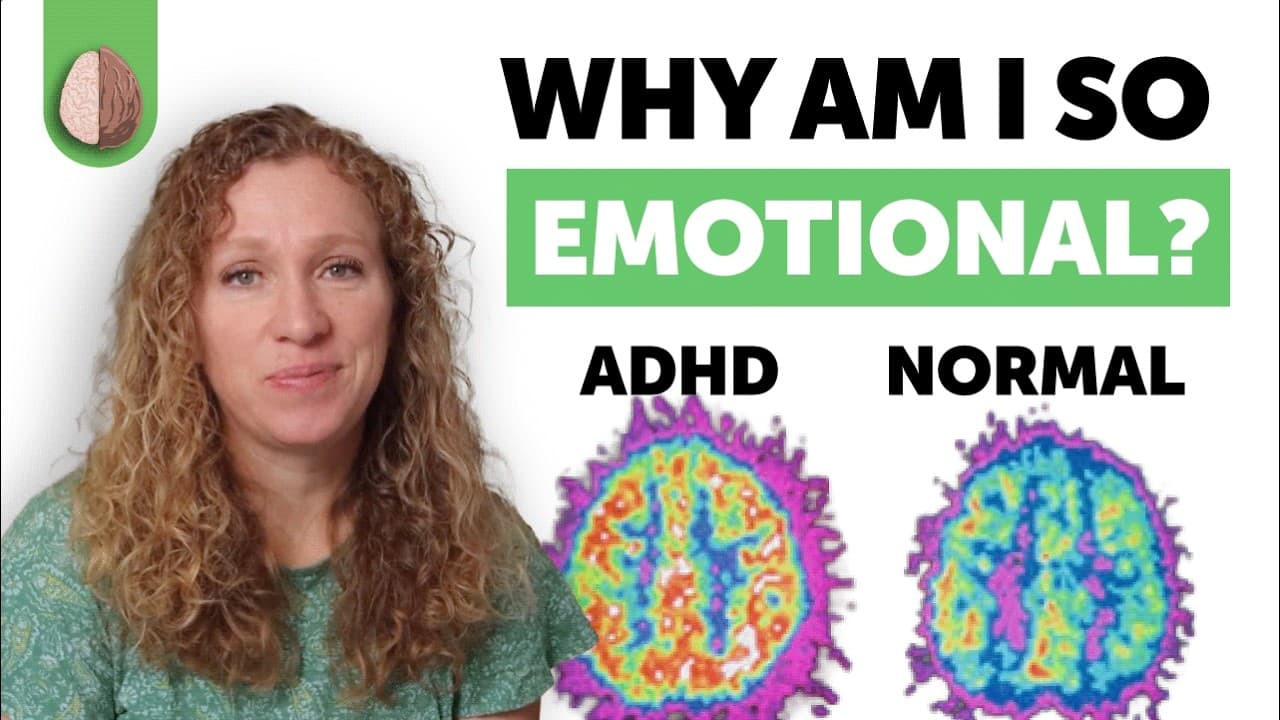
Up to 70% of people with ADHD struggle with emotional dysregulation because the prefrontal cortex, the brain's braking system, is underactive while the amygdala alarm system is overactive. Kids with ADHD show a 2- to 3-year delay in brain maturation, with cortical thickness peaking around age 13 instead of 10 and a half. These regulation skills can still be learned with therapy, skills, medication, and lifestyle tools.
Transcript
Hi, I'm Emma. I'm a therapist. I also meet the criteria for ADHD. And I've had to manually learn to regulate my emotions for the last 35 years because it feels like the dial on my emotions is turned way, way up. And it turns out that up to 70% of people with ADHD struggle with emotional dysregulation. So today, we're going to dive into th... Read More
Key Insights
- Up to 70% of people with ADHD struggle with emotional dysregulation, according to Emma, a therapist who also meets the criteria for ADHD and describes the dial on her emotions as turned way up, requiring 35 years of manually learned regulation.
- Kids with ADHD have an average 2- to 3-year delay in brain maturation. MRI scans of hundreds of kids showed cortical thickness peaking around age 10 and a half for typical children versus closer to 13 for children with ADHD.
- The prefrontal cortex sits right behind the forehead and works as the brain's braking system, helping you pause, think, and choose a response. In ADHD it tends to be underactive precisely during stressful or emotional moments when it is most needed.
- Short emotional latency is the researchers' term for feeling something and reacting very fast, often before thinking. Because the feelings hit the gas pedal before the brakes register a problem, the brain is less aware of its own overreactions and thinking errors.
- Low dopamine in the ADHD brain makes patience difficult, and norepinephrine swings between too much and too little. That swing contributes to the tired and wired sensation and the emotional volatility that accompanies ADHD.
- Emotional stickiness is when emotions linger longer than they do for neurotypical people, fueled by two processes: hyperfocus, which makes it hard to step back and gain perspective, and the default mode network, which sends a wandering mind into worry and rumination.
- Time blindness means that when something feels bad, it feels like it always has and always will. Dr. Ned Hallowell said that for people with ADHD there are only two times, now and not now, which combined with low frustration tolerance makes emotions feel permanent.
- Working through emotions is a multi-step process requiring you to hold several pieces of information at once, which poor working memory undermines. As ADHD expert Kjrstin Walters puts it, for people with ADHD, two steps is one step too many.
Install to Summarize YouTube Videos and Get Transcripts
Explore YouTube Video Summarizer or Get YouTube Transcript Extractor
Questions & Answers
Q: Why does ADHD make emotions feel so intense?
Two brain systems are out of balance. The prefrontal cortex, the braking system behind your forehead that helps you pause, think, and choose a response, tends to be underactive in ADHD, especially during stressful or emotional moments. Meanwhile the amygdala, the brain's alarm system, is overactive: it goes off more easily and stays on longer, particularly when something feels unfair, frustrating, or rejecting. The emotional part of the brain gets there first, so the feelings hit the gas pedal before the brakes even know there is a problem. Low dopamine and swinging norepinephrine add to the volatility.
Q: What percentage of people with ADHD have emotional dysregulation?
Up to 70% of people with ADHD struggle with emotional dysregulation. Emma, the therapist presenting this material, notes that she also meets the criteria for ADHD and has had to manually learn to regulate her emotions for the last 35 years because it feels like the dial on her emotions is turned way, way up. The figure reframes emotional intensity as a common neurological feature of ADHD rather than a personal failing, which is why the video argues people with ADHD are not broken, lazy, or too sensitive.
Q: How delayed is brain development in kids with ADHD?
On average, kids with ADHD have a 2- to 3-year delay in brain maturation. MRI scans of hundreds of kids found that cortical thickness typically peaks around age 10 and a half for a neurotypical child, but closer to 13 for a child with ADHD. The delay was most pronounced in the areas responsible for executive function, attention, and working memory. Kids with ADHD often catch up neurologically in their mid to late 20s, but the timing lag causes significant struggles with emotional and behavioral regulation throughout childhood.
Q: What is short emotional latency in ADHD?
Short emotional latency is the term researchers use for feeling something and reacting very fast, often before you have had time to think about it. It results from the emotional part of the brain reaching the decision point before the prefrontal cortex can apply the brakes. Because the reaction outruns the thinking, the brain is less likely to be aware of its own overreactions or thinking errors, and it becomes much harder to calm down after an emotional event. That is why an emotional reaction can spiral so quickly.
Q: What is emotional stickiness and what causes it?
Emotional stickiness is when an emotion takes hold, whether anger, sadness, or excitement, and lingers far longer than it would for a neurotypical person, making it hard to shift states. Two processes fuel it. The first is hyperfocus, an ADHD superpower where anything intense, stimulating, or interesting absorbs you completely, which makes stepping back or gaining perspective difficult. The second is the default mode network: people with ADHD are more likely to have a wandering mind that drifts into worries and ruminations, which then feeds anxiety and depression.
Q: How does time blindness affect emotional regulation?
ADHD brains struggle with tracking time, so when something feels bad, it feels like it has always felt bad and always will. Dr. Ned Hallowell said that for people with ADHD there are only two times, now and not now. Paired with low frustration tolerance, which stems from dopamine differences that make ADHD brains crave instant rewards and stimulation, time blindness makes any emotion feel like it will last forever. That sense of permanence is a potent setup for spiraling, since small inconveniences already feel overwhelming.
Q: Why does poor working memory make it harder to process emotions?
Working through emotions is a multi-step process that requires holding several pieces of information in mind while moving through the steps. The steps are naming your emotions, pausing and noticing your thoughts, exploring and clarifying by questioning those thoughts, choosing what you actually want, and taking action that lines up with your values. Each one demands that you hold multiple ideas in your head while remembering what comes next, all while feeling intensely angry. Poor working memory also makes it harder to solve the underlying problem the emotion is about.
Q: Can emotional regulation improve if you have ADHD?
Yes. Emma states that with the right support, including therapy, skills, medication, and lifestyle tools, these brain connections can strengthen and emotional regulation can absolutely improve. She speaks from personal experience, saying she pretty much had to learn how to do this manually, but with time she did learn to work through her feelings in a healthy way. The framing is that these are skills that can be learned and supported, not fixed traits, even though the underlying neurology makes them harder to acquire.
Summary & Key Takeaways
-
Brain scans of hundreds of kids found cortical thickness peaks around age 10 and a half for typical kids but closer to 13 for kids with ADHD, a delay most pronounced in areas handling executive function, attention, and working memory. Many catch up neurologically in their mid to late 20s, but the lag causes years of emotional and behavioral struggle first.
-
In the ADHD brain, the prefrontal cortex tends to be underactive during stressful or emotional moments while the amygdala fires more easily and stays on longer, especially around unfairness, frustration, or rejection. Researchers call the result short emotional latency: you react before you have time to think, making overreactions harder to notice and harder to recover from.
-
Five executive function deficits drive emotional dysregulation: low impulse control, difficulty shifting emotional states, low frustration tolerance, time blindness, and poor working memory. Since emotion processing itself requires naming, pausing, questioning thoughts, choosing, and acting in line with values, every step demands the exact executive function that ADHD impairs.
Read in Other Languages (beta)
Share This Summary 📚
Summarize YouTube Videos and Get Video Transcripts with 1-Click
Try YouTube Summary with ChatGPT & Claude or YouTube Transcript Generator
Explore More Summaries from Therapy in a Nutshell 📚






Summarize YouTube Videos and Get Video Transcripts with 1-Click
Try YouTube Summary with ChatGPT & Claude or YouTube Transcript Generator