Chip Huyen on What Actually Improves AI Apps
TL;DR
Talking to users, building reliable platforms, preparing better data, optimizing workflows, and writing better prompts improve AI apps far more than chasing the latest AI news, newest agentic framework, or fine-tuned models. Most AI product problems are actually UX issues, and fine-tuning should be a last resort rather than a first move.
Transcript
One question that get asked a lot and a lot is how do we keep up to date with the latest AI news? Why why do you need to keep up to date with the latest AI news? If you talk to the users and understand what they want, what they don't want, look into the feedback, then you can actually improve the application way way way more. A lot of companies are... Read More
Key Insights
- Talking to users is what actually improves AI apps, alongside building more reliable platforms, preparing better data, optimizing end-to-end workflows, and writing better prompts, rather than the things people assume matter.
- Staying up to date with the latest AI news is overrated because there is too much of it, and understanding user feedback improves an application far more than chasing new releases.
- Choosing between competing technologies matters less than people think; if optimal and non-optimal solutions produce similar performance, debating the choice wastes time that could go elsewhere.
- Adopting an unproven, hard-to-switch-out technology is risky because you can get stuck with it forever, so untested tools should be adopted cautiously rather than committed to early.
- Supervised fine-tuning trains a model on demonstration data where experts provide prompts and ideal answers so the model emulates the human expert's responses.
- Distillation lets open-source models learn by having strong existing models generate answers that a smaller model is trained to emulate, which differs fundamentally from outperforming those models.
- Managers overwhelmingly prefer an extra headcount over expensive coding agent subscriptions, while VP-level leaders managing many teams prefer the AI assistant because their metrics differ.
- Most AI hype fails to translate into results because companies try the tools, see little impact, and stop, since productivity is genuinely hard to measure.
Install to Summarize YouTube Videos and Get Transcripts
Explore YouTube Video Summarizer or Get YouTube Transcript Extractor
Questions & Answers
Q: What actually improves AI apps versus what people think improves them?
According to Chip Huyen, what actually improves AI apps is talking to users, building more reliable platforms, preparing better data, optimizing end-to-end workflows, and writing better prompts. What people mistakenly think improves them is staying up to date with the latest AI news, adopting the newest agentic framework, agonizing over which vector database to use, constantly evaluating which model is smarter, and fine-tuning a model. Understanding user feedback improves an application far more than chasing new technology.
Q: Why does Chip Huyen say you don't need to keep up with the latest AI news?
Chip argues there is simply too much AI news out there, and keeping up with all of it does not meaningfully improve your application. Instead, if you talk to users, understand what they want and don't want, and look into their feedback, you can improve the application far more. Staying current on news feels productive but rarely drives the real gains that come from understanding and serving users better.
Q: How should you decide between two competing AI technologies?
Chip suggests asking two questions. First, how much improvement could you actually get from the optimal solution versus a non-optimal one; if the difference is small, it is not worth spending significant time debating something that barely affects performance. Second, how hard would it be to switch the technology out later. If switching would be a lot of work and the technology is unproven, you risk being stuck with it forever, so you should think twice before overcommitting to something not yet battle-tested.
Q: What is the difference between pre-training and post-training?
Pre-training is where a model, essentially an algorithm, is fed enormous amounts of content and learns by predicting the next token or word across all that data, adjusting its weights when it gets predictions wrong. This encodes statistical information about a language. Post-training comes afterward and includes techniques like supervised fine-tuning and reinforcement learning that refine the model's behavior. Chip notes she lacks full visibility into exactly what secretive frontier labs do, but describes these as the broad stages.
Q: What is supervised fine-tuning?
Supervised fine-tuning uses demonstration data, where experts provide a prompt along with what the ideal answer should be, and the model is trained to emulate what the human expert would produce. It teaches the model to simulate expert responses on given prompts. This is one of the main post-training methods and forms the basis for how many models are refined after the initial pre-training stage on large amounts of data.
Q: How do open-source models use distillation to train?
Instead of relying on human experts to write high-quality answers, open-source models often use distillation, where they take popular, strong existing models and have them generate responses to prompts, then train a smaller model to emulate those responses. Chip appreciates the open-source community but stresses that being able to train a model that emulates an existing good model is very different from training a model that outperforms existing good models, which is a much bigger step.
Q: Why do managers and executives disagree about AI tools versus headcount?
When asked whether they would rather give the whole team expensive coding agent subscriptions or get an extra headcount, almost every manager chooses the headcount, because as a growing manager one HR head is significant. However, VP-level people managing many teams tend to choose the single AI assistant, because they care more about broader business metrics. The lesson is to think about what actually drives the productivity metrics that matter for your specific role.
Q: Why do most companies fail to see results from AI despite the hype?
Chip explains that although there are powerful tools that can design, write code, and build websites from scratch, progress is somehow more or less stuck, and companies often don't know what to build. The data shows most companies try AI, find it doesn't do much, and stop. A key reason is that productivity is really hard to measure, so companies struggle to identify and capture the gains, and many AI problems turn out to be UX issues rather than model issues.
Summary & Key Takeaways
-
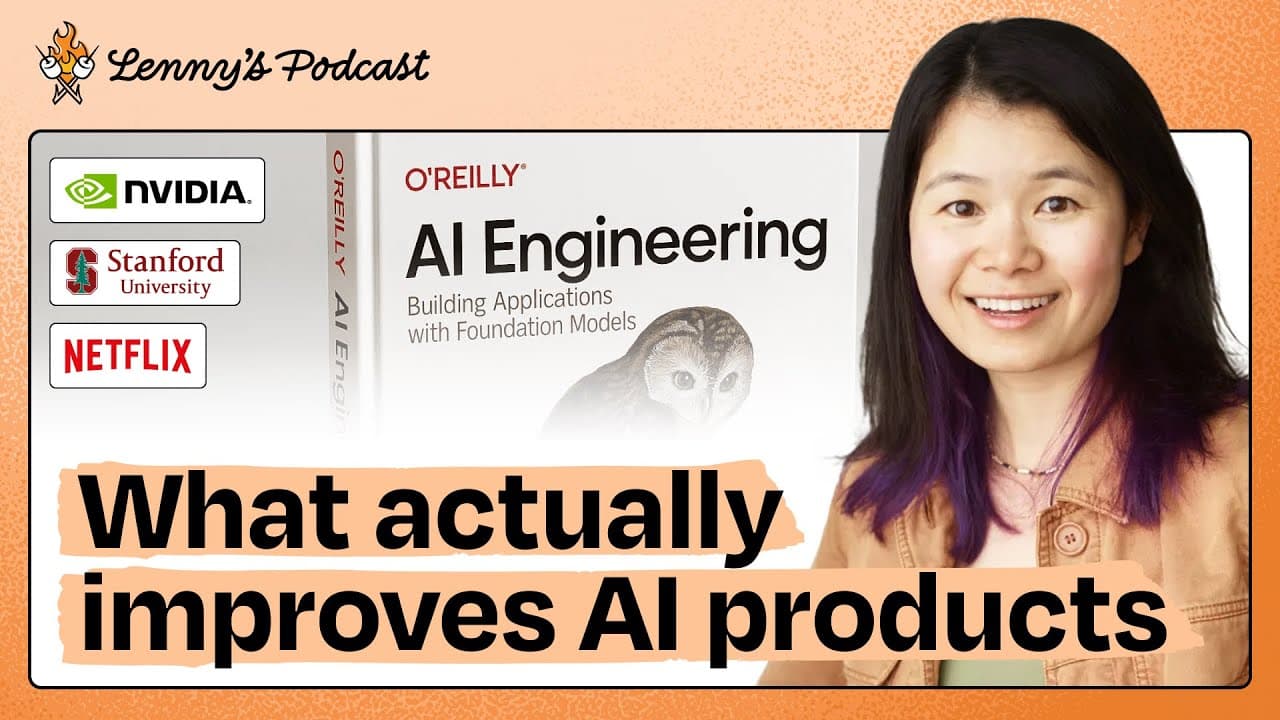
Chip Huyen, a core developer on Nvidia's Nemo platform, former Netflix AI researcher, Stanford instructor, and author of AI Engineering, argues that talking to users and improving data and prompts improve AI apps far more than chasing new models or frameworks.
-
A viral table she shared contrasts what people think improves AI apps (latest news, newest agentic framework, vector database choice, smarter models, fine-tuning) with what actually does: talking to users, reliable platforms, better data, optimized workflows, and better prompts.
-
The conversation explains core concepts including pre-training versus post-training, supervised fine-tuning on demonstration data, distillation for open-source models, and reinforcement learning, while noting fine-tuning should be a last resort and most AI problems are really UX issues.
Read in Other Languages (beta)
Share This Summary 📚
Summarize YouTube Videos and Get Video Transcripts with 1-Click
Try YouTube Summary with ChatGPT & Claude or YouTube Transcript Generator
Explore More Summaries from Lenny's Podcast 📚






Summarize YouTube Videos and Get Video Transcripts with 1-Click
Try YouTube Summary with ChatGPT & Claude or YouTube Transcript Generator