How to Run a Push Pull Legs Routine for Hypertrophy
TL;DR
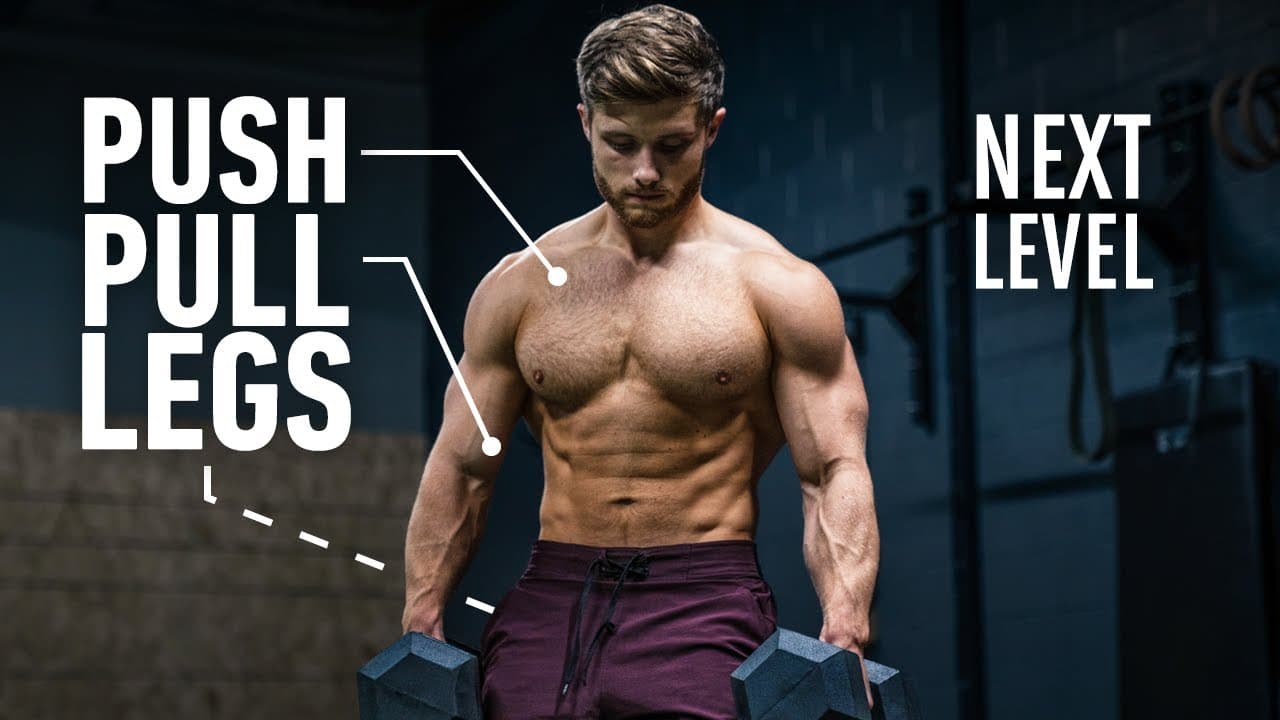
Anchor each session with one heavy compound at a submaximal load, then push the isolation work close to failure. The quad day opens with 3 sets of 4 squats at 80 percent of 1RM and ends with leg extensions, seated curls, calf myo reps and abs. Push day starts at 72.5 percent for 3 sets of 8 on bench, and pull day at 3 sets of 6 weighted pull-ups.
Transcript
all right what's going on guys and welcome to the new and improved push-pull leg series now unlike my last push-pull leg series from three years ago this time i'm combining the full week of training into this single video so if you want to run any of these workouts for yourself you can get after them right away you won't need to wait until the next... Read More
Key Insights
- Effort is distributed unevenly across a session by design. The squats and Romanian deadlifts leave several reps in reserve, while the unilateral leg press and later isolation work are pushed to roughly RPE 8 or 9 to drive the quads and glutes closer to failure.
- Rep slowdown is a practical way to estimate RPE. On a set of 15 leg presses, rep 13 took 1.5 seconds, rep 14 took 1.4 seconds and the final rep took 2.3 seconds, which indicates a true RPE of about 8 or 9.
- Driving the knees out during a squat ascent brings the hips closer to the bar, reducing the moment arm between the load and the hip joint. It is considered safe as long as the knees only travel until they point in the same direction as the toes.
- The rectus femoris is the only quad head crossing both the hip and the knee, so it shortens at the hip while lengthening at the knee during squats and leg presses. Setting the leg extension seat further back puts the hips in less flexion so it contributes more.
- Seated leg curls are preferred over lying leg curls because a study from Mayo and colleagues found they caused significantly more hamstring growth. The MASS research review attributed this to training at long muscle lengths, where the hamstrings are placed under greater stretch.
- Romanian deadlifts can cause an enormous amount of muscle damage and days of soreness if loaded heavy in week one. The recommendation is to keep the weight light, push the hips straight back for a solid hamstring stretch, then add load in following weeks.
- Machine work earns its place in a hypertrophy focused powerbuilding week. Heavy free weight movements tax the joints and smaller stabilizers, so machines let you push sets closer to failure with less overall cost, with a standing dumbbell Arnold press as a substitute.
- Dips are programmed to offset the range of motion deficit created by a powerlifting style bench press technique. The bottom position produces a big stretch on the pecs, which accumulating research suggests may be an important signal for growth. Deficit push-ups substitute well.
Install to Summarize YouTube Videos and Get Transcripts
Explore YouTube Video Summarizer or Get YouTube Transcript Extractor
Questions & Answers
Q: What does the quad focused leg day look like?
It begins with 3 to 4 minutes of dynamic stretching and a pyramid warm-up meant to prime the heavier sets while creating as little fatigue as possible. The working sets are squats for 3 sets of 4 at 80 percent of 1RM, Romanian deadlifts for 3 sets of 10, unilateral leg press for 3 sets of 15 per leg, eccentric accentuated leg extensions for 3 sets of 10 to 12, seated hamstring curls for 3 sets of 10 to 12 finishing with a drop set, standing calf raises, and an ab superset of plate weighted decline crunches and long lever pelvic tilt planks.
Q: Why drive the knees out at the top of a squat?
The purpose is to get the hips closer to the bar. As the knees push out, the hips are thrust forward, which reduces the moment arm between the load and the hip joint and makes it easier to break through a sticking point in the concentric portion of the lift. It is described as perfectly safe provided you only push the knees out until they point in the same direction as the toes, rather than pushing them out as far as possible. That distinction is what keeps the cue useful instead of excessive.
Q: How heavy should the squats and bench press be in this routine?
The squats are done for 3 sets of 4 reps at 80 percent of one rep max, which works out to 385 pounds in the video. Those sets are not supposed to feel brutal, especially in week one, starting around an RPE of 5 or 6 with four or five reps in reserve, then climbing to an RPE of 7 or 8 by the final set as fatigue accumulates. The bench press is 3 sets of 8 at 72.5 percent of one rep max, which comes out to 275 pounds.
Q: Are seated leg curls better than lying leg curls for hamstring growth?
A high quality study from Mayo and colleagues found that seated leg curls caused significantly more hamstring growth than lying leg curls. The MASS research review attributed this difference to the hypertrophic value of training at long muscle lengths, since the seated position places the hamstrings under a greater degree of stretch during the curl. This does not mean the lying leg curl is a bad exercise, and it is still used for variety, but the seated variation is the default choice when both are available.
Q: How should you set up a leg extension to target the rectus femoris?
Set the seat further back than usual. The rectus femoris is the only head of the quadriceps that crosses both the hip joint and the knee joint, which means it shortens at the hip while lengthening at the knee and therefore gets little stimulus from squats or leg presses. Moving the seat back places the hips in a less flexed position, allowing the rectus femoris to contribute more to knee extension. In this routine the leg extension is also done eccentric accentuated, with a three to four second lowering phase for 3 sets of 10 to 12.
Q: What is the myo rep technique used in this program?
After a main set taken to a high level of effort, you rest for a couple of breaths, perform another four reps, rest for a couple more breaths, hit another four, and repeat until you can no longer complete four clean reps. It is applied to the Egyptian cable lateral raise on the last set only, after 12 normal reps to an RPE of 9 or 10, because the side delts are easily neglected on a powerbuilding approach. The same technique is used for the smaller left calf after each set of standing calf raises.
Q: Why include dips on a push day that already has bench press?
The dip is there to make up for the so-called range of motion deficit created by a powerlifting style bench press technique. At the bottom of a dip, the pecs receive a large stretch, and accumulating evidence in the research points to that stretch as a potentially important signal for muscle growth. It is programmed for 3 sets of 12 to 15 reps. If you do not have access to dip handles, deficit push-ups are named as a good replacement that produces a comparable stretched position.
Q: What is on the lat focused pull day?
The pull session starts with weighted pull-ups for 3 sets of 6, using assistance instead if six body weight reps are not possible. An upright posture is held so the movement is closer to pure shoulder adduction, which loads the lats and teres muscles. Next is the seated cable row for 3 sets of 10 to 12 with a MAG grip attachment, elbows tucked and not driven behind the midline. Then a constant tension kneeling cable pullover isolates the lats, run with a one second up and one second down tempo until that tempo fades, followed by hammer cheat curls.
Summary & Key Takeaways
-
Day one is quad focused. After 3 to 4 minutes of dynamic stretching and a pyramid warm-up, the session runs squats for 3 sets of 4 at 80 percent of 1RM (385 pounds), Romanian deadlifts for 3 sets of 10 kept light in week one, and unilateral leg press for 3 sets of 15.
-
The rest of leg day targets the quads, hamstrings and calves directly: eccentric accentuated leg extensions for 3 sets of 10 to 12 with the seat set back, seated hamstring curls for 3 sets of 10 to 12 ending in a drop set, standing calf raises with extra myo reps for the smaller left calf, then weighted decline crunches supersetted with long lever pelvic tilt planks.
-
Push day opens with bench press for 3 sets of 8 at 72.5 percent of 1RM (275 pounds), then machine shoulder press for 3 sets of 12, dips for 3 sets of 12 to 15, eccentric skull crushers for 3 sets of 8 to 10, Egyptian cable lateral raises with myo reps on the last set, and cable tricep kickbacks for 2 sets of 20 to 30.
Read in Other Languages (beta)
Share This Summary 📚
Summarize YouTube Videos and Get Video Transcripts with 1-Click
Try YouTube Summary with ChatGPT & Claude or YouTube Transcript Generator
Explore More Summaries from Jeff Nippard 📚




Summarize YouTube Videos and Get Video Transcripts with 1-Click
Try YouTube Summary with ChatGPT & Claude or YouTube Transcript Generator