How to Achieve Band 9 in IELTS Listening
TL;DR
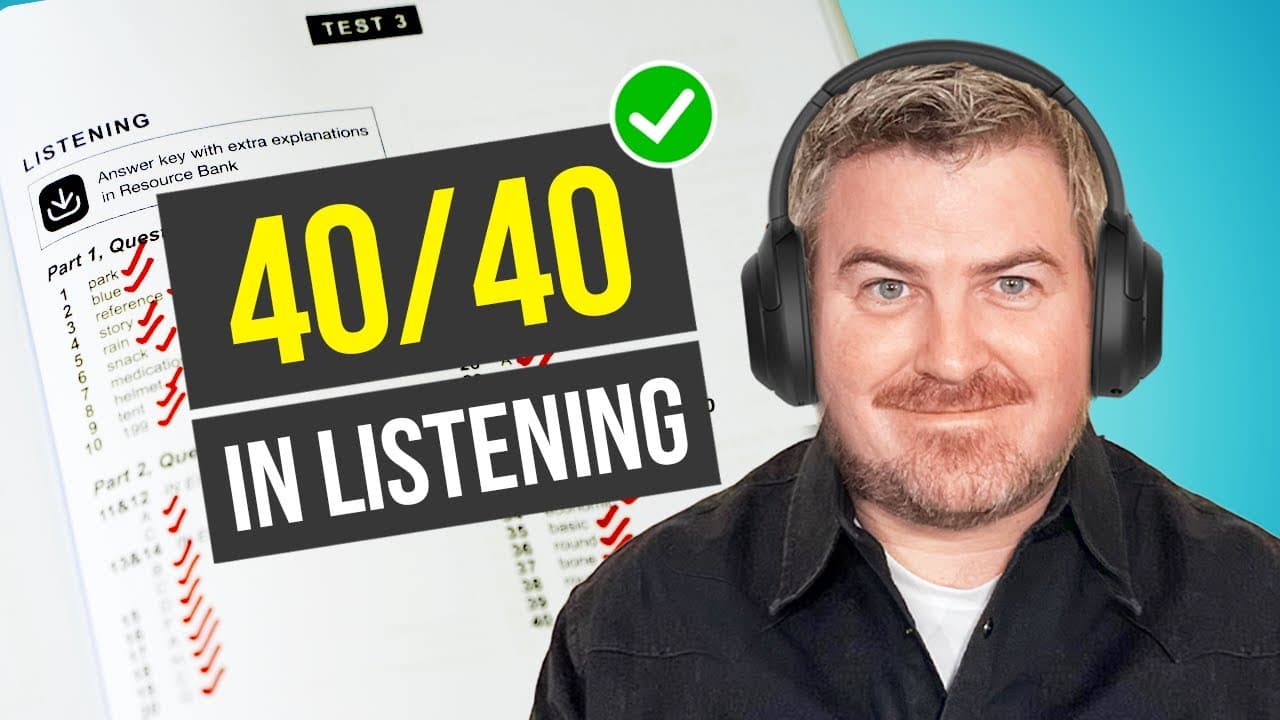
Build toward a Band 9 by mastering the four-part test format, matching practice to each section, and developing enough concentration to listen continuously for 30 minutes. Focus especially on Parts 3 and 4, use a different strategy for each question type, practice with varied English recordings, and train yourself to understand recordings after hearing them only once.
Transcript
you've just found the Ultimate Guide to IELTS listening this is the longest most detailed most comprehensive guide to IELTS listening on the internet it will help you succeed by helping you understand the test format tips and strategies that only ban nine students really understand we're also going to show you where to find real IELTS listing pract... Read More
Key Insights
- The IELTS Listening test is the same for Academic and General Training candidates, so preparation should include a broad range of social and academic situations rather than material associated with only one version of the examination.
- The test contains 40 questions divided across four parts that become progressively more difficult. Candidates seeking a Band 9 should aim for 40 correct answers and become completely familiar with the format before test day.
- Parts 3 and 4 are the most important areas for advanced preparation because they help separate Band 7, Band 8, and Band 9 performances. High-scoring candidates normally answer Parts 1 and 2 correctly, then concentrate heavily on the later sections.
- Part 1 is a general or social conversation involving more than one speaker, often requiring details such as telephone numbers, addresses, or license plates. Official Cambridge listening tests provide suitable practice for this unusual information-recording task.
- Part 2 is a general or social monologue, such as someone describing a holiday or reviewing a book. Podcasts and YouTube channels featuring one speaker can build the relevant skill, especially when candidates select subjects they genuinely enjoy.
- Part 3 is an academic discussion involving multiple speakers. Podcasts with several guests help candidates practice distinguishing voices and accents while recognizing interruptions, opinions, agreement, and disagreement within a group conversation.
- Part 4 is normally an academic lecture delivered by one speaker. TED Talks can help candidates notice how a speaker organizes ideas and uses sequencing language, including expressions such as “first” and “firstly,” to clarify the structure.
- Listening stamina is a trainable skill that should be developed gradually. Candidates can begin with five minutes of complete concentration, increase to seven, 10, 12, or 15 minutes, and eventually sustain the 30 minutes required by the test.
Install to Summarize YouTube Videos and Get Transcripts
Explore YouTube Video Summarizer or Get YouTube Transcript Extractor
Questions & Answers
Q: How is the IELTS Listening test structured?
The IELTS Listening test has 40 questions across four parts, and the sections become progressively more difficult. Parts 1 and 2 use general or social contexts, while Parts 3 and 4 use academic contexts. The test is the same for Academic and General Training candidates, and the complete listening period lasts 30 minutes.
Q: How should I prepare for IELTS Listening Part 1?
IELTS Listening Part 1 normally presents a general or social interaction involving more than one speaker, commonly two people. The task may require recording practical information such as a telephone number, address, or license plate number. Because this listening activity is unusual in everyday life, the recommended preparation is repeated practice with official Cambridge listening tests.
Q: What is the best practice for IELTS Listening Part 2?
IELTS Listening Part 2 features one person speaking in a social or general situation, such as discussing a holiday or reviewing a book. Suitable practice includes podcasts with a single host and YouTube videos featuring one person speaking to the camera. Choosing enjoyable subjects makes it easier to practice regularly during commutes, lunch breaks, or other free periods.
Q: How can I improve my performance in IELTS Listening Part 3?
IELTS Listening Part 3 involves multiple people discussing a topic in an academic context. Practice with podcasts that include two, three, or four guests debating subjects such as history, science, or health. Pay attention to differences in accent, interruptions, expressions of opinion, and the language speakers use when agreeing or disagreeing with one another.
Q: How should I practice for IELTS Listening Part 4?
IELTS Listening Part 4 normally consists of one person delivering an academic lecture. TED Talks are useful practice because they demonstrate how a speaker presents, organizes, and connects ideas. While listening, notice structural language such as “first” or “firstly,” along with statements that preview what will be discussed next, because these signals make the lecture easier to follow.
Q: Why does each IELTS Listening question type need a different strategy?
The test may include more than 10 question types, including multiple choice, summary completion, map labeling, and information completion. These tasks assess different listening skills, so one universal strategy is unsuitable. Candidates should become comfortable with the format and requirements of each type, then apply a strategy designed for that specific task instead of approaching every question identically.
Q: How can I build enough concentration for the 30-minute listening test?
Listening concentration should be developed gradually rather than tested at full length immediately. Begin with five minutes of completely focused listening to a practice test, podcast, or TED Talk. Increase the duration over subsequent sessions to seven or 10 minutes, then 12 or 15 minutes, continuing until you can maintain full attention for the required 30 minutes.
Q: Why should I practice listening to recordings only once?
The IELTS Listening recording is played only once on test day, so repeatedly replaying practice audio does not reproduce the examination conditions. Practicing with a single hearing trains you to focus immediately, process information in real time, and decide on an answer without depending on repetition. This also reflects situations such as lectures, workplace instructions, and airport announcements.
Summary & Key Takeaways
-
The IELTS Listening test is identical for Academic and General Training candidates. It contains 40 questions across four progressively more difficult parts. Strong candidates become familiar with every section, practice both social and academic listening contexts, and devote additional preparation to Parts 3 and 4, which distinguish higher score levels.
-
Each test part requires different listening practice. Part 1 features multiple speakers in a social setting, Part 2 uses one speaker in a social context, Part 3 involves multiple speakers discussing an academic topic, and Part 4 normally presents a single speaker delivering an academic lecture. Practice sources should reflect these differences.
-
Effective preparation combines test-specific strategies with gradually developed listening stamina. Candidates should learn separate approaches for more than 10 possible question types, extend focused listening sessions until they can concentrate for 30 minutes, and practice hearing recordings only once because the test audio is not repeated on test day.
Read in Other Languages (beta)
Share This Summary 📚
Summarize YouTube Videos and Get Video Transcripts with 1-Click
Try YouTube Summary with ChatGPT & Claude or YouTube Transcript Generator
Explore More Summaries from IELTS Advantage 📚




Summarize YouTube Videos and Get Video Transcripts with 1-Click
Try YouTube Summary with ChatGPT & Claude or YouTube Transcript Generator