How Do Running Power Meters Measure Performance?
TL;DR
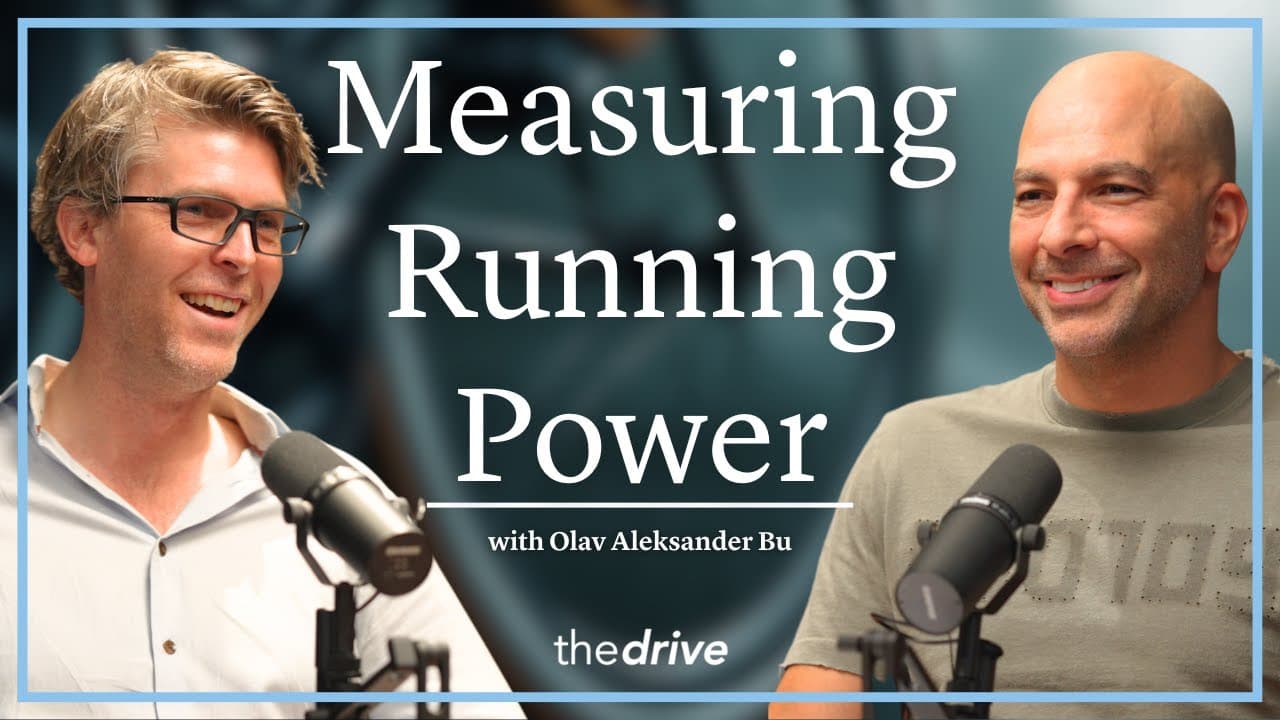
Running power meters estimate performance using either force-sensing insoles or small shoe-mounted motion sensors that capture three-dimensional acceleration. Their greatest value is biofeedback: athletes can compare power, speed, movement, fatigue, and metabolic cost to determine whether changes in shoes, technique, or training improve how efficiently energy becomes forward motion.
Transcript
Is there is there some major disruption where we just have this dramatic change in technique to have a bigger positive impact on frontal surface area than the negative effect it might have on propulsion? Yeah. So this this then touches up on let's say uh one of my favorite areas and that's bio feedback. In cycling we have extremely good tools for b... Read More
Key Insights
- Power and speed are complementary biofeedback signals because holding cycling power constant while observing velocity reveals whether a change improves performance. Experienced athletes can become sensitive to speed differences as small as half a kilometer per hour, although wind and other conditions still affect the comparison.
- Running power meters use direct or indirect measurement methods. A force-sensing insole functions like a force plate inside the shoe, while a compact motion-capture device combines entered body weight with three-dimensional acceleration data to estimate forces during each ground contact.
- Shoe-mounted motion sensors work outside laboratories because the devices have become small enough to attach directly to footwear. They require signal filtering because running has many degrees of freedom and produces substantial measurement noise, particularly when a system attempts to capture multiple force vectors.
- Commercial running power meters can reproduce laboratory force curves when validated on force-plate tracks or specialized treadmills with integrated force plates. Motion-based systems can additionally capture the foot path, enabling three-dimensional visualization of movement after a run under fresh, fatigued, racing, or technical conditions.
- Running power is more difficult to quantify than cycling power because running involves greater freedom of movement and a less direct relationship between gross and net mechanical output. Scientific disagreement about what running power represents has contributed to slower adoption among runners.
- A single power value simplifies complex mechanical information for practical use. Commercial systems condense numerous measurable vectors because presenting every available output would be difficult for most athletes to interpret, while specialists may prefer raw components instead of one modeled number.
- Metabolic power modeling links a running power estimate with expected oxygen consumption. The discussed commercial approach produces an output that aligns with treadmill oxygen-consumption measurements, making the metric usable without a metabolic measurement device, even though it is not a raw mechanical value.
- Raw mechanical and metabolic measurements can separate biomechanical changes from energetic changes. Comparing positive, negative, net, and gross mechanical power with metabolic data helps evaluate whether different shoes, training, or technique alter movement mechanics, energy use, or the conversion of available fuel into speed.
Install to Summarize YouTube Videos and Get Transcripts
Explore YouTube Video Summarizer or Get YouTube Transcript Extractor
Questions & Answers
Q: How do running power meters measure force and power?
Running power meters use either direct force sensing or indirect motion analysis. A force-sensing insole acts like a force plate inside the shoe and records the forces generated during contact. A shoe-mounted motion device captures three-dimensional acceleration, combines it with the runner’s entered body weight, and estimates force because one supporting foot carries the runner’s weight during ground contact.
Q: Why is running power harder to quantify than cycling power?
Running has more degrees of freedom than cycling, creating more possible movement directions, more measurement noise, and a more complicated relationship between gross and net power. Researchers and device developers therefore still debate what running power should represent and how it should be quantified. This uncertainty is one reason power measurement has not been adopted as widely in running as in cycling.
Q: Can shoe-mounted running power sensors work outdoors?
Shoe-mounted motion sensors are small enough to operate outside a laboratory and do not require a treadmill. They attach directly to the shoe and capture movement during ordinary running. The recorded data can later show the foot path in three dimensions and reveal how mechanics changed when the runner was fresh, fatigued, racing, or moving through technical sections.
Q: How accurate are commercial running power meters?
The discussed commercial devices have been validated against tracks containing force plates and specialized treadmills with integrated force plates. In those comparisons, the recorded force curves match the laboratory curves. Motion-capture models can also record the foot’s path. Their outputs still require filtering, however, because running motion creates noise and involves many degrees of freedom.
Q: What is the difference between mechanical and metabolic running power?
Mechanical power concerns the forces and movement produced by the runner, including positive, negative, net, and gross components. Metabolic power is a modeled output tied to the expected energetic cost and oxygen consumption at a given workload. A commercial system can provide a metabolic equivalent, while researchers with metabolic devices may instead prefer raw mechanical measurements for direct comparison.
Q: Why are power meters useful as biofeedback tools?
Power meters let athletes compare a measured workload with an outcome such as speed. In cycling, maintaining a constant power while becoming faster provides immediate evidence that positioning or another adjustment may be beneficial. Running power can support similar comparisons by showing how changes in technique, shoes, training, or fatigue affect forces, movement, velocity, and energetic cost.
Q: Why might an expert prefer raw power data over one score?
A single score compresses complex information into a value that most athletes can use easily, but it can conceal meaningful mechanical components. An expert with oxygen-consumption and other metabolic measurements may prefer positive, negative, net, and gross mechanical power. Those raw values allow a more granular comparison between biomechanical output, metabolic input, and resulting running speed.
Q: How can running power data evaluate shoes or training changes?
Running power data can show whether a change affects biomechanics, metabolic demand, or both. By comparing raw mechanical components with oxygen-consumption measurements and resulting speed, an analyst can examine whether different shoes or training improve the conversion of available energy into motion. Foot-path visualization can also reveal how the runner’s mechanics change with fatigue or race conditions.
Summary & Key Takeaways
-
Cycling combines power and GPS speed to provide direct biofeedback, allowing experienced riders to notice how small adjustments affect velocity at a constant workload. Running watches offer related feedback, while newer running power meters add force and motion measurements that can reveal how an athlete’s mechanics change during training or competition.
-
Running power meters use two principal methods. Force-sensing insoles directly record forces inside the shoe, while compact shoe-mounted motion sensors use body weight and three-dimensional acceleration to estimate force. Tests against force-plate tracks and specialized treadmills show matching force curves, while motion sensors can also reconstruct the foot’s path in three dimensions.
-
Running power remains harder to define than cycling power because running permits more degrees of freedom and creates a more complicated relationship between gross and net power. Commercial systems therefore condense complex measurements into one modeled value, while advanced analysis can retain positive, negative, net, and gross mechanical power for comparison with metabolic measurements.
Read in Other Languages (beta)
Share This Summary 📚
Summarize YouTube Videos and Get Video Transcripts with 1-Click
Try YouTube Summary with ChatGPT & Claude or YouTube Transcript Generator
Explore More Summaries from Peter Attia MD 📚





Summarize YouTube Videos and Get Video Transcripts with 1-Click
Try YouTube Summary with ChatGPT & Claude or YouTube Transcript Generator