Why Is Most of Japan So Sparsely Populated?
TL;DR
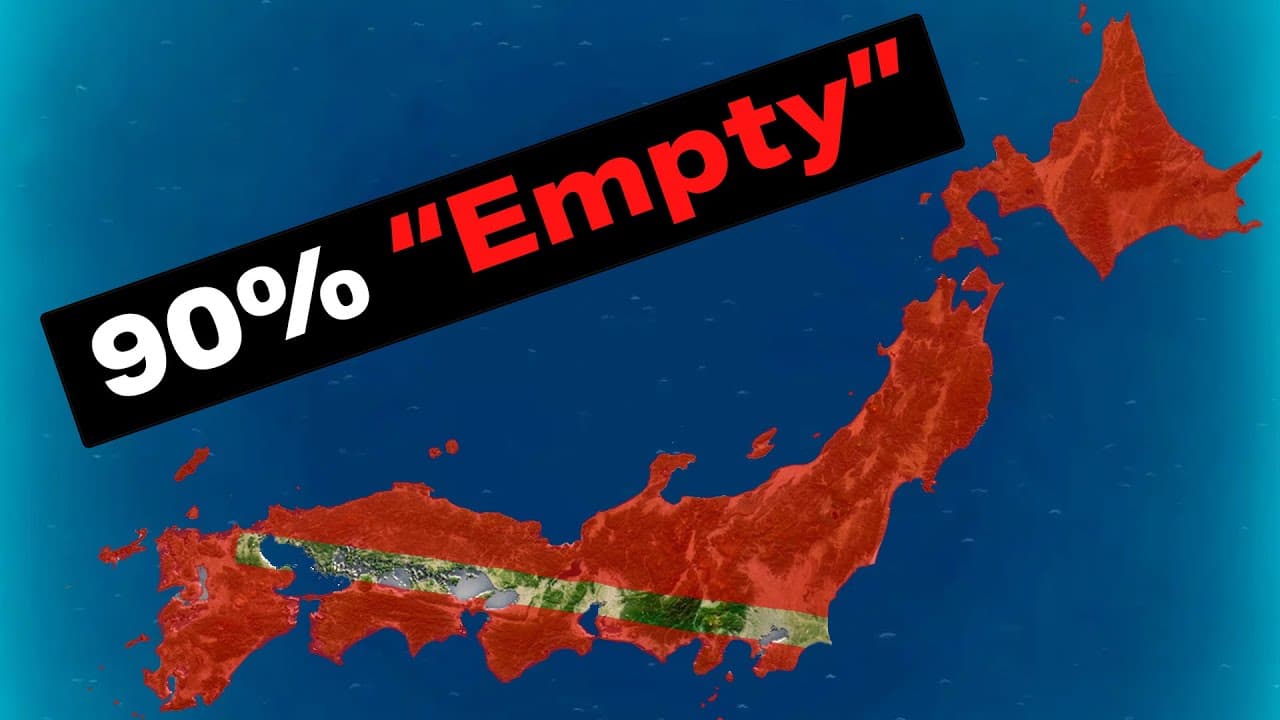
Japan’s population is concentrated because mountains cover about 73% of its land, leaving relatively little flat terrain for cities and agriculture. The Pacific corridor combines the country’s largest plains, major rivers, exceptional natural harbors, and the navigable Seto Inland Sea, concentrating roughly 80 million people and 70% of the economy within less than 10% of Japan’s land area.
Transcript
Japan is one of the world's most populous countries. Home to around 123 million people today, Japan is the world's 11th most populous country and it's also home to the world's second most populous island, Honshu. Home to more than 83% of the Japanese population and more than 102 million people all on its own. But when you look just beneath the surf... Read More
Key Insights
- Japan’s population is concentrated within a narrow, roughly 1,200-kilometer corridor containing about 80 million people. This Taiheiyo Belt occupies less than 10% of the national land area, while only about 43 million people inhabit the remaining 90% plus of the country.
- The Taiheiyo Belt is nearly 17 times more densely populated than the rest of Japan. Its average density exceeds that of Vatican City, while the remaining territory has an average population density described as roughly comparable to the US state of Pennsylvania.
- The Taiheiyo Belt produces about 70% of Japan’s economy. Its concentration of metropolitan areas, ports, industry, and transportation infrastructure makes the population divide even more pronounced economically than the contrast created by settlement patterns alone.
- Mountainous terrain is the main physical limitation on Japanese settlement. Mountains cover about 73% of the country, leaving only about one-quarter of its territory readily available for substantial habitation, agriculture, and affordable urban development.
- The Kanto, Kinai, and Nobi plains support Japan’s three largest metropolitan areas. Together, these flat regions contain nearly 70 million people, including more than 41 million around Tokyo, more than 19.3 million around Osaka, and more than 9.3 million around Nagoya.
- Tokyo Bay, Osaka Bay, and Ise Bay combine deep, sheltered waters with extensive adjacent plains. These geographic pairings created unusually favorable locations for large populations, commercial trade, naval activity, and the long-term development of Japan’s principal political and economic centers.
- The Sea of Japan coast has smaller plains and fewer useful natural harbors than the Pacific coast. Its smoother coastline lacks equivalents to the massive Tokyo and Osaka bays, and its notable ports are not connected to hinterlands capable of supporting similarly large nearby populations.
- The Seto Inland Sea functions as a protected internal navigation route between Honshu, Kyushu, and Shikoku. Its calm waters compensate for Japan’s rough, disconnected rivers, which commonly contain rapids and waterfalls that make them unsuitable for inland navigation and commercial transport.
Install to Summarize YouTube Videos and Get Transcripts
Explore YouTube Video Summarizer or Get YouTube Transcript Extractor
Questions & Answers
Q: Why is most of Japan sparsely populated?
Most of Japan is sparsely populated because about 73% of the country is mountainous. This leaves only about one-quarter of its land readily suited to substantial habitation, agriculture, and affordable urban construction. Population consequently concentrates on coastal plains and the limited flatter interior areas. The largest concentrations developed where broad plains, major rivers, sheltered bays, and navigable coastal waters occur together.
Q: What is the Taiheiyo Belt in Japan?
The Taiheiyo Belt is Japan’s narrow, highly populated Pacific corridor connecting many of its largest metropolitan areas, including Fukuoka, Hiroshima, Kobe, Osaka, Kyoto, Nagoya, and Tokyo. It extends for roughly 1,200 kilometers, occupies less than 10% of Japan’s land, contains about 80 million people, and accounts for approximately 70% of the national economy.
Q: How concentrated is Japan’s population?
Roughly 80 million of Japan’s approximately 123 million people live within a long corridor occupying less than 10% of the country’s land. About 43 million live throughout the remaining 90% plus. The corridor’s average population density is nearly 17 times greater than that of the rest of Japan, demonstrating an unusually sharp internal contrast in settlement.
Q: Why are Tokyo, Osaka, and Nagoya so populous?
Tokyo, Osaka, and Nagoya occupy Japan’s three largest continuous areas of flat land. Tokyo spreads across the Kanto Plain, Osaka and neighboring cities occupy the Kinai Plain, and Nagoya sits within the Nobi Plain. Each region also has major rivers and access to a large, useful natural harbor, supporting agriculture, construction, commerce, and very large populations.
Q: How do natural harbors shape Japan’s population geography?
Natural harbors strengthened population growth by connecting large, flat plains with sheltered maritime trade routes. Tokyo Bay and Osaka Bay are described as huge, deep, exceptionally well-sheltered harbors beside the Kanto and Kinai plains. Ise Bay provides similar advantages beside the Nobi Plain. These combinations encouraged settlement, commercial activity, and the development of major economic centers.
Q: Why is Japan’s Pacific coast more populated than its Sea of Japan coast?
The Pacific coast has larger continuous plains, deeper and more sheltered natural harbors, and stronger connections between ports and populous hinterlands. The Sea of Japan coastline is smoother, with fewer useful bays, while its notable harbors are much smaller than Tokyo Bay and Osaka Bay. They also lack adjacent plains large enough to sustain similarly extensive metropolitan populations and trade.
Q: How does the Seto Inland Sea support settlement and trade?
The Seto Inland Sea provides a large, protected navigation zone between Honshu, Kyushu, and Shikoku. Only four narrow straits connect it with the greater Pacific, leaving most of its waters calmer and more navigable than the surrounding ocean. Located in the center of the Taiheiyo Belt, it supports coastal movement and trade where inland river navigation is difficult.
Q: Why are Japan’s rivers poorly suited to transportation?
Japan’s mountainous terrain creates rivers that are commonly rough, steep, and filled with rapids and waterfalls. Most rivers also do not connect with one another, limiting the development of an integrated inland navigation system. The Seto Inland Sea compensates for this weakness by providing calm, protected waters that enable maritime transportation and trade through the center of the populated Pacific corridor.
Summary & Key Takeaways
-
Japan’s population is heavily concentrated along the Taiheiyo Belt, a narrow corridor running about 1,200 kilometers through major metropolitan areas from Fukuoka toward Tokyo. Roughly 80 million people live within this region, which occupies less than 10% of Japan’s land and generates about 70% of the national economy.
-
Mountainous terrain is the primary constraint on settlement because about 73% of Japan is covered by mountains. The Taiheiyo Belt crosses the country’s three largest continuous flat areas: the Kinai Plain around Osaka, Kobe, and Kyoto, the Nobi Plain around Nagoya, and the Kanto Plain around Tokyo.
-
The Pacific side gained additional advantages from Tokyo Bay, Osaka Bay, Ise Bay, and other useful natural harbors connected to large, flat hinterlands. The Seto Inland Sea also provides calm, protected navigation between Honshu, Kyushu, and Shikoku, compensating for Japan’s rough, disconnected rivers and strengthening coastal trade and settlement.
Read in Other Languages (beta)
Share This Summary 📚
Summarize YouTube Videos and Get Video Transcripts with 1-Click
Try YouTube Summary with ChatGPT & Claude or YouTube Transcript Generator
Explore More Summaries from RealLifeLore 📚


Summarize YouTube Videos and Get Video Transcripts with 1-Click
Try YouTube Summary with ChatGPT & Claude or YouTube Transcript Generator