How were 10 lost buildings imagined and rebuilt?
TL;DR
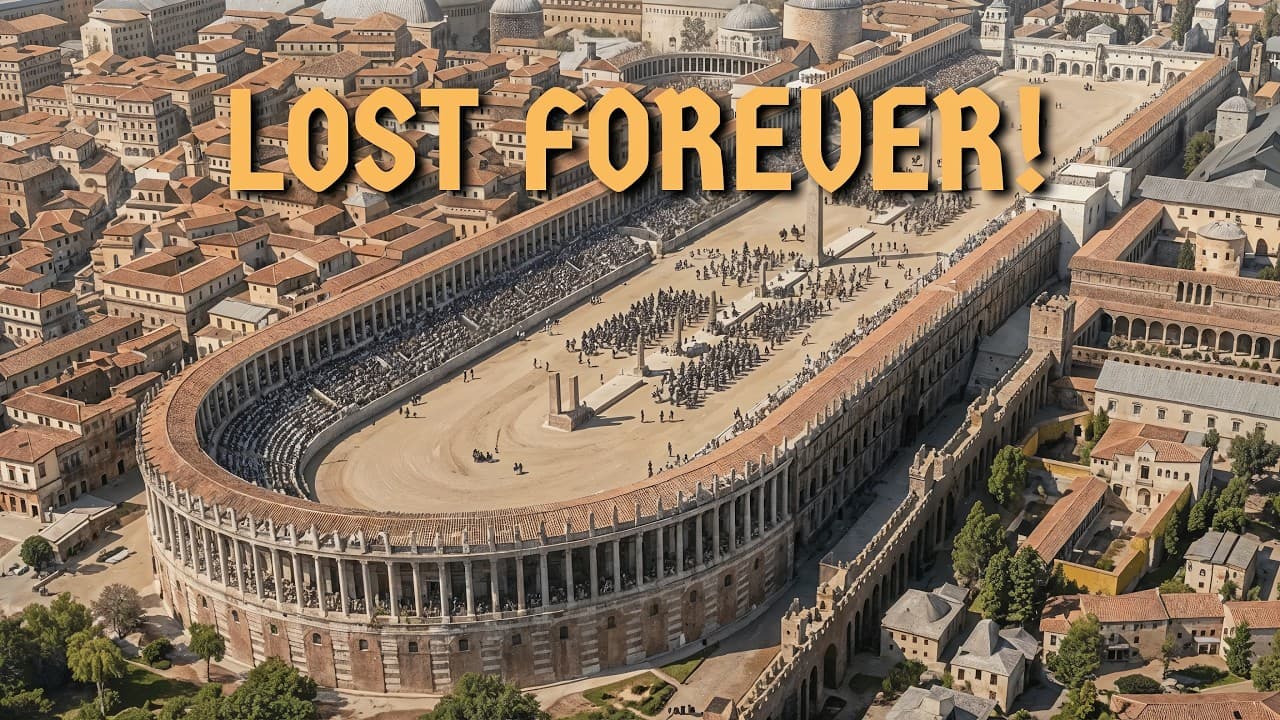
AI tools reconstruct ten legendary lost structures from historical records, drawings and eyewitness accounts. The video explains how architecture, myth, and archaeology converge to recreate these spaces, showing what they looked like and how their destruction shaped history. Each reconstruction blends description and evidence to shift our view of ancient ambition and empire.
Transcript
Some buildings become eternal. The pyramids have stood for 4,500 years. The coliseum survived the fall of Rome. The Pathonon still watches over Athens. These monuments outlasted the empires that built them. Proof that stone and ambition can defy time itself. But what about the buildings that didn't survive? the ones just as magnificent, just as imp... Read More
Key Insights
- The Hanging Gardens of Babylon are reconstructed from Greek and Roman descriptions to imagine terraces, trees, and water systems despite no Babylonian records confirming their existence.
- The Lighthouse of Alexandria reconstruction is grounded in ancient coins, eyewitness descriptions, and visible ruins, illustrating how a known structure can be reimagined through multiple data sources.
- The Colossus of Rhodes reconstruction corrects common myths by using eyewitness accounts and archaeology, depicting a 30-meter statue on a marble pedestal rather than the popular straddling harbor image.
- The Cothon of Carthage is shown as a circular military harbor with an island command post and 200 warships, illustrating how naval power can define a civilization’s strategic footprint.
- The Baths of Caracalla reconstruction explains hot and cold rooms, libraries, gardens, and a vast water system, highlighting how Roman engineering enabled social and daily life on a grand scale.
- The Great Palace of Constantinople is presented as a city within a city, with private harbors, throne rooms, and the Hagia Sophia nearby, emphasizing centralized power and ceremonial geography.
- The Old St. Peter’s Basilica and Old St. Paul’s Cathedral are treated as pivotal, yet vanished frames of religious and urban life that shaped medieval and early modern urban identity.
- The Globe and the Bastille reconstructions illustrate how cultural and political landmarks can become symbols of national memory, even when their physical forms are lost to time.
Install to Summarize YouTube Videos and Get Transcripts
Explore YouTube Video Summarizer or Get YouTube Transcript Extractor
Questions & Answers
Q: A real search query question about the video (e.g. 'How to...', 'What is...', 'Why does...', 'When should...'). Question 1
The video answers how AI can reconstruct lost buildings by combining ancient descriptions, drawings, coins, and archaeological traces. It shows that reconstruction is a synthesis of multiple sources to visualize spaces that have vanished, explaining the limits of accuracy when sources conflict and how artists or historians fill gaps with informed interpretation.
Q: Question 2
Question 2 asks how the Hanging Gardens are conceptualized given the lack of Babylonian records. The answer explains that Greek and Roman writers described terraces, exotic plants and water systems, and that modern AI uses these descriptions to create a plausible reconstruction while acknowledging possible speculation and alternative theories about location and form.
Q: Question 3
Question 3 concerns the Lighthouse of Alexandria. The answer details that the reconstruction relies on ancient coins, eyewitness accounts, and ruins, with Theoshi’s drawing serving as a foundation. It also notes that the lighthouse existed and stood as a symbol of maritime knowledge and urban pride in ancient Alexandria.
Q: Question 4
Question 4 explores the Colossus of Rhodes. The answer clarifies that ancient sources never describe it as straddling the harbor; instead, it stood on a marble pedestal near the harbor entrance. The AI reconstruction uses eyewitness descriptions to depict a tall statue visible from ships without obstructing the harbor.
Q: Question 5
Question 5 asks about the Cothon of Carthage. The answer explains it as a circular military harbor with a central island command post, housing 200 warships, and describes how its architecture functioned as a weapon that contributed to Rome’s fear and eventual conquest.
Q: Question 6
Question 6 focuses on the Baths of Caracalla. The answer covers the complex engineering: hot and cold pools, libraries, gardens, and extensive water and furnace systems, all designed to showcase imperial wealth and provide public amenities while revealing the advanced Romans’ understanding of temperature control.
Q: Question 7
Question 7 asks about the Great Palace of Constantinople. The answer describes it as a city within a city, with private harbors and grand throne rooms, and notes its proximity to Hagia Sophia, illustrating how Byzantine power projected onto land and sea and how palatial space reinforced authority.
Q: Question 8
Question 8 deals with the Globe and Bastille reconstructions. The answer explains that these sites symbolize cultural and political memory, showing how lost buildings can endure in collective memory through AI-driven visualizations that echo Shakespearean and revolutionary histories.
Summary & Key Takeaways
-
The video outlines ten vanished monuments and explains how AI reconstructions are created from historical records, drawings, and accounts to visualize spaces that no longer exist.
-
It emphasizes the difference between myth and evidence, noting that some reconstructions rely on eyewitness descriptions while others follow archaeological traces and coins or ruins.
-
The narrative connects architectural wonders to the broader theme of how infrastructure and imperial power shaped ancient civilizations and their legacies.
Read in Other Languages (beta)
Share This Summary 📚
Summarize YouTube Videos and Get Video Transcripts with 1-Click
Try YouTube Summary with ChatGPT & Claude or YouTube Transcript Generator
Explore More Summaries from Matt Reconstructs History 📚
Summarize YouTube Videos and Get Video Transcripts with 1-Click
Try YouTube Summary with ChatGPT & Claude or YouTube Transcript Generator