How Did Colonial Boston Move Toward Revolution?
TL;DR
Boston moved toward revolution as British authority increasingly collided with local resistance in its streets, harbor, taverns, and meeting halls. Trade made the city an important Atlantic port, while places such as the Old State House, Boston Common, the Green Dragon Tavern, and Faneuil Hall became settings where taxation, representation, military power, and organized protest shaped its transformation.
Transcript
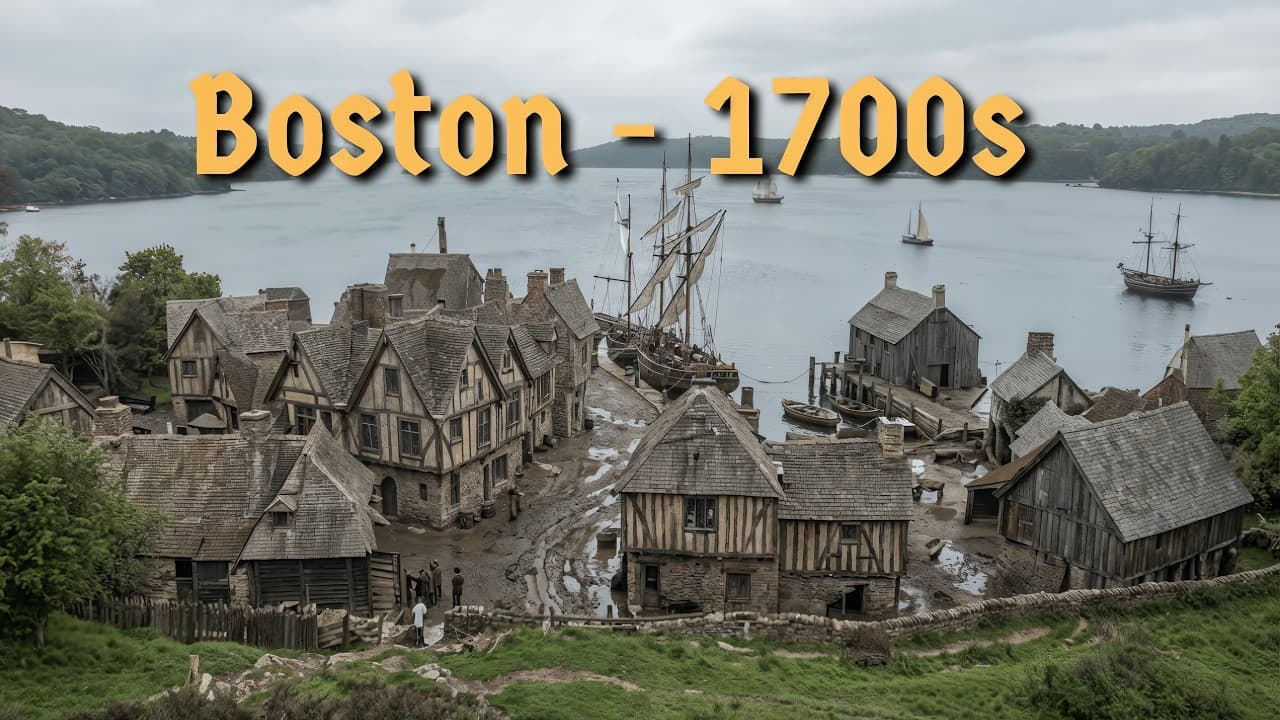
By the 1760s, Boston had become one of the most important cities in British North America. A crowded port shaped by trade, power, and rising tension. Within a generation, the city would be driven through revolution, scarred by conflict, and rebuilt as part of a new nation. In this video, I use modern AI tools to bring historic paintings, maps, and ... Read More
Key Insights
- Boston was one of the most important cities in British North America by the 1760s, with a crowded port shaped by trade, political power, and rising tension. Within a generation, revolution and conflict would transform it into part of a newly independent nation.
- The Winthrop fleet's arrival in 1630 laid the groundwork for Boston by bringing settlers led by John Winthrop to Massachusetts Bay. The settlement's first meeting house followed in 1632 near today's State Street, placing an early civic center close to modern downtown.
- Boston Harbor was the engine of the city's Atlantic economy, with ships carrying cargo and passengers between Boston, Europe, and the Caribbean. Early 18th-century views show the settlement becoming a recognizable port town rather than remaining a small and uncertain colonial outpost.
- Long Wharf was one of Boston's primary gateways to the Atlantic world, extending farther into the harbor than nearby docks and piers. Arriving ships unloaded cargo there, passengers entered the town there, and its position and outline can still be traced in the modern city.
- Boston Light was completed in 1716 on Little Brewster Island as the first lighthouse built in what would become the United States. British forces destroyed the original structure while withdrawing in 1776, but it was rebuilt in 1783 and continues guiding vessels into the harbor.
- Castle William represented British military authority at the entrance to Boston Harbor. Located on Castle Island, it guarded the narrow approaches to the town and reminded arriving ships that Boston was both a commercial port and a strategically defended part of the British Empire.
- Public spaces became centers of revolutionary tension as British authority faced organized resistance. The Old State House housed colonial government, soldiers drilled on Boston Common, the Green Dragon Tavern hosted political organizers, and Faneuil Hall brought debates over taxation and representation into public view.
- The Boston Tea Party was a deliberate protest against British taxation in December 1773, when colonists boarded ships and dumped tea into the harbor. Some participants disguised themselves as Mohawk Indians to conceal their identities and present the action as distinctly American rather than British.
Install to Summarize YouTube Videos and Get Transcripts
Explore YouTube Video Summarizer or Get YouTube Transcript Extractor
Questions & Answers
Q: How did Boston develop before the American Revolution?
Boston developed from a fragile settlement established after the Winthrop fleet arrived in 1630 into a growing and crowded Atlantic port. Its meeting house, harbor, docks, churches, government buildings, public grounds, and commercial spaces supported daily life. By the 1760s, trade and imperial power had made Boston one of the most important cities in British North America, while political tension increasingly shaped its streets and institutions.
Q: Why was Boston Harbor important in the 1700s?
Boston Harbor powered the city's Atlantic economy by connecting it with Europe and the Caribbean. Ships brought cargo and passengers into the town, especially through major waterfront structures such as Long Wharf. The harbor also had strategic importance. Boston Light helped ships navigate its entrance, while Castle William guarded the narrow approaches and represented the military authority that protected and controlled this important British colonial port.
Q: What role did Long Wharf play in colonial Boston?
Long Wharf served as one of colonial Boston's primary gateways to the Atlantic world. It projected farther into the water than the surrounding docks and piers, making its scale and importance visible from the harbor. Ships arriving from Europe and the Caribbean unloaded cargo there, and passengers stepped ashore there. It therefore shaped commerce, travel, and the first impression Boston made on people approaching the town by sea.
Q: What happened to Boston Light during the Revolutionary War?
Boston Light was originally completed in 1716 on Little Brewster Island at the entrance to Boston Harbor. It guided arriving ships and was often the first sign of land after a long Atlantic crossing. During the Revolutionary War, British forces deliberately destroyed the original structure in 1776 while withdrawing from Boston. The lighthouse was rebuilt in 1783 and still stands on the same site, continuing to guide harbor traffic.
Q: How did British authority appear in everyday Boston life?
British authority was visible through Boston's government buildings, military defenses, officials, and soldiers. The Old State House was the seat of colonial government, where laws were debated, taxes imposed, and royal proclamations issued. Castle William guarded the harbor, the Province House accommodated royal governors, and British soldiers drilled on Boston Common. These institutions placed imperial power beside ordinary commerce, recreation, gatherings, and movement through the city.
Q: Why was the Green Dragon Tavern important to the Revolution?
The Green Dragon Tavern was an informal political headquarters rather than merely a drinking establishment. During the 1760s and early 1770s, merchants, craftsmen, dock workers, and political organizers gathered there to debate British policies and coordinate resistance. Groups including the Sons of Liberty used private rooms to plan protests, exchange intelligence, and respond to new taxes. Such conversations helped turn dissatisfaction and uncertainty into organized political action.
Q: How did Faneuil Hall contribute to colonial resistance?
Faneuil Hall combined a market on its ground floor with a public meeting hall above. By 1775, Bostonians gathered there to debate taxation, representation, and the growing presence of British authority. Crowded meetings and speeches shaped public opinion openly, moving resistance beyond private discussions and into Boston's streets. The building became a pressure point where frustration was discussed, organized, and transformed into collective action.
Q: What was the purpose of the Boston Tea Party?
The Boston Tea Party was a deliberate protest against British taxation in December 1773. Colonists boarded ships in Boston Harbor and dumped chests of tea into the water to send a political message rather than create a spectacle. Some participants disguised themselves as Mohawk Indians, partly to hide their identities and partly to frame the act as distinctly American. The protest pushed Boston closer to open resistance.
Summary & Key Takeaways
-
Boston developed from the settlement established after the Winthrop fleet arrived in 1630 into an important British North American port. Its first meeting house, wooden buildings, harbor, ships, churches, and expanding streets show how a fragile colonial experiment gradually became a crowded town shaped by Atlantic trade and civic institutions.
-
Boston Harbor connected the town to Europe and the Caribbean through Long Wharf, while Boston Light guided arriving vessels and Castle William defended the harbor approaches. Harvard College trained clergy and civic leaders nearby. Together, these commercial, military, religious, and educational sites reveal the institutions supporting Boston before the Revolution.
-
British authority and colonial resistance occupied the same urban spaces. The Old State House enforced royal government, soldiers drilled on Boston Common, organizers gathered at the Green Dragon Tavern, and residents debated at Faneuil Hall. The 1773 destruction of taxed tea accelerated resistance, while Washington's 1789 visit symbolized the new nation.
-
Key Insights
Read in Other Languages (beta)
Share This Summary 📚
Summarize YouTube Videos and Get Video Transcripts with 1-Click
Try YouTube Summary with ChatGPT & Claude or YouTube Transcript Generator
Explore More Summaries from Matt Reconstructs History 📚



Summarize YouTube Videos and Get Video Transcripts with 1-Click
Try YouTube Summary with ChatGPT & Claude or YouTube Transcript Generator