What Was Life Like in Seventeenth-Century London?
TL;DR
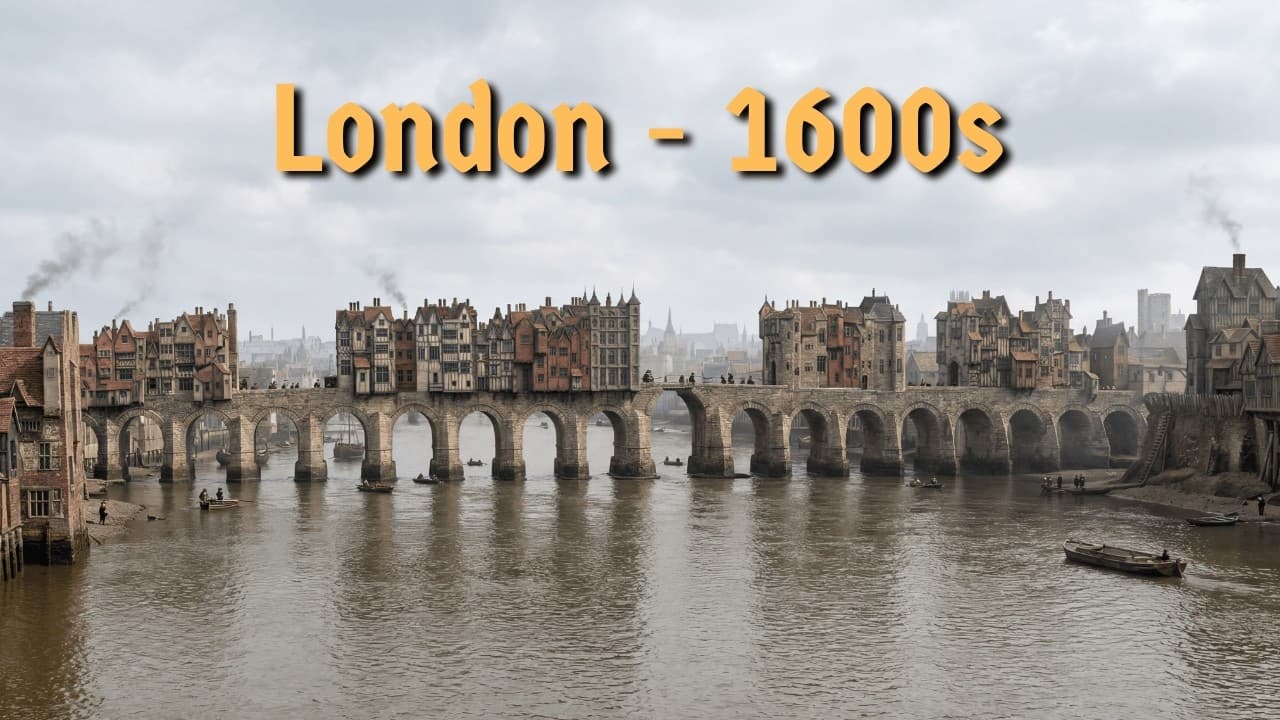
London in the 1600s was a dense metropolis approaching half a million people, shaped by Thames traffic, international trade, royal power, and political conflict. Old London Bridge functioned as a crossing, marketplace, and neighborhood, while the Great Fire of 1666 destroyed much of medieval London and forced the city to rebuild and reshape itself.
Transcript
London in the 1600s was already one of the largest cities in Europe with a population approaching half a million people. It was a dense fast growing metropolis shaped by trade, river traffic, and constant movement along the temps. In this video, I use modern AI tools to bring historic paintings and engravings to life, allowing us to shift perspecti... Read More
Key Insights
- London was one of Europe’s largest cities in the 1600s, with its population approaching half a million people. Its dense and fast-growing urban environment was shaped by commerce, river traffic, and the continuous movement of residents, laborers, traders, animals, carts, and imported goods.
- Old London Bridge was a complete urban neighborhood built above the Thames, not merely a river crossing. Multistory houses, shops, warehouses, chapels, and gatehouses lined it so thoroughly that the structure appeared from a distance like a continuous district spanning the water.
- The bridge’s narrow stone arches created powerful tidal currents that made river navigation dangerous. Barges, ferries, merchant vessels, and smaller craft had to pass through strong surges beneath the bridge, where accidents were common and restricted flow sometimes contributed to winter freezing.
- The Thames was London’s primary highway, transporting grain, timber, coal, cloth, imported goods, politicians, clergy, messengers, and ordinary citizens. It connected local neighborhoods with England’s interior, Europe, and the Atlantic world, making riverside landings essential points of commerce, travel, and government.
- The Great Fire of 1666 spread rapidly through London’s timber buildings, narrow streets, and crowded districts. Aldgate burned, Old St. Paul’s Cathedral was consumed, and much of medieval London became ash, creating a turning point that forced extensive rebuilding and urban reshaping.
- The Tower of London combined several central state functions during the 1600s. It operated as a fortress, arsenal, treasury, prison, record repository, weapons store, and home of the crown jewels, making it both a place of punishment and a cornerstone of English government.
- Cheapside was both a major commercial thoroughfare and a stage for royal display. During Marie de Medici’s 1638 procession, soldiers, officials, crowds, conduits, crosses, and temporary structures filled the street amid growing political and religious tensions that preceded civil war.
- Westminster and Whitehall concentrated political, religious, judicial, and royal authority beside the Thames. Parliament, Westminster Hall, Westminster Abbey, and the vast Palace of Whitehall relied on river access, reflecting how London’s principal route of transportation also connected the institutions of national power.
Install to Summarize YouTube Videos and Get Transcripts
Explore YouTube Video Summarizer or Get YouTube Transcript Extractor
Questions & Answers
Q: What was London like during the 1600s?
London in the 1600s was a dense, rapidly growing metropolis with a population approaching half a million, already making it one of Europe’s largest cities. Trade, river traffic, and constant movement shaped daily life. Its crowded timber buildings and narrow streets created serious fire risks, while the Thames carried passengers, raw materials, merchandise, and imported goods through the city.
Q: Why was Old London Bridge important in the 1600s?
Old London Bridge was indispensable because it was the only permanent crossing of the Thames in central London until the 18th century. It linked the City of London with Southwark and supported houses, shops, warehouses, chapels, and gatehouses. The bridge simultaneously served as infrastructure, a marketplace, a residential neighborhood, a commercial artery, and a visible symbol of authority and control.
Q: What dangers did people face on Old London Bridge?
People on Old London Bridge faced congestion, poor sanitation, and the constant threat of fire among tightly packed multistory buildings. Below them, massive piers and narrow stone arches restricted the Thames and generated powerful currents. Boats attempting to navigate those arches encountered strong surges, making accidents common, while carts, horses, pedestrians, traders, and residents competed for space above.
Q: How did the Thames shape life and trade in seventeenth-century London?
The Thames functioned as London’s primary highway, carrying barges, ferries, merchant vessels, and smaller rivercraft. Grain, timber, coal, cloth, and imported goods moved along the water, which connected London with England’s interior, Europe, and the wider Atlantic world. River landings also delivered politicians, clergy, messengers, courtiers, and citizens directly to Westminster and Whitehall.
Q: How did the Great Fire of London spread in 1666?
The Great Fire began as a small blaze in September 1666 but spread rapidly because London contained many timber buildings packed along narrow, crowded streets. Aldgate burned, Old St. Paul’s Cathedral was consumed, and the city appeared from across the Thames as a continuous wall of fire. Within days, much of medieval London had been reduced to ash.
Q: Why was the Great Fire of London a turning point?
The Great Fire was a turning point because it destroyed much of medieval London and cleared centuries of dense construction. The catastrophe forced the city to rebuild, reshape its urban environment, and begin again. Its destruction reached major landmarks, including Old St. Paul’s Cathedral, although the Tower of London narrowly escaped the flames visible near the Thames.
Q: What roles did the Tower of London serve in the 1600s?
The Tower of London served as a fortress, arsenal, treasury, prison, record repository, weapons store, and home of the crown jewels. High-profile prisoners accused of treason were confined within its walls. These combined military, financial, administrative, punitive, and royal functions placed the riverside complex at the center of state power rather than making it solely a prison.
Q: How did Westminster and Whitehall represent power in the 1600s?
Westminster gathered Parliament, courts, royal tradition, and national religion beside the Thames. The old Palace of Westminster housed political power, Westminster Hall hosted legal proceedings and state trials, and Westminster Abbey held coronations and royal funerals. Nearby Whitehall was England’s largest royal residence and the monarchy’s primary home, where royal government operated across an extensive complex.
Summary & Key Takeaways
-
London approached half a million residents during the 1600s, making it one of Europe’s largest cities. Trade, river traffic, and constant movement shaped its growth. The Thames served as its main highway, carrying people and goods while linking the capital with England’s interior, Europe, and the wider Atlantic world.
-
Old London Bridge was a densely developed street suspended above the Thames, containing homes, shops, warehouses, chapels, and gatehouses. Its narrow arches created dangerous currents, while its buildings brought congestion, fire risk, and unsanitary conditions. Despite those problems, it remained central London’s only permanent Thames crossing until the 18th century.
-
London’s landmarks embodied different forms of power and change. The Tower served the English state, Cheapside hosted commerce and royal ceremony, Westminster concentrated political and spiritual authority, and Whitehall housed royal government. The Great Fire of 1666 devastated medieval London, while later demolition and redevelopment transformed many surviving historic sites.
Read in Other Languages (beta)
Share This Summary 📚
Summarize YouTube Videos and Get Video Transcripts with 1-Click
Try YouTube Summary with ChatGPT & Claude or YouTube Transcript Generator
Explore More Summaries from Matt Reconstructs History 📚
Summarize YouTube Videos and Get Video Transcripts with 1-Click
Try YouTube Summary with ChatGPT & Claude or YouTube Transcript Generator