How to Pass a Software Engineering Interview
TL;DR
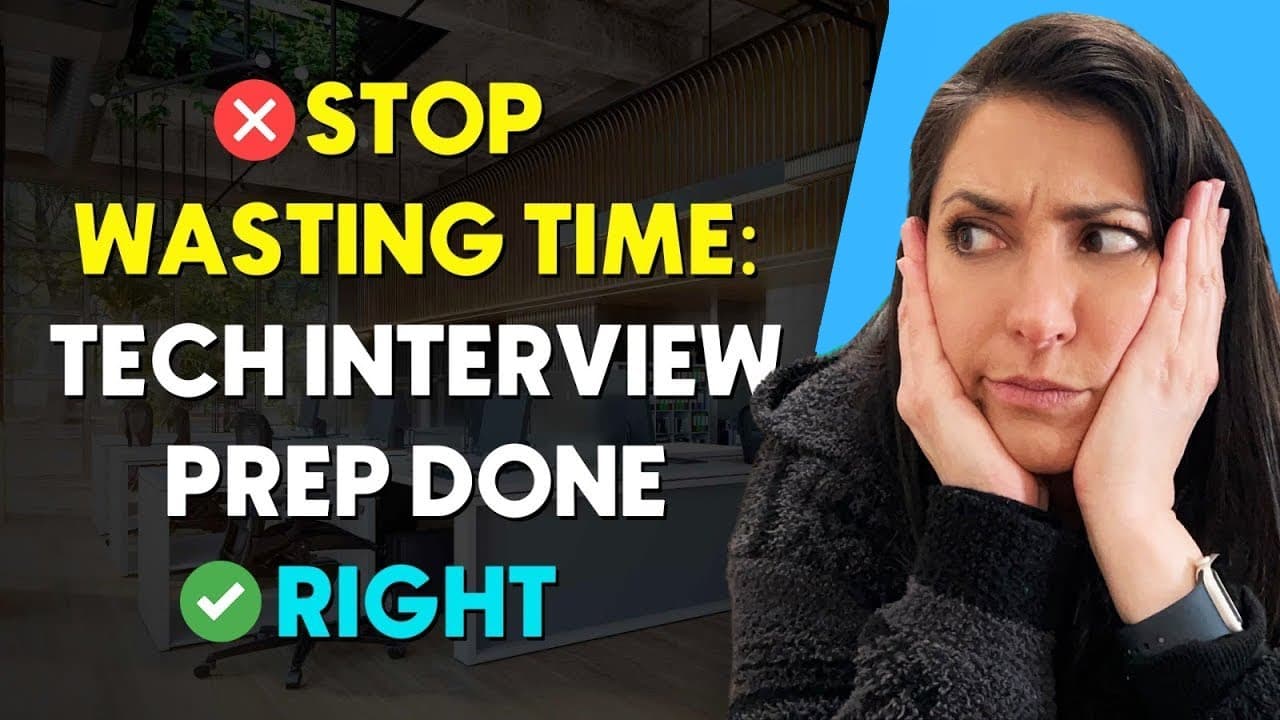
Treat the interviewer like a future colleague, ask clarifying questions, and explain how you evaluate trade-offs instead of rushing toward an answer. Prepare for the company’s systems and your expected level, practice at least 25 medium coding problems, review core system concepts, and choose solutions that are practical enough to complete within the interview.
Transcript
if you're watching this video it's probably because I sent it to you now if I didn't send this to you hello it's time to put down your coding questions because we need to get you ready for your software engineering interviews I've been prepping Engineers for their interviews for many years and I'm here to give you advice that you won't find in many... Read More
Key Insights
- A collaborative mindset can reduce interview anxiety by reframing the interviewer as a potential future colleague. This shift discourages performative answers and encourages the candidate to communicate naturally, investigate problems carefully, and respond as they would during an actual technical discussion with a coworker.
- Clarifying questions are essential when interview prompts are complex or intentionally incomplete. Candidates can use who, what, where, when, why, and how to uncover missing requirements, understand the interviewer’s purpose, and avoid committing to a solution before the problem is sufficiently defined.
- Company research should shape interview answers because interviewers often evaluate proposals against the systems they currently operate. Startup environments may require quick pivots and more coding, while legacy organizations may have older codebases that many engineers have modified and more organizational safeguards against errors.
- Software engineering is programming integrated over time, with added attention to scale and trade-offs. Strong candidates explain how software may change, remain maintainable, handle increasing demands, and balance competing constraints instead of treating an algorithmic answer as an isolated coding exercise.
- Medium coding problems provide the most practical preparation focus according to the recruiter’s experience. Easy problems are useful warm-ups, while hard problems are described as less practical for interviews. Candidates should solve at least 25 medium questions and practice as many additional problems as possible.
- Senior-level capability includes more than writing correct code. It involves handling complexity and ambiguity, collaborating effectively, communicating clearly, showing enthusiasm for learning, understanding deployments, planning monitoring and alerting, negotiating with non-developers, and predicting how software will degrade when dependent systems fail.
- Interviewers value the reasoning process because software engineering problems often lack one predefined solution. Candidates should verbalize their analysis, compare alternatives, explain time and space trade-offs, identify edge cases, make reasonable design decisions, and demonstrate that they can receive feedback without becoming egocentric.
- A practical solution can be stronger than the theoretically optimal solution when interview time is limited. For a quickselect-style problem, a candidate might implement a heap, then mention the more optimal partitioning approach and explain that its additional complexity makes it harder to complete reliably during the interview.
- More videos from this channel:
- More from this channel: Farah Sharghi
Install to Summarize YouTube Videos and Get Transcripts
Explore YouTube Video Summarizer or Get YouTube Transcript Extractor
Questions & Answers
Q: How can I reduce nervousness during a tech interview?
Reframe the interview as a conversation with a current colleague whom you have not met before. This mindset reduces the pressure to impress an evaluator and makes it easier to respond naturally. Approach each prompt as a shared technical problem, ask questions when information is missing, and communicate as if the interviewer could become someone you work with in the future.
Q: What clarifying questions should I ask in a software engineering interview?
Use the five W’s and the H: who, what, where, when, why, and how. These questions help reveal missing requirements, inputs, outputs, data formats, constraints, and the purpose behind the prompt. Interviewers may intentionally omit important information to test whether you investigate ambiguity, so avoid immediately proposing an answer before confirming what problem must actually be solved.
Q: How should company research affect my technical interview answers?
Determine whether the employer is a startup, a mid-sized company, or a large legacy organization, because its systems and operating constraints can influence how interviewers evaluate an answer. Startups may prioritize fast pivots and expect engineers to write more code, while legacy companies may operate older codebases that many engineers have modified and maintain stronger protections against individual errors.
Q: What is the difference between programming and software engineering in an interview?
Programming centers on writing code and algorithms, while software engineering treats programming as work that must function over time and under real operational constraints. Candidates should discuss how software will change, remain efficient, scale to meet demand, and balance trade-offs. Producing an algorithm matters, but explaining how the solution applies to a durable system matters even more.
Q: How many LeetCode problems should I practice for a tech interview?
The recruiter recommends solving at least 25 medium LeetCode questions and encourages candidates to practice as many additional questions as possible. Easy questions can serve as warm-ups, while hard questions are described as less practical for typical interviews. Coding exercises should not be the entire preparation plan, because fundamentals, communication, ambiguity, trade-offs, and system thinking are also evaluated.
Q: What qualities do interviewers expect from a senior software engineer?
A senior engineer should demonstrate the ability to manage complexity and ambiguity, collaborate with others, communicate clearly, and remain enthusiastic about learning. Specific strengths include caring about monitoring and alerting beyond unit tests, negotiating with product managers and operations staff, understanding deployment processes, and explaining how software will degrade when parts of a larger system stop working.
Q: How should I explain my solution during a coding interview?
Verbalize how you reached the solution instead of only presenting the final answer. Explain your assumptions, analysis, alternative approaches, time and space trade-offs, and relevant edge cases. Interviewers want evidence that you can work toward a solution when no predefined answer exists, balance competing options, discuss architectural choices, and respond constructively to feedback throughout the conversation.
Q: Should I always use the most optimal algorithm in an interview?
No. A less optimal approach can be the better interview choice when it is reliable and practical to implement within the available time. For a quickselect-related problem, the recruiter suggests that a heap may be preferable to implementing partitioning. You can still mention the more optimal approach and explain that its complexity creates a greater risk of not finishing the solution.
Summary & Key Takeaways
-
Effective interview performance begins with a calmer, collaborative mindset. Candidates should imagine that they are speaking with a current colleague, not trying to impress an evaluator. When a problem is complex or vague, they should ask clarifying questions using who, what, where, when, why, and how before proposing a solution.
-
Preparation should reflect both the candidate’s expected level and the company’s environment. Startups, mid-sized organizations, and large legacy companies have different systems and constraints. Candidates should understand that software engineering extends beyond programming by considering how software changes over time, scales, remains efficient, degrades, and survives operational demands.
-
Coding practice remains important, but isolated whiteboard drills are insufficient. The recommended approach is to prioritize medium LeetCode problems, solving at least 25, while reviewing fundamentals and system design concepts. During interviews, candidates should verbalize their reasoning, compare alternatives, discuss time and space trade-offs, identify edge cases, and accept feedback.
Read in Other Languages (beta)
Share This Summary 📚
Summarize YouTube Videos and Get Video Transcripts with 1-Click
Try YouTube Summary with ChatGPT & Claude or YouTube Transcript Generator
Explore More Summaries from Farah Sharghi 📚




Summarize YouTube Videos and Get Video Transcripts with 1-Click
Try YouTube Summary with ChatGPT & Claude or YouTube Transcript Generator