17 Brutally Honest Truths About Scaling Facebook Ads Profitably
TL;DR
Scaling Facebook ads profitably requires diverse creative concepts, valuable offers, accurate attribution, and decisions based on profit rather than ROAS alone. The speaker draws on 11 years of experience and explains 17 truths, including why each concept targets a different audience, when incremental attribution matters, and why retention supports sustainable growth. Read on for specific guidance on creative strategy, campaign scaling, offers, metrics, and customer retention.
Transcript
I started running Facebook ads 11 years ago and along the way I made every mistake in the book and I've used that knowledge at the Moonlighters to scale over a hundred seven eight and even nine figure e-commerce brands. So to save you hundreds of thousands of dollars and tons of frustration, I've put together a brutally honest list of 17 truths tha... Read More
Key Insights
- Facebook ad success relies on diverse ad concepts targeting different audiences.
- Strong offers are crucial; they should provide real value beyond discounts.
- Understanding attribution models is essential for accurate performance metrics.
- Competing for attention requires impactful hooks and relevant targeting.
- The learning phase is not a one-size-fits-all; scaling requires strategic patience.
- Strategists are more valuable than media buyers for holistic business growth.
- Return on ad spend is not synonymous with profit; focus on scaling profits.
- Retention is more important than acquisition; focus on customer loyalty.
Install to Summarize YouTube Videos and Get Transcripts
Explore YouTube Video Summarizer or Get YouTube Transcript Extractor
Questions & Answers
Q: How do you scale Facebook ads profitably?
Build multiple creative concepts that independently attract different audiences, then scale the concepts that meet your business target instead of concentrating spend only on the highest reported ROAS. Evaluate performance through attribution and overall profit, maintain consistent creative input, and support acquisition with retention strategies.
Q: How has Facebook ad targeting changed with Andromeda?
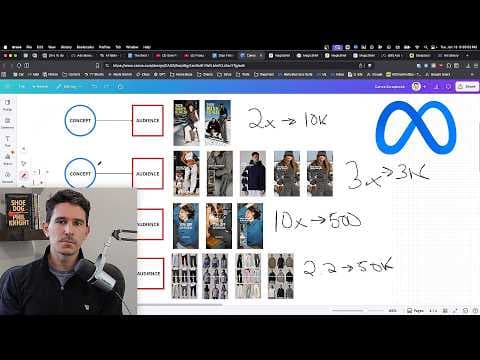
The old model paired a selected audience with many creatives, while the newer model uses each creative concept to reach its own audience. The speaker therefore describes the concept, not merely an individual creative, as the targeting.
Q: Why should an advertiser use several creative concepts?
Different concepts can attract different audiences and contribute revenue independently. In the example, product images on a splash background, products in a natural environment, and authentic-looking UGC receive 80%, 15%, and 5% of spend respectively, yet all help create a successful account.
Q: What makes a strong Facebook advertising offer?
A strong offer gives consumers meaningful value and stands out from competing offers; it is not limited to a discount, percentage reduction, or buy-one-get-one promotion. Barkbox’s example doubles the first box for free, giving the customer $45 more in toys without imposing the same amount in actual product cost on the company.
Q: Why is attribution important when evaluating Facebook ads?
Attribution helps identify what is driving net-new business rather than relying on potentially misleading reported metrics. In the example, a reported 3.63 ROAS falls to 1.81 under incremental attribution, showing how substantially the interpretation can change.
Q: Should Facebook advertisers use incremental attribution?
The speaker calls incremental attribution the best view for assessing actual performance, especially when a large gap appears between attribution settings. However, 7-day click and 1-day view should still be used in most cases to optimize ads, while switching to incremental attribution may make sense when spending supports a high level of conversions.
Q: Why is return on ad spend not the same as profit?
A higher ROAS does not automatically produce the greatest business profit or scaling opportunity. If the target is 2x, concepts returning 2x, 3x, and 3.2x can all contribute profitable volume; moving all spend to the 3.2x concept would not necessarily preserve that return.
Q: What matters most when capturing attention with Facebook ads?
Advertisers have only split seconds to capture someone’s attention in Instagram Reels, feeds, or Stories. A strong hook, relevant product targeting, and a good offer must work together; otherwise, the viewer scrolls and the ad wastes money.
Summary & Key Takeaways
-
Facebook ad success depends on creating diverse ad concepts, each targeting specific audiences. Strong offers that provide real value are crucial, and understanding attribution models is essential for accurate performance assessment. Competing for attention requires impactful hooks and relevant targeting, while strategists offer more value than media buyers by focusing on overall business growth.
-
The learning phase in Facebook ads is not universally applicable, and scaling requires strategic patience and a focus on profitability rather than just return on ad spend. Retention strategies are crucial, as they ensure customer loyalty and long-term success, making them more important than mere acquisition.
-
Effective Facebook ad campaigns require consistent creative input and a well-structured campaign strategy. Media buyers are often overrated, while strategists provide more holistic value. Emphasizing retention and understanding the limitations of return on ad spend are key to achieving sustainable growth in advertising.
Read in Other Languages (beta)
Share This Summary 📚
Summarize YouTube Videos and Get Video Transcripts with 1-Click
Try YouTube Summary with ChatGPT & Claude or YouTube Transcript Generator
Explore More Summaries from Sam Piliero 📚




Summarize YouTube Videos and Get Video Transcripts with 1-Click
Try YouTube Summary with ChatGPT & Claude or YouTube Transcript Generator