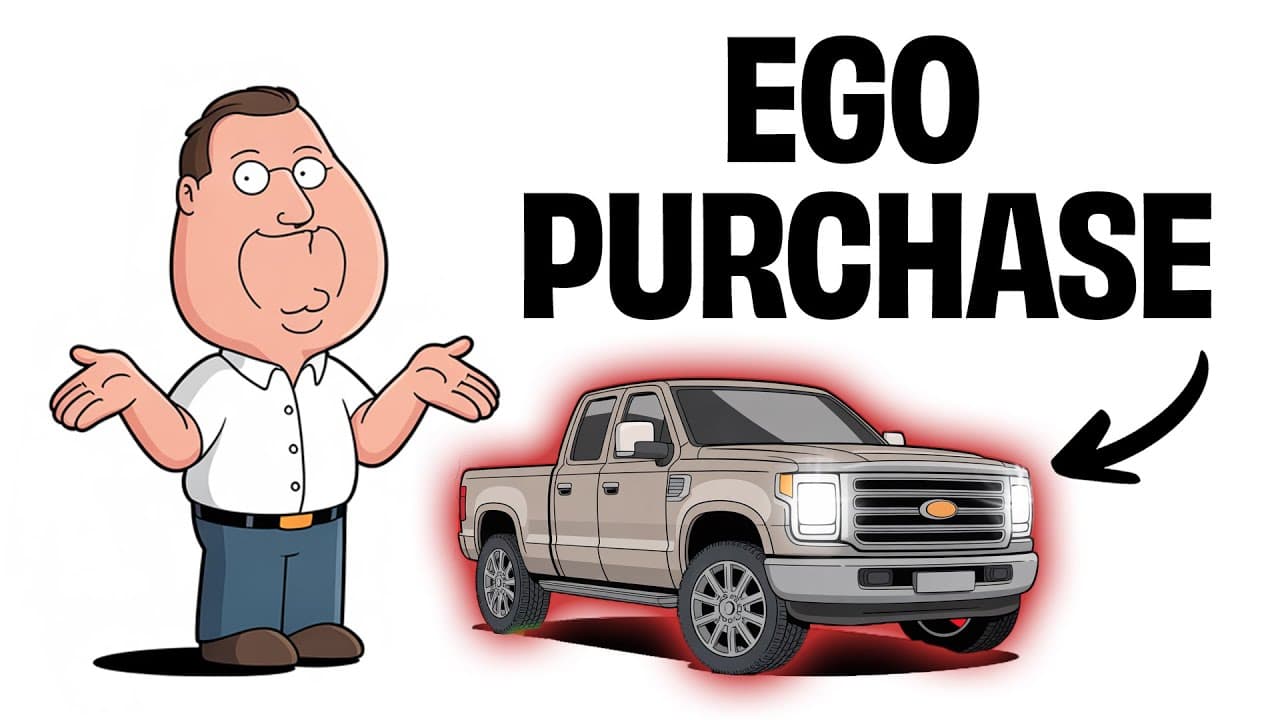
What is the real cost of a Pavement Princess truck?
TL;DR
The video exposes how an $87,000 truck can drain money far faster than a sensible sedan. It compares monthly costs and long term consequences, showing the hidden price of ego purchases. The takeaway: the financial sacrifice over years often outweighs any perceived prestige or utility.
Transcript
You're idling at a red light in your $87,000 Ford F-250 King Ranch Edition. The leather seats smell new. The dashboard glows like a spaceship. And when you roll past that Prius, you sit 6 in taller than everyone else on the road. You feel powerful. You feel capable. You feel like a man who can handle anything life throws at him. Except here's the t... Read More
Key Insights
- The cost of prestige purchases includes ongoing monthly expenses that far exceed initial payments.
- The monthly delta between a truck and a sedan compounds over years, dramatically changing financial outcomes.
- High value trucks carry higher insurance and maintenance costs that amplify yearly expenses beyond the sticker price.
- Fuel economy differences translate into real annual savings when comparing a truck to a sedan.
- Tires, maintenance, and registration for a large vehicle add predictable recurring costs not present on smaller cars.
- The loan and interest on a depreciating asset can dramatically inflate total spending over the loan term.
- Owning a truck can constrain future financial options like buying a home due to debt to income ratios.
- Investing the monthly delta instead of financing the truck can yield substantially different long term wealth outcomes.
- More videos from this channel:
- More from this channel: Nick Invests
Install to Summarize YouTube Videos and Get Transcripts
Explore YouTube Video Summarizer or Get YouTube Transcript Extractor
Questions & Answers
Q: What is the main argument against buying an expensive truck for show rather than work use?
The main argument is that a truck bought to project masculinity or status is a financial drain when the user actually only needs basic transportation. The video demonstrates that the ongoing costs—monthly payments, higher fuel, insurance, tires, maintenance, and taxes—consume more than the perceived benefit, reducing long term financial flexibility.
Q: How does the video describe the monthly cost comparison between a truck and a sedan?
The video lays out a monthly cost comparison where the truck creates a substantial difference versus a sedan. This delta arises from higher fuel consumption, larger insurance premiums, and added maintenance costs, which collectively push the total monthly outlay well beyond what a more modest vehicle would require, altering overall cash flow.
Q: What is said about opportunity cost in the video?
The video emphasizes opportunity cost by showing how the monthly difference between the truck and a sedan could be invested instead. It argues that this alternative could grow into a substantial sum over time, potentially funding major life goals, such as a house or retirement, rather than being tied up in depreciating assets.
Q: What impact does the truck have on home buying and debt ratios according to the video?
According to the video, the truck payment can take up a large share of gross income, pushing debt payments above comfortable thresholds. This reduces buying power for a mortgage, as lenders look at debt to income ratios, potentially disqualifying someone from affording a home and constraining long term financial plans.
Q: How does hedonic adaptation factor into the truck purchase?
Hedonic adaptation is described as the phenomenon where the initial thrill of owning the truck fades quickly, leaving ongoing payments as the lasting consequence. The video notes that the luxury feel disappears while the monthly cost—insurance, maintenance, and depreciation—remains, creating a persistent source of financial stress.
Q: What does the video suggest about investing versus financing for the monthly delta?
The video suggests that investing the monthly delta instead of financing the truck could yield a much different financial trajectory. By allocating those funds to investments with a reasonable return, a person could accumulate wealth over time rather than depreciating funds on a vehicle that may not meet their actual needs.
Q: What psychological effects are discussed in relation to the truck payment?
The discussion covers how the truck payment can affect financial behavior and career risk appetite. The burden of the payment can deter leaving a bad job, pursuing a new opportunity, or taking risks, because the ongoing obligation creates a fear of instability if earnings change or emergencies arise.
Q: What is the overall conclusion about the true cost of the Pavement Princess phenomenon?
The overall conclusion is that cosplaying as a blue collar worker through an expensive truck is financially costly and emotionally stressful. The video argues that the costs extend beyond price tags to influence life decisions, relationships, and long term wealth, urging viewers to reconsider whether the perceived benefit justifies the expense.
Summary & Key Takeaways
-
The video demonstrates that a high value vehicle purchased to project a blue collar image creates ongoing costs that exceed the value of the asset, affecting monthly cash flow and long term finances.
-
The analysis contrasts a luxury pickup with a practical sedan, highlighting how fuel, insurance, tires, maintenance, and registration add up to a substantial monthly burden.
-
It culminates in a thought experiment about investing the monthly difference and the potential future value of that decision, emphasizing financial risk and opportunity costs.
Read in Other Languages (beta)
Share This Summary 📚
Summarize YouTube Videos and Get Video Transcripts with 1-Click
Try YouTube Summary with ChatGPT & Claude or YouTube Transcript Generator
Explore More Summaries from Nick Invests 📚




Summarize YouTube Videos and Get Video Transcripts with 1-Click
Try YouTube Summary with ChatGPT & Claude or YouTube Transcript Generator