Pharmacokinetics | Dosage Regimen
TL;DR
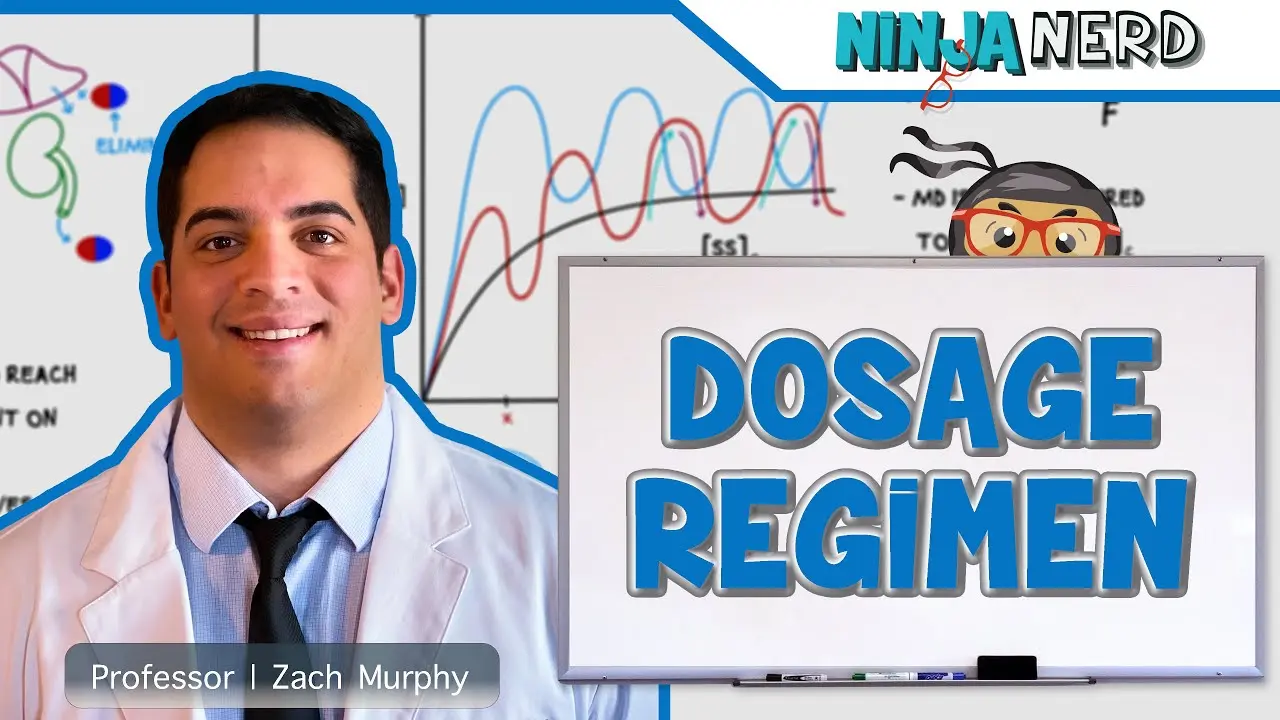
Dosage regimen in pharmacokinetics involves determining the dose, dosing interval, and route of administration to achieve optimal concentrations of a drug in the body.
Transcript
all right so the last thing that's important for pharmacokinetics is being able to design and optimize a dosage regimen this is really kind of like the crux of pharmacokinetics so whenever you're talking about giving a particular dosage regimen it's really important because it talks about three particular things what's the dose of the drug that i'm... Read More
Key Insights
- ❓ Dosage regimen in pharmacokinetics involves determining the dose, dosing interval, and route of administration.
- ☠️ Continuous infusion allows for the steady-state concentration of a drug by balancing dosing rate and elimination rate.
- 🙊 Maintenance doses are used to maintain steady-state concentrations, while loading doses help rapidly reach peak serum drug concentrations.
- 🖐️ Clearance plays a crucial role in determining the maintenance dose, and any decrease in clearance requires a reduction in the dose.
- 🔊 The volume of distribution is a key factor in determining the appropriate loading dose for a drug, with high volume of distribution requiring a higher loading dose.
- ☠️ Steady state concentration is achieved when the dosing rate of a drug is equal to its elimination rate.
- 🥡 It takes approximately four to five half-lives to reach steady-state concentration or eliminate 95% of the drug.
Install to Summarize YouTube Videos and Get Transcripts
Explore YouTube Video Summarizer or Get YouTube Transcript Extractor
Questions & Answers
Q: What factors need to be considered when designing a dosage regimen?
When designing a dosage regimen, it is important to determine the appropriate dose, dosing interval, and the best route of administration for the drug's desired effect.
Q: What is the significance of steady state concentration in dosage regimen?
Steady state concentration is the point at which the dosing rate of a drug is equivalent to its elimination rate, resulting in a consistent drug concentration in the body.
Q: How can clearance affect maintenance doses?
If clearance is reduced due to renal or hepatic dysfunction, the maintenance dose needs to be decreased to avoid drug accumulation and potential toxicity.
Q: What is the purpose of a loading dose?
A loading dose is administered to rapidly reach peak serum drug concentrations, particularly in critically ill patients who may not have time to wait for steady state concentrations.
Key Insights:
- Dosage regimen in pharmacokinetics involves determining the dose, dosing interval, and route of administration.
- Continuous infusion allows for the steady-state concentration of a drug by balancing dosing rate and elimination rate.
- Maintenance doses are used to maintain steady-state concentrations, while loading doses help rapidly reach peak serum drug concentrations.
- Clearance plays a crucial role in determining the maintenance dose, and any decrease in clearance requires a reduction in the dose.
- The volume of distribution is a key factor in determining the appropriate loading dose for a drug, with high volume of distribution requiring a higher loading dose.
- Steady state concentration is achieved when the dosing rate of a drug is equal to its elimination rate.
- It takes approximately four to five half-lives to reach steady-state concentration or eliminate 95% of the drug.
- Modifying the dosing interval can help adjust drug concentrations, especially in patients with renal or hepatic dysfunction.
Summary & Key Takeaways
-
Dosage regimen in pharmacokinetics involves three key factors: dose, dosing interval, and route of administration.
-
Continuous infusions provide steady-state concentrations of a drug by balancing dosing rate and elimination rate.
-
Maintenance doses are used to maintain steady-state concentrations, while loading doses help rapidly reach peak serum drug concentrations.
Read in Other Languages (beta)
Share This Summary 📚
Summarize YouTube Videos and Get Video Transcripts with 1-Click
Try YouTube Summary with ChatGPT & Claude or YouTube Transcript Generator
Explore More Summaries from Ninja Nerd 📚




Summarize YouTube Videos and Get Video Transcripts with 1-Click
Try YouTube Summary with ChatGPT & Claude or YouTube Transcript Generator