How to Structure Facebook Ads Campaigns
TL;DR
Separate Facebook ads into prospecting, retargeting, and retention campaigns so the platform cannot freely redirect a smaller budget toward existing or already-engaged customers. Use audience-segment breakdowns, incremental attribution, reach, impressions, and frequency to judge performance, then apply strict inclusions and exclusions to preserve each campaign’s intended role.
Transcript
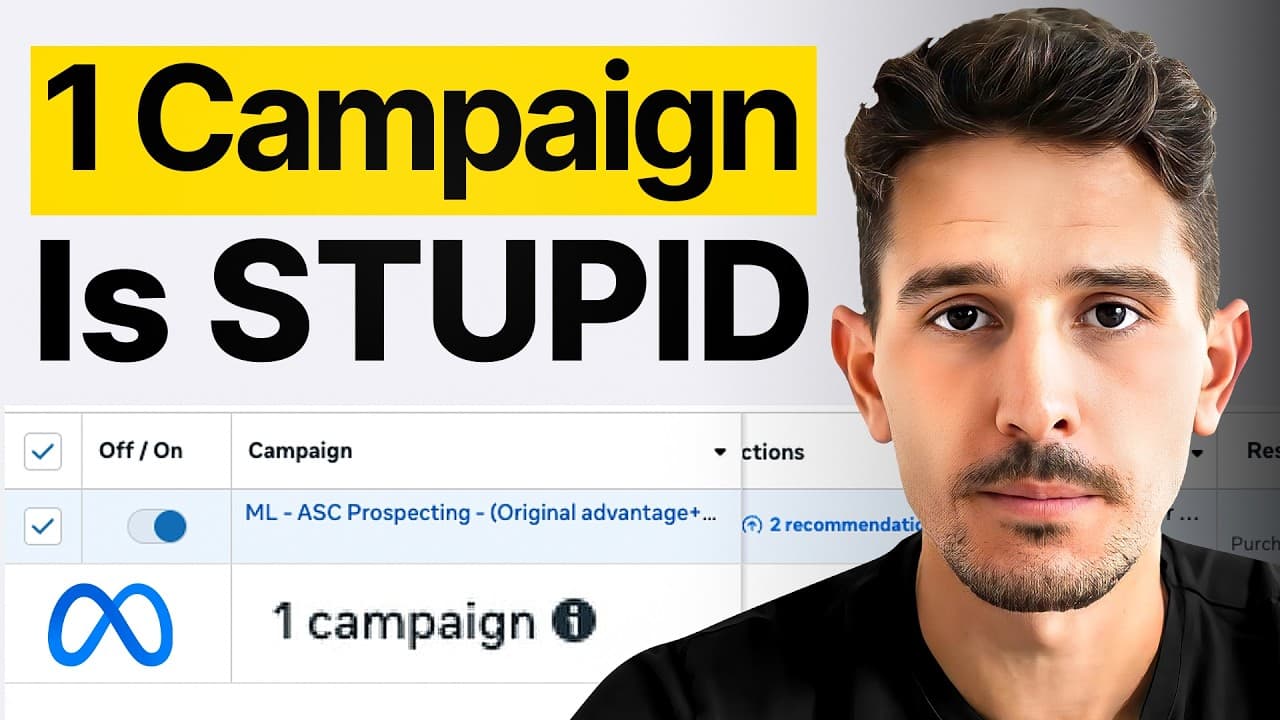
If you're running Facebook ads, then you've probably heard about the one campaign method. A method that claims to be so good that all you need to do is throw all your ads in one adset inside just one campaign. Now, as with most things, this is in fact too good to be true. And I'm going to completely debunk this strategy as someone who has spent ove... Read More
Key Insights
- The one-campaign method gives Facebook freedom to shift spending among new audiences, engaged customers, and existing customers, leaving advertisers without firm control over which group receives ads or how much of the total budget each group consumes.
- Audience-segment reporting is essential because it separates spending and results for new, engaged, and existing audiences. In the example, the campaign spent about $73,000 on new audiences and approximately $55,000 on engaged and existing customers combined.
- Incremental attribution estimates which conversions occurred because of Facebook advertising instead of counting people who may have purchased without the ads. This distinction can substantially change how apparently strong returns from warm audiences should be interpreted.
- Existing customers produced the weakest incremental result in the example, with return on ad spend falling from 6 to 1.3. Engaged audiences fell from 5.4 to 2, while new audiences declined from 3.3 to 1.6.
- Frequency reveals potential audience saturation because the example reached only 165,000 existing customers and 155,000 engaged customers. Existing customers saw ads 14.8 times on average, engaged customers eight times, and new audiences five times across a reach of 1.75 million.
- The one-campaign approach may be more viable for brands spending $10,000 to $40,000 or more per day because Facebook eventually must find new customers. Businesses spending $500 to $2,000 per day are more vulnerable to excessive warm-audience spending.
- The M3 structure separates prospecting, retargeting, and retention into distinct swim lanes. These lanes manage new-customer acquisition, engaged-audience acquisition, and existing-customer retention independently rather than assuming every person progresses through a fixed top-to-bottom funnel.
- Retargeting requires strict audience boundaries, including recent visitors or engagers while excluding purchasers. The recommended setup turns Advantage Plus off and avoids using custom audiences as suggestions because those options could undermine the intended targeting and exclusions.
Install to Summarize YouTube Videos and Get Transcripts
Explore YouTube Video Summarizer or Get YouTube Transcript Extractor
Questions & Answers
Q: Why should advertisers avoid one Facebook ads campaign?
A single campaign allows Facebook to distribute money freely among new audiences, engaged customers, and existing customers. That can produce attractive short-term return on ad spend while directing too much budget toward people who already know the brand or might purchase without advertising. Smaller advertisers may therefore believe they are acquiring new customers when a substantial share of spending is actually serving warm audiences.
Q: How can you see where Facebook ad spend is going?
Use the audience-segment breakdown to distinguish new audiences, engaged customers, and existing customers. When these segments are configured correctly, the report shows how much money and performance each group receives. In the account examined, roughly $73,000 went to new audiences, while approximately $55,000 went to engaged and existing customers, exposing an allocation that overall campaign metrics concealed.
Q: What does incremental attribution show in Facebook ads?
Incremental attribution indicates which conversions happened because of Facebook advertising, excluding people estimated to have converted without the ads. In the example, ordinary reporting made engaged and existing audiences look strongest, but their returns dropped sharply under incremental attribution. Engaged return on ad spend fell from 5.4 to 2, while existing-customer return fell from 6 to 1.3.
Q: Why can high Facebook ads ROAS be misleading?
High reported return on ad spend can include purchases from existing or engaged customers who may have converted without seeing the ads. The example campaign reported 4.39 overall return on ad spend and more than half a million in revenue, yet incremental reporting showed much weaker returns among warm audiences. Strong totals can therefore hide overspending, audience saturation, and insufficient new-customer acquisition.
Q: How does ad frequency reveal audience overspending?
Frequency shows how often the average person within an audience receives ads. In the example, existing customers had a frequency of 14.8 and engaged customers had a frequency of eight, while new audiences averaged five exposures. The warm groups also reached only 165,000 and 155,000 people, compared with 1.75 million new-audience users, indicating repeated delivery to limited pools.
Q: What is the M3 Facebook ads campaign structure?
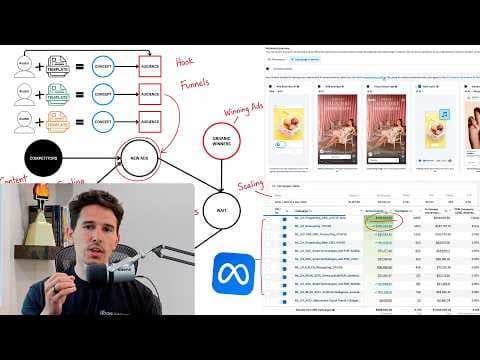
The M3 method uses separate campaign swim lanes for prospecting, retargeting, and retention. Prospecting focuses on acquiring new customers, retargeting addresses recently engaged people, and retention serves existing customers. This is not presented as a conventional top, middle, and bottom funnel. Its purpose is to control audience allocation while still creating competitive conditions among ads within the appropriate campaign.
Q: How should a Facebook ads retention campaign be set up?
A retention campaign should target existing purchasers using a 180-day purchaser pixel audience plus CRM purchaser lists covering 180 days and all time. The demonstrated setup turns Advantage Plus off, keeps ages broad and all genders enabled, and does not use the audiences as suggestions. Creative can feature new products, new arrivals, best sellers, or other messages relevant to existing customers.
Q: How should Facebook ads retargeting audiences be organized?
The recommended starting structure covers add-to-cart users from 90 days, website visitors from 30 days, and Instagram plus Facebook engagers from 14 days. Website retargeting combines a CRM visitor list with the website pixel audience, then excludes 180-day pixel purchasers, 180-day CRM purchasers, and all-time CRM purchasers. Advantage Plus and the audience-suggestion option remain disabled to preserve these boundaries.
Summary & Key Takeaways
-
The one-campaign method combines ads in a single ad set and lets Facebook allocate spending across new, engaged, and existing audiences. In the example account, about $55,000 of $128,000 went to engaged and existing audiences. This limits the advertiser’s control over customer acquisition and can make overall results look stronger than they are.
-
Incremental attribution changes the interpretation of campaign performance by estimating conversions caused by Facebook ads. The example’s reported return on ad spend fell from 5.4 to 2 for engaged audiences, from 6 to 1.3 for existing customers, and from 3.3 to 1.6 for new audiences, revealing excessive retention spending.
-
The M3 method creates separate swim lanes for prospecting, retargeting, and retention instead of treating advertising as a traditional top, middle, and bottom funnel. Retention targets purchaser lists, while retargeting covers recent cart additions, website visitors, and social engagers. Advantage Plus audience expansion and audience suggestions are disabled to maintain targeting boundaries.
Read in Other Languages (beta)
Share This Summary 📚
Summarize YouTube Videos and Get Video Transcripts with 1-Click
Try YouTube Summary with ChatGPT & Claude or YouTube Transcript Generator
Explore More Summaries from Sam Piliero 📚




Summarize YouTube Videos and Get Video Transcripts with 1-Click
Try YouTube Summary with ChatGPT & Claude or YouTube Transcript Generator