How to Generate Better Ideas With AI Agents
TL;DR
Split open-ended ideation across isolated agents, give each agent a different framing, and use a separate critic to score the results for novelty, viability, and fit. This tree-of-thought approach reduces idea contamination and repetitive answers, while a pre-check limits its token-heavy process to problems with multiple plausible solutions, meaningful stakes, and no request for a quick or standard response.
Transcript
Claude Code, Codeex, and pretty much every other agent you use all have one serious problem, and you run into it the moment you need one of them to actually make a decision. These models can think a problem through, but they never come up with anything new. And it doesn't matter which one you're using because all of them fall short the moment you n... Read More
Key Insights
- AI agents are effective at dividing implementation work into smaller tasks, creating to-dos, delegating to subagents, and running work in parallel, but they do not automatically apply the same decomposition to ideation when users request genuinely different directions.
- Conventional AI brainstorming often produces superficial variation because the model reaches for patterns that appeared frequently in its training data. The resulting answers may sound different while representing the same underlying idea, leaving less common but potentially useful angles unexplored.
- A shared context window can weaken independent evaluation because every possibility is developed alongside the others. Ideas begin to influence one another, contextual noise accumulates, and the agent becomes more likely to return similar concepts with altered wording instead of distinct alternatives.
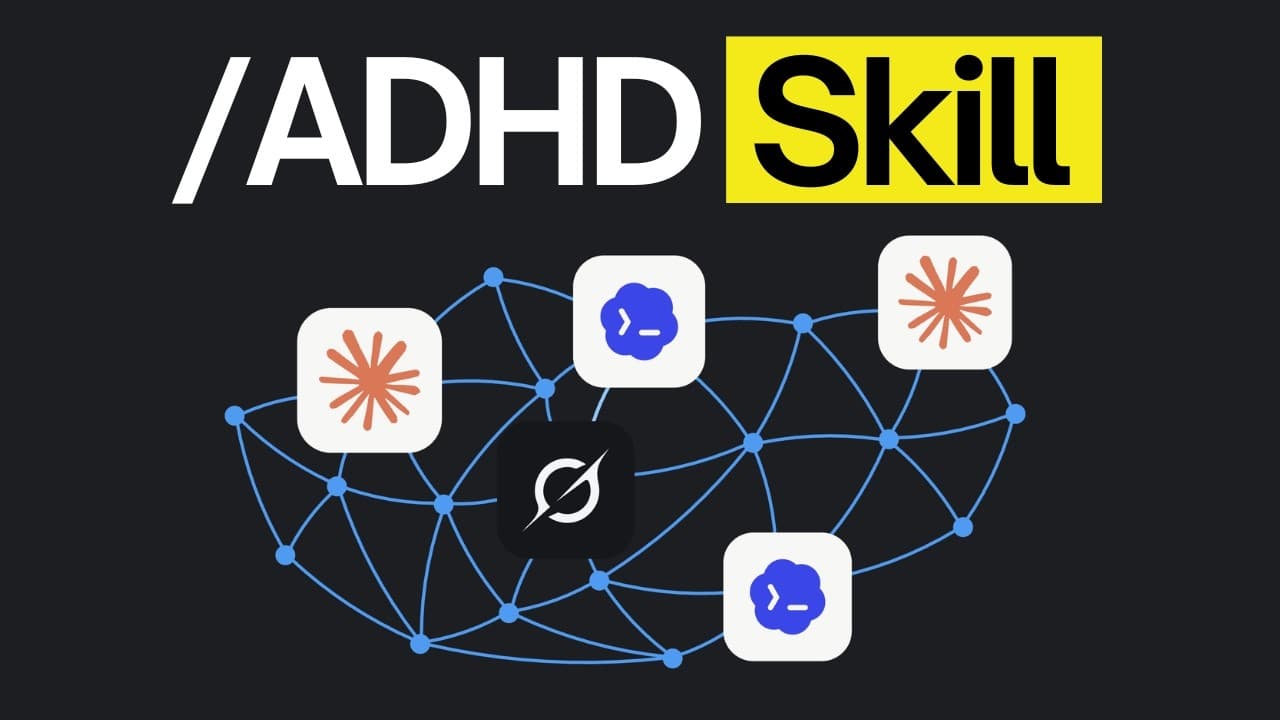
- The ADHD skill uses a tree-of-thought structure that assigns separate branches of a problem to isolated agents. Each branch develops one possibility in its own context window, with no knowledge of what the other agents are considering, before the results are merged.
- Frames are distinct lenses drawn from the skill's frame library and assigned to individual agents. Each agent receives its selected frame, the system prompt, and the problem, which encourages different interpretations while preserving separation among the branches of thought.
- A critic agent evaluates every proposed idea as a skeptical senior engineer. It scores each result on novelty, meaning how new it is, viability, meaning whether it can realistically be built, and fit, meaning how closely it addresses the original problem.
- The final selection process removes weak ideas, shortlists the strongest candidates, and reviews a trap list describing problems that could arise during implementation. Ideas marked as non-obvious receive additional priority, pushing the outcome beyond the first common responses a model is likely to generate.
- The automatic pre-check limits unnecessary token use by asking whether the problem is open-ended, whether choosing the obvious answer incorrectly would have meaningful costs, and whether the user's wording requests something quick or standard. Direct invocation bypasses this screening and runs the skill immediately.
- More videos from this channel:
- More from this channel: AI LABS
Install to Summarize YouTube Videos and Get Transcripts
Explore YouTube Video Summarizer or Get YouTube Transcript Extractor
Questions & Answers
Q: How can AI agents generate genuinely different ideas?
AI agents can generate more distinct ideas by splitting an open-ended problem across multiple isolated agents. Each agent receives a different frame, works inside its own context window, and has no knowledge of the other branches. A separate critic then scores the independent results for novelty, viability, and fit before the strongest ideas are shortlisted and merged into a final answer.
Q: Why do AI brainstorming results often sound repetitive?
AI brainstorming results often repeat because models favor patterns that appeared most frequently in their training data. Even when the wording changes, the underlying direction may remain the same. Working through every possibility in one context window makes this worse because ideas influence one another, contextual noise builds up, and each possibility is not evaluated independently.
Q: What is the tree-of-thought approach used by the ADHD skill?
The tree-of-thought approach creates multiple branches of subagents that independently explore different possibilities. Each branch works in isolation with a distinct framing of the same problem, much like separate branches growing from a tree. After each branch settles on a possibility, the skill collects the results, evaluates them, and combines the strongest surviving ideas into the final response.
Q: How does the ADHD skill keep ideas from influencing each other?
The skill places each ideation branch in a separate agent with its own context window and no shared context. It also assigns each agent a frame, which serves as a specific lens for interpreting the problem. Because agents do not know what the other branches are developing, one early idea cannot pull every later response toward the same underlying direction.
Q: How does the critic agent evaluate proposed ideas?
The critic agent follows a prompt that tells it to behave like a skeptical senior engineer and judge every proposal rigorously. It scores ideas on novelty, which measures how new or creative they are, viability, which asks whether they could realistically be built, and fit, which measures how well they address the problem. Low-scoring ideas are discarded.
Q: When should the ADHD skill run automatically?
Automatic invocation is intended for open-ended problems where experienced people could propose several workable answers and where choosing an obvious but wrong answer would impose a real cost. The pre-check also examines the user's wording. If the request asks for something quick or standard, the process stops because a multi-agent exploration would consume tokens without matching the requested result.
Q: How do you install the ADHD skill for an AI coding agent?
The installation begins by copying and running the command provided in the project's GitHub repository from the terminal of the relevant project. The installer asks which supported AI coding agent should receive the skill and whether it should use project scope or be available across projects. The transcript states that the installer supports more than 45 agents.
Q: Why is this ideation method useful for test-driven development?
Test-driven development benefits because ordinary agents may write tests only for common cases and overlook other routes a user could take through an application. Separate ideation branches can explore different paths and edge cases before implementation begins. The agent should first receive a product requirements document and a technical specification so it understands both the intended product and the chosen technical constraints.
Summary & Key Takeaways
-
AI coding agents can divide implementation work among subagents, but their brainstorming often remains trapped inside one context window. Because the model favors common patterns from its training data, requested variations may express essentially the same idea in different words while overlooked directions never receive independent consideration or evaluation.
-
The ADHD skill applies a tree-of-thought structure to ideation. It assigns different frames to isolated agents that share no context, gathers their independently developed possibilities, and sends them to a skeptical critic agent. The critic scores novelty, viability, and fit, rejects weaker ideas, reviews potential traps, and prioritizes non-obvious survivors.
-
The skill supports more than 45 AI coding agents and can be installed for one project or made available across projects. It uses a pre-check before automatic invocation because running many agents consumes substantial tokens. Suggested applications include test-driven development, where diverse perspectives can uncover user paths and edge cases that ordinary test generation misses.
Read in Other Languages (beta)
Share This Summary 📚
Summarize YouTube Videos and Get Video Transcripts with 1-Click
Try YouTube Summary with ChatGPT & Claude or YouTube Transcript Generator
Explore More Summaries from AI LABS 📚



Summarize YouTube Videos and Get Video Transcripts with 1-Click
Try YouTube Summary with ChatGPT & Claude or YouTube Transcript Generator