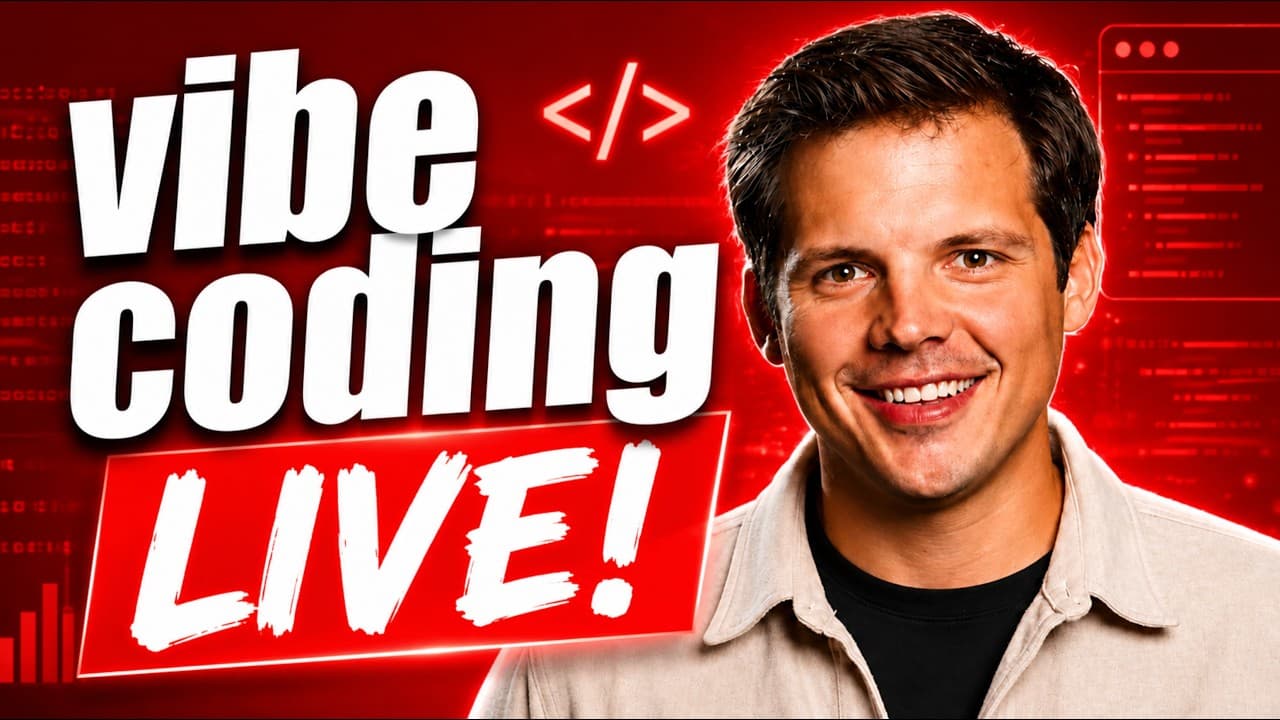
How to Vibe Code an App and Find Paying Customers
TL;DR
Start with a problem you personally experience, define the simplest useful workflow, and use natural-language AI tools to build the product. The planned app, OnlyWaivers.com, would let organizers create event waiver links, optionally model an existing PDF, collect participant names and signatures, and eventually operate as a SaaS, while customer outreach would avoid relying on the creator's existing audience.
Transcript
All right, I'm gonna start. I'm gonna I'm live streaming. I'm doing this. I'm live streaming to X, Facebook, and YouTube right now. And I'm going to vibe code an app live and try to find paying customers live without leveraging my audience. Okay? So, anyone in the world that has access to a $20 a month vibe coding app should and could be able to do... Read More
Key Insights
- A personally experienced problem is the starting point for the product: liability waivers for church youth activities are cumbersome to distribute, complete, transport, and collect, especially when participants forget or lose printed forms before an event.
- Vibe coding is described as using natural-language instructions to create an application without conventional programming knowledge. The creator says he lacks coding experience and cannot independently build a website outside tools such as Wix or Squarespace, yet expects AI to enable the project.
- The customer-acquisition constraint is that the creator does not want to rely on his existing audience. Although viewers could become customers, he plans to pursue outside channels such as Facebook ads and Reddit so the experiment remains more realistic and approachable to other builders.
- The proposed product is a SaaS from its first version, rather than merely a private tool. An organizer would provide an event name and date, with the option to upload an existing waiver PDF when an organization requires particular language or fields.
- The recipient workflow is intentionally simple: a generated link can be shared with any number of people, and each recipient enters the names of the relevant adult or children before tapping to sign. Reducing friction is central to the proposed product design.
- OnlyWaivers.com was selected as the domain because the creator wanted a short, memorable dot-com containing the word waiver. He accepted that the name could limit the product to one category and purchased the domain through Namecheap for $12.
- Replit Agent 4 is the selected development tool, and the creator describes Replit as an AI application built on a large language model. He plans to give it a detailed initial prompt so that less corrective back-and-forth may be required during development.
- The last mile of vibe coding is identified as the hardest stage because reaching a completely finished product can require substantial refinement. The creator compares this to the final changes in home construction and therefore uses Claude to prepare a stronger prompt for Replit.
- More videos from this channel:
- More from this channel: Chris Koerner on The Koerner Office Podcast
Install to Summarize YouTube Videos and Get Transcripts
Explore YouTube Video Summarizer or Get YouTube Transcript Extractor
Questions & Answers
Q: How can you start vibe coding an app without coding experience?
Begin with a concrete problem you already understand, then describe the intended users and workflow in ordinary language. The creator defines vibe coding as using natural-language instructions to build an application without coding knowledge. He uses Claude to improve the initial product prompt and plans to give that prompt to Replit Agent 4, reducing the amount of later back-and-forth.
Q: What problem is OnlyWaivers.com intended to solve?
OnlyWaivers.com is intended to reduce the friction involved in collecting liability waivers for group activities. In the creator's church congregation, organizers work with roughly 60 or 70 young people, and forms may be sent as PDFs that families must complete, print, sign, and bring. Forms can be lost or forgotten, leaving organizers with an uncomfortable decision about participation and risk.
Q: How would the proposed online waiver app work?
An organizer would enter an event name and date, then optionally upload an existing waiver PDF for the application to emulate when required fields or organizational language must be preserved. The app would generate a link that could be sent to any number of people. Recipients would add the applicable adult or child names and tap to sign the waiver.
Q: Why does the creator want the app to be a SaaS from day one?
The creator is building the application to solve his own waiver problem, but he also wants to resell it rather than keep it as a private tool. Calling it a SaaS from day one tells Replit that the product must support use beyond a single organization. The livestream challenge also includes trying to find a paying customer after creating the application.
Q: How does the creator plan to find customers without his audience?
The creator explicitly excludes his existing audience as the primary customer-acquisition advantage, even though he says viewers are welcome to pay for the product. He plans to test other approaches, naming Facebook ads and Reddit as possible channels. This constraint is meant to make the experiment more realistic and approachable for people who do not already have an audience.
Q: Why did the creator choose the OnlyWaivers.com name?
The creator wanted a domain containing the word waiver that was easy to spell, easy to remember, limited to roughly three or four syllables, and preferably used a dot-com ending. He selected OnlyWaivers.com and bought it through Namecheap for $12. He acknowledged that the name could pigeonhole the business into one category but accepted that tradeoff.
Q: Why does the creator use Claude before prompting Replit?
The creator uses Claude to develop a stronger product prompt before beginning the Replit build. He says he does not normally add this preliminary step, but expects it to reduce headaches and repeated corrections later. The prompt explains the SaaS goal, event setup, optional PDF upload, generated sharing link, participant-name fields, and simple tap-to-sign experience.
Q: What does the last mile mean in vibe coding?
The last mile refers to the difficult final stage of turning a mostly working application into a properly finished product. The creator compares it with completing a house, where final changes after major construction can take nearly as long as earlier work. He believes a better initial prompt can make this refinement stage less difficult by reducing unnecessary back-and-forth with Replit.
Summary & Key Takeaways
-
The creator begins an unannounced livestream across X, Facebook, and YouTube with a specific challenge: build an app through vibe coding and try to find a paying customer without relying on his audience. He presents the experiment as something accessible to anyone who can use a $20-per-month vibe coding application.
-
The product idea comes from organizing youth activities for a church congregation with roughly 60 or 70 young people. Paper and PDF liability waivers create friction because families may need to print, sign, transport, and return them. Missing forms can force organizers to choose between excluding a participant and accepting risk.
-
The proposed SaaS, OnlyWaivers.com, would let an organizer enter an event name and date, optionally upload an existing PDF for the app to emulate, and generate a shareable link. Recipients would enter the relevant adult or child names and tap to sign. The creator plans to build it using Replit Agent 4.
Read in Other Languages (beta)
Share This Summary 📚
Summarize YouTube Videos and Get Video Transcripts with 1-Click
Try YouTube Summary with ChatGPT & Claude or YouTube Transcript Generator
Explore More Summaries from Chris Koerner on The Koerner Office Podcast 📚


Summarize YouTube Videos and Get Video Transcripts with 1-Click
Try YouTube Summary with ChatGPT & Claude or YouTube Transcript Generator