How to Make Money Building AI Mobile Apps
TL;DR
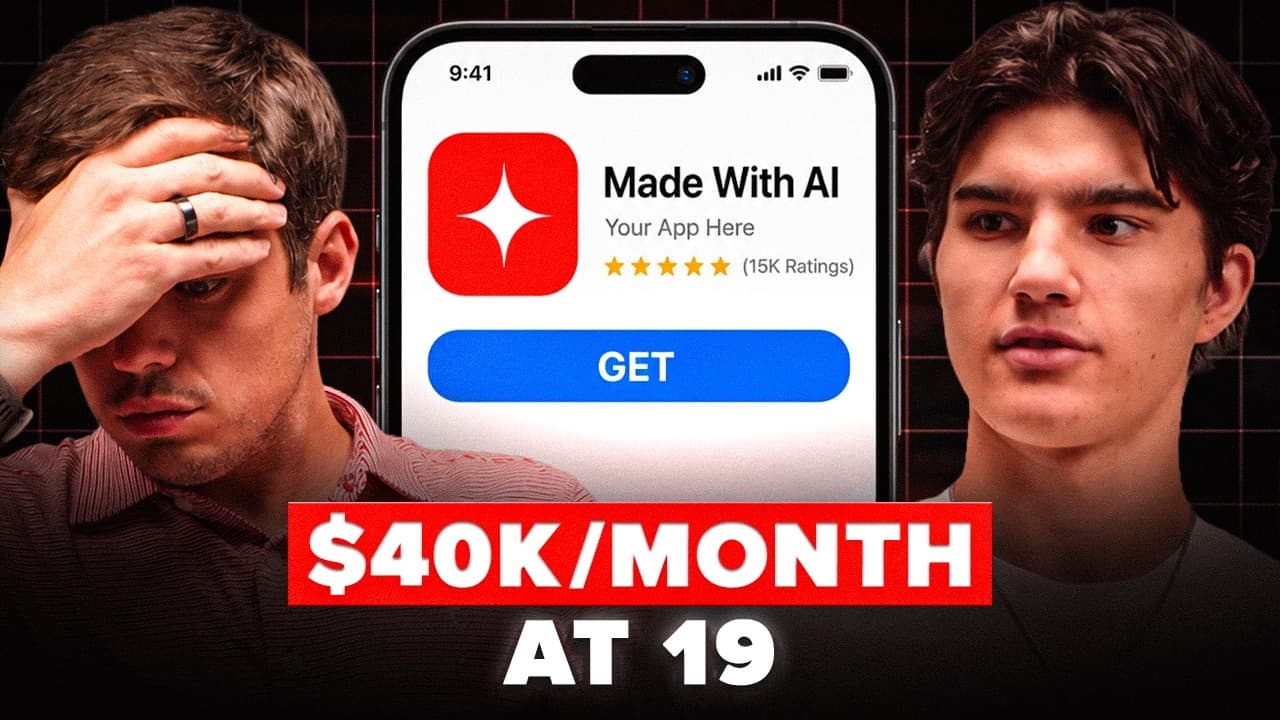
Start with a narrowly focused mobile app that solves a problem you understand, then validate demand through organic short-form content before scaling with creators and paid ads. George generated roughly $225,000 in nine months without prior coding experience, using an AI app builder, recurring subscriptions, visual features, niche influencers, and yearly plans.
Transcript
225,000 in like nine months of building five coding apps without any coding experience. Yeah. Oh my gosh. Quarter million dollars. My goal is to hit a million in revenue before uh 20 before age 20. Yeah. And when do you turn 20? Turn 20 next April. We did like 8K in the first week. And I was like, holy, this is insane. I have a full busin... Read More
Key Insights
- George generated roughly $225,000 in nine months by building five AI-powered mobile apps despite having no previous coding experience. His results came from using Ror to create mobile software, launching repeatedly, and concentrating on apps after an earlier supplement business produced poor advertising economics.
- Fight AI was a test app that analyzed uploaded MMA match or training footage and returned strengths, weaknesses, and suggestions for improvement. George charged $10 per month or $60 per year, showing how a narrowly defined analysis service could support both monthly and annual subscriptions.
- Organic short-form content was George's first validation channel for Fight AI. He and a friend created a new Instagram account, posted simple promotional videos, and received approximately 30,000 to 40,000 views on some posts despite starting without an established audience.
- Fight AI reached about $500 in monthly recurring revenue after being built mainly as an experiment. That early result convinced George that software offered better potential than his supplement company, where paid advertising was losing money and product margins were weak.
- Wrestle AI became George's first serious software business and produced almost all of his app revenue up to the period discussed. His experience as a varsity wrestling captain gave him direct familiarity with the users, training footage, and performance problems the product addressed.
- Ror enabled George to build native mobile applications without traditional programming experience. After he publicly shared his experience using the platform and regularly discussed product needs with its founder, Ror invited him to join its growth team as a founding team member.
- Operational systems allowed Wrestle AI to continue running while George worked full time for Ror. He developed those systems during the app's first two months, reducing the amount of direct attention it required while preserving his ability to pursue additional products.
- George's launch playbook uses visually demonstrable features, niche creator partnerships, Meta ad testing, and yearly subscriptions to acquire customers and build recurring revenue. According to the description, two newer apps each scaled to $10,000 within 45 days, contributing to $30,000 in December and $40,000 in January.
- More videos from this channel:
- More from this channel: Chris Koerner on The Koerner Office Podcast
Install to Summarize YouTube Videos and Get Transcripts
Explore YouTube Video Summarizer or Get YouTube Transcript Extractor
Questions & Answers
Q: How can someone build a profitable AI app without coding experience?
George used Ror, an AI app builder for mobile applications, to create products without knowing how to code. He began with Fight AI as a low-stakes experiment, then treated Wrestle AI as his first serious product. His approach combined a narrowly defined customer problem, an easily demonstrated feature, organic social posts, creator partnerships, paid advertising tests, and recurring subscription options.
Q: What problem did Fight AI solve for its users?
Fight AI allowed users to upload video of an MMA match or training session, including activities such as shadow boxing or sparring. The app analyzed the footage and returned a breakdown covering strengths, weaknesses, and ways to improve. George initially built it for himself as a test of whether he could create a functioning mobile application with Ror.
Q: How did George market his first AI mobile app?
George and a friend opened a new Instagram account for Fight AI and posted simple videos about the product. They did not begin with a large following, yet some posts received roughly 30,000 to 40,000 views. The attention helped produce early subscription revenue and demonstrated that organic content could validate interest before a larger investment in customer acquisition.
Q: How did George price Fight AI?
Fight AI offered a monthly subscription for $10 and an annual subscription for $60. The product eventually reached about $500 in monthly recurring revenue before its initial momentum began fading. Even at that modest scale, the recurring software income impressed George because he had built the app experimentally and promoted it through organic posts rather than relying on an existing audience.
Q: Why did George stop prioritizing his supplement company?
George's supplement company required money for inventory, ingredient sourcing, contract manufacturing, certifications, and paid advertising. He said its advertisements were losing money and the business had almost no margin. Fight AI, by comparison, reached roughly $500 in monthly recurring revenue after a relatively simple launch, convincing him that mobile software had more attractive economics and deserved his full attention.
Q: Why was Wrestle AI a strong niche product for George?
Wrestle AI matched George's direct experience as a varsity wrestler and team captain. He understood the sport, the audience, and the value of receiving feedback on match or training footage. That founder-market connection gave him a concrete problem to address and helped make the product credible. Wrestle AI subsequently generated almost all of his app revenue up to the period discussed.
Q: What launch playbook helped George scale newer apps?
The playbook described in the interview centers on selecting a strong visual feature, partnering with creators who already reach the target niche, testing Meta advertisements, and offering yearly subscriptions to develop recurring revenue. The description states that George used this broader approach to scale two newer apps to $10,000 within 45 days, although he did not publicly identify those apps.
Q: How much revenue did George generate from his AI apps?
George reported generating roughly $225,000 over nine months while building five AI-powered mobile apps without prior coding experience. He said revenue reached $30,000 in December and $40,000 in January. Wrestle AI accounted for almost all earlier revenue, while two newer apps later contributed after each scaled to $10,000 within 45 days.
Summary & Key Takeaways
-
George moved from unprofitable supplement advertising into mobile software after Fight AI demonstrated stronger economics. Built with the AI app builder Ror, the test app analyzed uploaded MMA footage and offered feedback. Organic Instagram posts attracted tens of thousands of views, helping the app reach about $500 in monthly recurring revenue.
-
Wrestle AI became George's first serious app and generated most of his roughly $225,000 in nine-month revenue. His wrestling experience gave him a clear audience and problem to address. After establishing systems around the business, he could continue operating it while working full time on Ror's growth team.
-
The broader launch playbook combines a strong visual feature, creator partnerships, Meta advertising tests, and recurring yearly subscriptions. George said two newer apps each reached $10,000 within 45 days, while total monthly revenue rose from $30,000 in December to $40,000 in January. His next target is $1 million before age 20.
Read in Other Languages (beta)
Share This Summary 📚
Summarize YouTube Videos and Get Video Transcripts with 1-Click
Try YouTube Summary with ChatGPT & Claude or YouTube Transcript Generator
Explore More Summaries from Chris Koerner on The Koerner Office Podcast 📚




Summarize YouTube Videos and Get Video Transcripts with 1-Click
Try YouTube Summary with ChatGPT & Claude or YouTube Transcript Generator