How Can an AI Agent Build a Profitable Business?
TL;DR
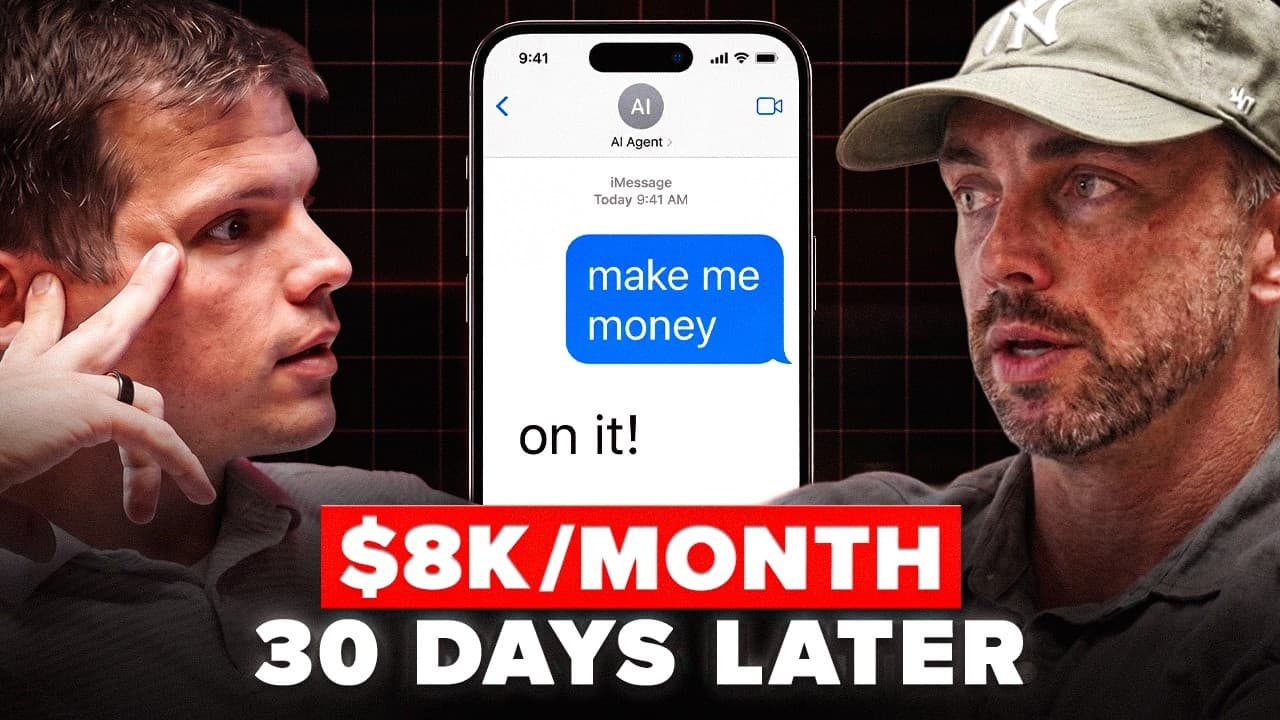
An AI agent generated a little over $8,000 in monthly recurring revenue by creating websites for local businesses and supporting outreach with postcards and QR codes. The experiment also produced more than $300 per month from personalized bedtime stories, showing that agents can handle research, content creation, website production, advertising, and other extended business tasks when properly connected.
Transcript
We have a little over 8K a month from from this experiment. So, I wanted to bring you here so we could come up with some business ideas that agents could launch for us entirely. And then I'm going to fly you back here in a month. We're going to touch base on if those ideas made any money and if so, how much they made, how you did it, how ... Read More
Key Insights
- The strongest reported result is a little over $8,000 in monthly recurring revenue from websites created for local businesses. The AI agent found 350 businesses in Utah, produced a website for each one, and supported an outreach process using postcards and QR codes.
- OpenClaw is presented as an AI assistant that can use different connected models and services to complete extended tasks. Its capabilities depend on proper setup, including access to communication channels, documents, email, storage, payment methods, and any other integrations required by the assigned work.
- A familiar messaging interface reduces the effort required to use an AI agent regularly. Brandon communicated with his agent through iMessage because he already spent time there, while his company similarly placed client agents inside Slack or email when those were the clients’ primary working environments.
- The agent’s computing environment is a continuously online Mac Mini located in Brandon’s office in Provo, Utah. It does not require an attached display, and completed work can be delivered through text messages, Google Docs, Google Sheets, Gmail, or Google Drive.
- Personalized bedtime stories are delivered as individual email content rather than through a dedicated application. Parents can provide a child’s name and preferences, such as princesses or cars, and receive a customized story in their inbox at a scheduled time each evening.
- The bedtime-story concept generated more than $300 per month in recurring revenue during the experiment. Its value proposition focused on solving the recurring problem of creating fresh stories for children while avoiding the adoption barrier associated with downloading and repeatedly opening another application.
- The cost of generating each local-business website was described as only a handful of cents in tokens. This low production cost allowed the agent to create 350 individual websites, demonstrating how automated execution can support a broad outreach campaign without manually building every site.
- AI agents can perform multistep competitive research beyond producing a simple written response. Brandon described tasks involving finding startups, examining marketing strategies, funding, competitive advantages, links, and onboarding communications, then organizing the findings in documents and relating them to an existing business.
Install to Summarize YouTube Videos and Get Transcripts
Explore YouTube Video Summarizer or Get YouTube Transcript Extractor
Questions & Answers
Q: How did an AI agent generate over $8,000 per month?
The AI agent found 350 local businesses in Utah and created 350 websites for them. The broader outreach process used postcards containing QR codes to present those websites to prospective customers. According to the reported one-month results, this website business produced a little over $8,000 in monthly recurring revenue, while each generated website required only a handful of cents in token costs.
Q: What tasks did the AI agent complete for the business experiment?
The agent supported several parts of business creation, including finding local companies, producing websites, generating personalized bedtime stories, creating advertisements, and conducting detailed research. It could also organize findings in Google Docs or Google Sheets and deliver information through iMessage. The description additionally identifies postcard outreach with QR codes as part of the successful local-business website offer.
Q: What is OpenClaw and how was it used?
OpenClaw is described as an AI assistant that can complete broad and extended tasks when configured with the necessary models, tools, and account access. Brandon used it as a personal agent named Zach Morris, communicated with it through iMessage, and connected it to Gmail, Google Docs, Google Drive, and a continuously online Mac Mini that performed the underlying work.
Q: Why was the AI agent connected to iMessage?
The agent was connected to iMessage because Brandon already used the Messages app throughout his day. Keeping the assistant inside a familiar, frequently used interface reduced friction and encouraged more regular interaction. The same principle guided client installations: agents could be placed in Slack for companies working primarily in Slack, or in email for clients whose work centered on email.
Q: How did the personalized bedtime-story business work?
Parents could provide information such as a child’s name and preferred themes, including princesses or cars. The service would then create a personalized story and send it directly to the parent’s email inbox at a scheduled time each evening. The concept functioned like individualized recurring email content and addressed the difficulty of inventing a fresh bedtime story every night.
Q: How much revenue did the bedtime-story business generate?
The personalized bedtime-story business generated more than $300 per month in monthly recurring revenue during the one-month experiment. It was smaller than the local-business website operation, which reached a little over $8,000 per month, but it still demonstrated that customized email content could become a paid recurring service without requiring customers to install and use another application.
Q: Why did the creators prefer email delivery over building an app?
They believed customers already had many applications and regularly used only a small portion of them, making another app difficult to adopt. Email placed the personalized stories inside a channel customers already visited. Their broader argument was that customers primarily want a problem solved, so a familiar delivery method can be more practical than a separate product interface.
Q: What infrastructure supported the AI agent’s work?
The agent ran through a Mac Mini in Brandon’s office in Provo, Utah, which remained online continuously and did not need an attached screen. It was connected to iMessage, Gmail, Google Docs, and Google Drive. Those integrations allowed Brandon to issue requests by text and receive completed research, documents, spreadsheets, or other information through services he already used.
Summary & Key Takeaways
-
Brandon Doyle configured OpenClaw as a personal AI agent named Zach Morris and accessed it through iMessage. A continuously online Mac Mini ran the system, while connections to Gmail, Google Docs, Google Drive, and other services allowed the agent to conduct research, complete extended tasks, and deliver results through familiar communication channels.
-
The pair considered several businesses that an AI agent could launch, including personalized bedtime stories, local-business website outreach, and Facebook Marketplace arbitrage. The bedtime-story concept delivered customized stories by email at a scheduled time, using each child’s name and preferences without requiring families to download and regularly open another application.
-
After one month, the personalized bedtime-story business had generated more than $300 in monthly recurring revenue. The larger result came from an agent that found 350 local businesses in Utah, created 350 websites at a token cost of only a handful of cents per site, and supported postcard outreach that produced over $8,000 monthly recurring revenue.
Read in Other Languages (beta)
Share This Summary 📚
Summarize YouTube Videos and Get Video Transcripts with 1-Click
Try YouTube Summary with ChatGPT & Claude or YouTube Transcript Generator
Explore More Summaries from Chris Koerner on The Koerner Office Podcast 📚




Summarize YouTube Videos and Get Video Transcripts with 1-Click
Try YouTube Summary with ChatGPT & Claude or YouTube Transcript Generator