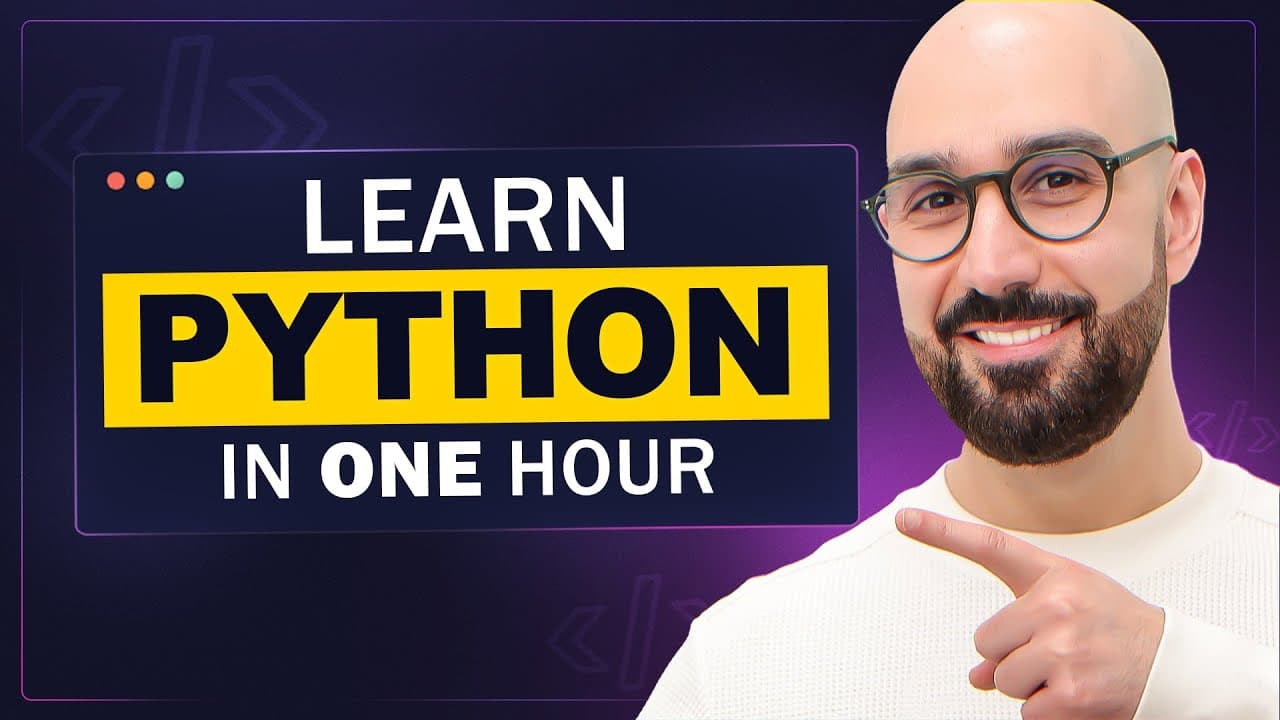
Master Python Basics in Just One Hour
TL;DR
This tutorial teaches you fundamental Python programming concepts, including variables, functions, and data types. Explore practical applications like data science, machine learning, and web development while learning to write and run Python code effectively. Ideal for beginners, it guides you from installation to creating your first programs.
Transcript
in this python tutorial you're going to learn everything you need to know to start programming in python if you want to learn python programming for data science machine learning or web development this python tutorial is the perfect place to learn python you don't need any prior knowledge in python or programming in general i'm going to teach you ... Read More
Key Insights
- 🕸️ Python is a versatile programming language that can be used for various applications such as data science, machine learning, web development, and automation.
- 🎰 Python is the number one language for machine learning and data science projects.
- ✊ Popular websites like YouTube, Instagram, Spotify, Dropbox, and Pinterest are powered by Python and the Django framework.
- 💝 To start programming in Python, download the latest version of Python from python.org and install it, making sure to enable the "Add Python to PATH" option.
- 🥶 The recommended code editor for Python is PyCharm, available for free in the community edition.
- 📁 Python programs can consist of multiple files, with each file containing code that performs specific functions.
- 😒 Python uses variables to store and manipulate data, and they can be declared and assigned values in a variety of ways.
- #️⃣ Python supports different types of data, including numbers (integers and floats), strings, and booleans.
- 👻 Functions in Python, such as the print function, allow you to perform specific actions or operations on your data.
- 🌏 Python offers various built-in functions for converting data types, such as the int, float, bool, and str functions.
- 🔠 Python allows you to interact with users by using the input function to receive input from the terminal or command line.
- 👻 Conditional statements such as if, else, and elif allow you to control the flow of your program based on certain conditions.
- 🎭 Python supports various arithmetic operators for performing mathematical operations, including addition, subtraction, multiplication, division, exponentiation, and modulus.
- 🟰 Comparison operators in Python allow you to compare values and determine if they are equal, not equal, greater than, less than, etc.
- 👻 Logical operators in Python, such as and, or, and not, allow you to combine multiple conditions and evaluate their truth value.
- 👨💻 Python provides the ability to define functions, which are reusable blocks of code that perform a specific task.
- 👂 Lists in Python are used to store multiple values in a single variable, and they can be modified by adding, removing, or changing elements.
- 👂 Tuples in Python are similar to lists, but they are immutable, meaning they cannot be changed after creation.
- 🧡 The range function in Python allows you to generate a sequence of numbers, which is often used in for loops to iterate over a specific range.
- ❓ Tuples are useful when you want to ensure that a sequence of objects remains unchanged.
Install to Summarize YouTube Videos and Get Transcripts
Explore YouTube Video Summarizer or Get YouTube Transcript Extractor
Questions & Answers
Q: What are some applications of Python programming?
Python can be used for data science, machine learning, web development, and automation. It is the number one language for machine learning and data science projects.
Q: How do I download and install Python?
To download Python, visit python.org and select the latest version. Make sure to enable the "Add Python to PATH" option during installation.
Q: What is the recommended code editor for Python?
PyCharm is a popular code editor for Python, available for free in the community edition. It is recommended for its features and ease of use.
Q: How do I write my first Python code?
After installing Python and a code editor, create a new Python project and a new Python file. Write your code in the file, such as a simple "Hello, World!" program, and run it to see the output.
Key Insights:
- Python is a versatile programming language that can be used for various applications such as data science, machine learning, web development, and automation.
- Python is the number one language for machine learning and data science projects.
- Popular websites like YouTube, Instagram, Spotify, Dropbox, and Pinterest are powered by Python and the Django framework.
- To start programming in Python, download the latest version of Python from python.org and install it, making sure to enable the "Add Python to PATH" option.
- The recommended code editor for Python is PyCharm, available for free in the community edition.
- Python programs can consist of multiple files, with each file containing code that performs specific functions.
- Python uses variables to store and manipulate data, and they can be declared and assigned values in a variety of ways.
- Python supports different types of data, including numbers (integers and floats), strings, and booleans.
- Functions in Python, such as the print function, allow you to perform specific actions or operations on your data.
- Python offers various built-in functions for converting data types, such as the int, float, bool, and str functions.
- Python allows you to interact with users by using the input function to receive input from the terminal or command line.
- Conditional statements such as if, else, and elif allow you to control the flow of your program based on certain conditions.
- Python supports various arithmetic operators for performing mathematical operations, including addition, subtraction, multiplication, division, exponentiation, and modulus.
- Comparison operators in Python allow you to compare values and determine if they are equal, not equal, greater than, less than, etc.
- Logical operators in Python, such as and, or, and not, allow you to combine multiple conditions and evaluate their truth value.
- Python provides the ability to define functions, which are reusable blocks of code that perform a specific task.
- Lists in Python are used to store multiple values in a single variable, and they can be modified by adding, removing, or changing elements.
- Tuples in Python are similar to lists, but they are immutable, meaning they cannot be changed after creation.
- The range function in Python allows you to generate a sequence of numbers, which is often used in for loops to iterate over a specific range.
- Tuples are useful when you want to ensure that a sequence of objects remains unchanged.
- Python offers a variety of other advanced concepts and features, such as magic methods, modules and packages, file handling, exception handling, and more, which can be explored further in advanced Python courses or resources.
Summary & Key Takeaways
-
This Python tutorial covers everything from the basics to more advanced concepts, making it suitable for beginners.
-
Python is a multi-purpose programming language that can be used for data science, machine learning, and web development.
-
Popular websites like YouTube, Instagram, Spotify, Dropbox, and Pinterest are powered by Python and the Django framework.
Read in Other Languages (beta)
Share This Summary 📚
Summarize YouTube Videos and Get Video Transcripts with 1-Click
Try YouTube Summary with ChatGPT & Claude or YouTube Transcript Generator
Explore More Summaries from Programming with Mosh 📚


Summarize YouTube Videos and Get Video Transcripts with 1-Click
Try YouTube Summary with ChatGPT & Claude or YouTube Transcript Generator