How to Use Python for Machine Learning Basics
TL;DR
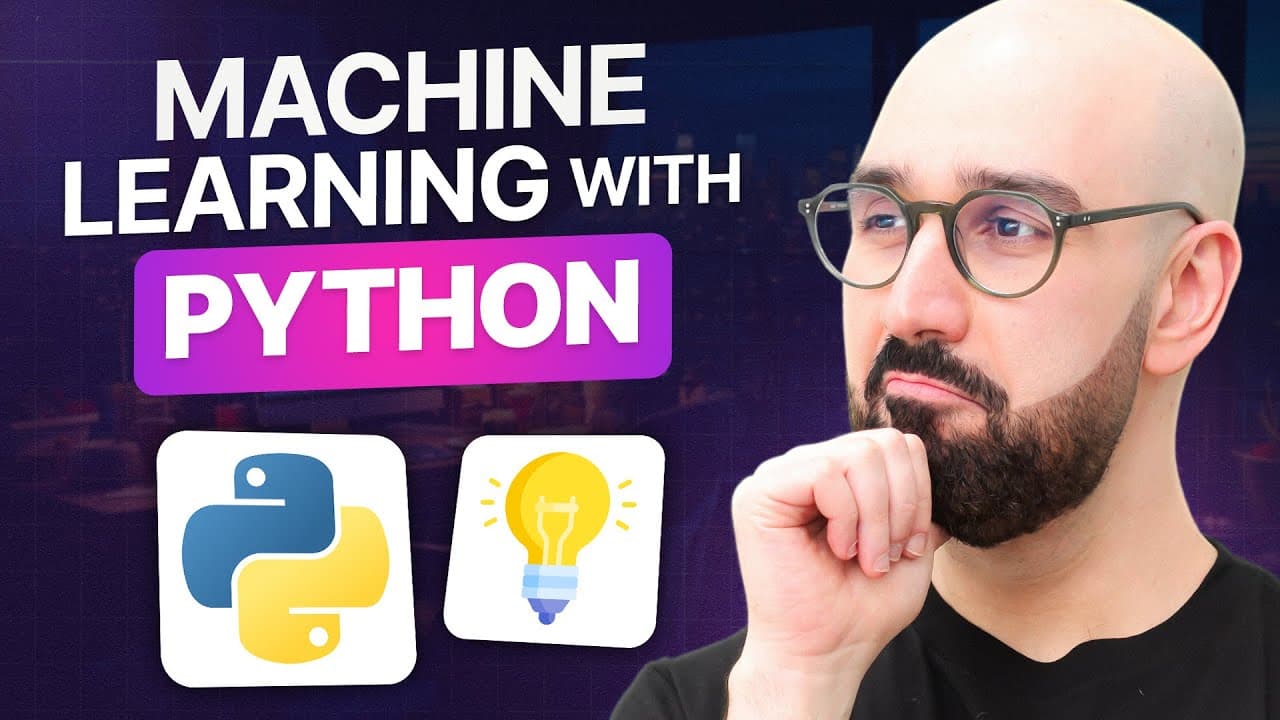
Learn to build a machine learning model using Python and Jupyter Notebook. The tutorial guides you through solving a real-world problem by creating a model that predicts music preferences based on user data. It covers essential steps like data preparation, model training, and evaluation, using libraries like scikit-learn, pandas, and numpy.
Transcript
if you're looking for a machine learning tutorial with python and jupyter notebook this tutorial is for you you're going to learn how to solve a real world problem using machine learning and python we're going to start off with a brief introduction to machine learning then we're going to talk about the tools you need and after that we're going to j... Read More
Key Insights
- Machine learning is a subset of artificial intelligence that enables computers to learn from data and make predictions.
- A typical machine learning project includes data import, data cleaning, model creation, training, prediction, and evaluation.
- Scikit-learn is a popular Python library that provides various machine learning algorithms like decision trees and neural networks.
- Data cleaning involves removing duplicates and irrelevant data to ensure the model learns accurate patterns.
- The decision tree algorithm is used to classify data based on input features, making it suitable for simple prediction tasks.
- Jupyter Notebook is an ideal environment for machine learning projects due to its ability to visualize data easily.
- Model accuracy is assessed by comparing predictions with actual outcomes, often requiring data splitting into training and testing sets.
- Model persistence allows saving a trained model to a file, enabling future predictions without retraining.
Install to Summarize YouTube Videos and Get Transcripts
Explore YouTube Video Summarizer or Get YouTube Transcript Extractor
Questions & Answers
Q: How to build a machine learning model with Python?
To build a machine learning model with Python, you start by importing your data, cleaning it to remove duplicates or irrelevant entries, and then splitting it into training and testing sets. Next, select a suitable algorithm, such as a decision tree, to create and train the model. Finally, test the model's accuracy and adjust it as needed.
Q: What is the role of data cleaning in machine learning?
Data cleaning is crucial in machine learning as it ensures the quality of the input data. It involves removing duplicates, irrelevant, or incomplete data entries, thus preventing the model from learning incorrect patterns. Clean data is essential for training an accurate and reliable model, as poor data quality can lead to inaccurate predictions.
Q: Why use Jupyter Notebook for machine learning projects?
Jupyter Notebook is preferred for machine learning projects due to its ability to easily visualize data and results. It supports interactive coding, where you can run code line-by-line and immediately see the output, making it easier to debug and understand data patterns. This environment is particularly useful when working with large datasets and complex models.
Q: What is the decision tree algorithm in machine learning?
The decision tree algorithm is a supervised learning method used for classification and regression tasks. It works by splitting data into branches based on feature values, creating a tree-like model of decisions. Each node represents a feature, each branch a decision rule, and each leaf a class label. It's easy to understand and interpret, making it a popular choice for beginners.
Q: How to evaluate a machine learning model's accuracy?
To evaluate a model's accuracy, split the data into training and testing sets. Train the model with the training set and make predictions on the testing set. Compare the predictions with the actual outcomes using metrics like accuracy score, which indicates the percentage of correct predictions. High accuracy suggests a reliable model, while low accuracy may require model adjustments.
Q: What is model persistence in machine learning?
Model persistence involves saving a trained machine learning model to a file, allowing it to be reused for future predictions without retraining. This approach saves time and computational resources, especially with large datasets. Libraries like scikit-learn provide functions to save and load models, enabling efficient deployment of machine learning solutions.
Q: What libraries are essential for Python machine learning?
Essential libraries for Python machine learning include scikit-learn for implementing algorithms, pandas for data manipulation, numpy for numerical computations, and matplotlib for data visualization. These libraries provide the tools needed to preprocess data, build models, and visualize results, forming the foundation of machine learning projects in Python.
Q: How does data splitting affect model training?
Data splitting affects model training by determining how much data is used for learning patterns versus testing accuracy. Typically, 70-80% of data is used for training and 20-30% for testing. Proper splitting ensures the model learns effectively and is evaluated on unseen data, which helps in assessing its generalization capabilities and avoiding overfitting.
Summary & Key Takeaways
-
Machine learning enables computers to learn patterns from data and make predictions without explicit programming. It involves creating a model, training it with data, and using it to predict outcomes. This tutorial uses Python and libraries like scikit-learn to demonstrate building a model that predicts music preferences based on user data.
-
The tutorial covers essential steps in a machine learning project, such as data import, cleaning, model training, and evaluation. It uses a decision tree algorithm to classify data and make predictions, emphasizing the importance of data quality and model accuracy.
-
Jupyter Notebook is recommended for machine learning projects due to its data visualization capabilities. The tutorial also highlights the significance of model persistence, allowing trained models to be saved and reused for future predictions, saving time and computational resources.
Read in Other Languages (beta)
Share This Summary 📚
Summarize YouTube Videos and Get Video Transcripts with 1-Click
Try YouTube Summary with ChatGPT & Claude or YouTube Transcript Generator
Explore More Summaries from Programming with Mosh 📚




Summarize YouTube Videos and Get Video Transcripts with 1-Click
Try YouTube Summary with ChatGPT & Claude or YouTube Transcript Generator