How to become a DevOps engineer in 10-14 months
TL;DR
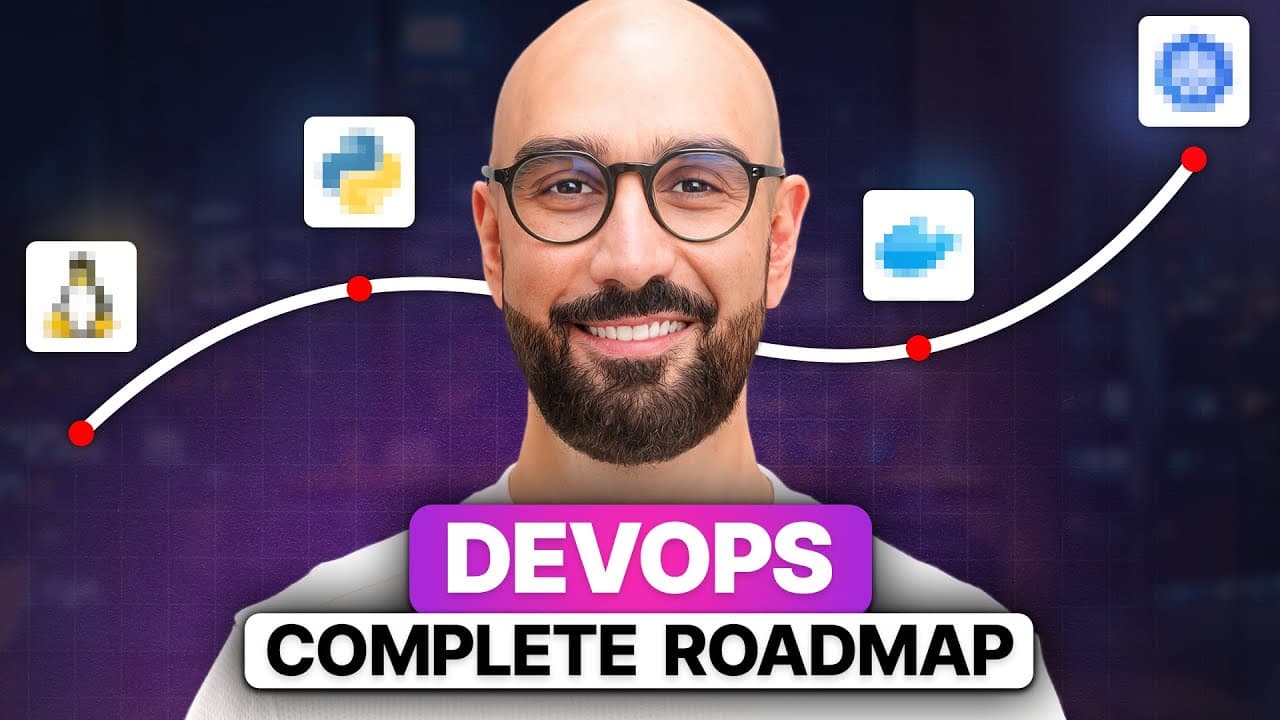
The path starts with Linux fundamentals and scripting, then moves through networking, version control, programming, and cloud basics. You proceed to containerization, CI/CD, orchestration, networking services, configuration management, infrastructure as code, and monitoring. With 3 to 5 hours of daily study, the total timeline is 10 to 14 months and focuses on practical tooling and hands-on practice.
Transcript
if you're looking to break into devops or want to level up your skills you're in the right place today I'm sharing the complete devops road map I'll walk you through the essential skills you need the tools I personally recommend and how much time you should spend on each assuming you dedicate 3 to 5 hours of studying every day this road map should ... Read More
Key Insights
- Linux fundamentals form the backbone of DevOps work, calling for strong command line skills, bash scripting, and core file system, permissions, and process management knowledge. This foundation is essential for configuring and maintaining servers and applications in production.
- Networking concepts are critical because systems rely on reliable data movement, so learners must understand OSI and TCP/IP models, IP addressing, DNS, DHCP, common protocols, firewalls, and basic troubleshooting tools like ping and trace route.
- Git is a must for tracking changes and collaboration, requiring familiarity with clone, commit, push, pull, branches and merges, and remote repositories to manage code effectively across teams.
- Programming languages are used to automate tasks and manage configurations, with Python recommended for its simplicity, libraries, and versatility; learners should build a solid foundation in syntax, data structures, scripts, and error handling.
- Cloud providers require hands on practice with at least one platform; AWS is suggested as a starting point, including launching and configuring virtual servers, data storage, user management, and isolated networks to simulate real environments.
- Containerization centers on Docker, including image creation, container lifecycle management, Dockerfile writing, and multi container applications via Docker Compose to ensure consistent runs across environments.
- CI/CD pipelines automate integration and deployment; Jenkins is highlighted for its versatility and community support, with emphasis on pipeline creation, Jenkins files, automated tests, and deployment workflows.
- Orchestration with Kubernetes covers architecture, master and worker nodes, pods, services, deployments, resource management, and networking models, followed by securing and scaling applications in production.
- Networking and infrastructure services involve setting up reverse and forward proxies, caching, firewalls, and load balancing, with Nginx recommended for reverse proxy and handling related configurations.
- Configuration management focuses on Ansible as the starting point for automating deployments, writing playbooks, roles, modules, and handling variables and templates.
- Infrastructure as code emphasizes Terraform as a flexible, widely used tool for provisioning, with provider and resource concepts, modules, and basic workflows to manage infrastructure as machine readable configuration.
- Monitoring and logging cover Prometheus and Grafana as core tools for collecting metrics, forming queries, and setting up alerts to maintain performance and health of systems and apps.
Install to Summarize YouTube Videos and Get Transcripts
Explore YouTube Video Summarizer or Get YouTube Transcript Extractor
Questions & Answers
Q: A real search query question about the video (e.g. 'How to...', 'What is...', 'Why does...'),
Answer to question 1. Detailed, factual, at least 50 words. Standalone answer citable without additional context.
Q: Question 2
Answer 2. At least 50 words.
Q: Question 3
Answer 3. At least 50 words.
Q: Question 4
Answer 4. At least 50 words.
Q: Question 5
Answer 5. At least 50 words.
Q: Question 6
Answer 6. At least 50 words.
Q: Question 7
Answer 7. At least 50 words.
Q: Question 8
Answer 8. At least 50 words.
Summary & Key Takeaways
-
This summary outlines a practical, time-bound learning plan for aspiring DevOps engineers, emphasizing a progressive sequence of core skills and tools. It starts with fundamentals like Linux and networking, then covers version control, programming, cloud basics, containers, CI/CD, orchestration, and monitoring. It stresses daily commitment and hands-on practice.
-
The guide recommends focusing on one cloud provider initially, with AWS as a common starting point. It also prioritizes Docker for containerization, Jenkins for CI/CD, Kubernetes for orchestration, and Prometheus for monitoring, all aligned with a 10 to 14 month learning horizon.
-
The overall roadmap is designed to build competence through structured weeks and focus areas, encouraging supplementation with a free PDF and other tutorials. It culminates in a broad, real-world skill set suitable for entry to mid level DevOps roles.
Read in Other Languages (beta)
Share This Summary 📚
Summarize YouTube Videos and Get Video Transcripts with 1-Click
Try YouTube Summary with ChatGPT & Claude or YouTube Transcript Generator
Explore More Summaries from Programming with Mosh 📚




Summarize YouTube Videos and Get Video Transcripts with 1-Click
Try YouTube Summary with ChatGPT & Claude or YouTube Transcript Generator