How to become a data scientist in 12 months
TL;DR
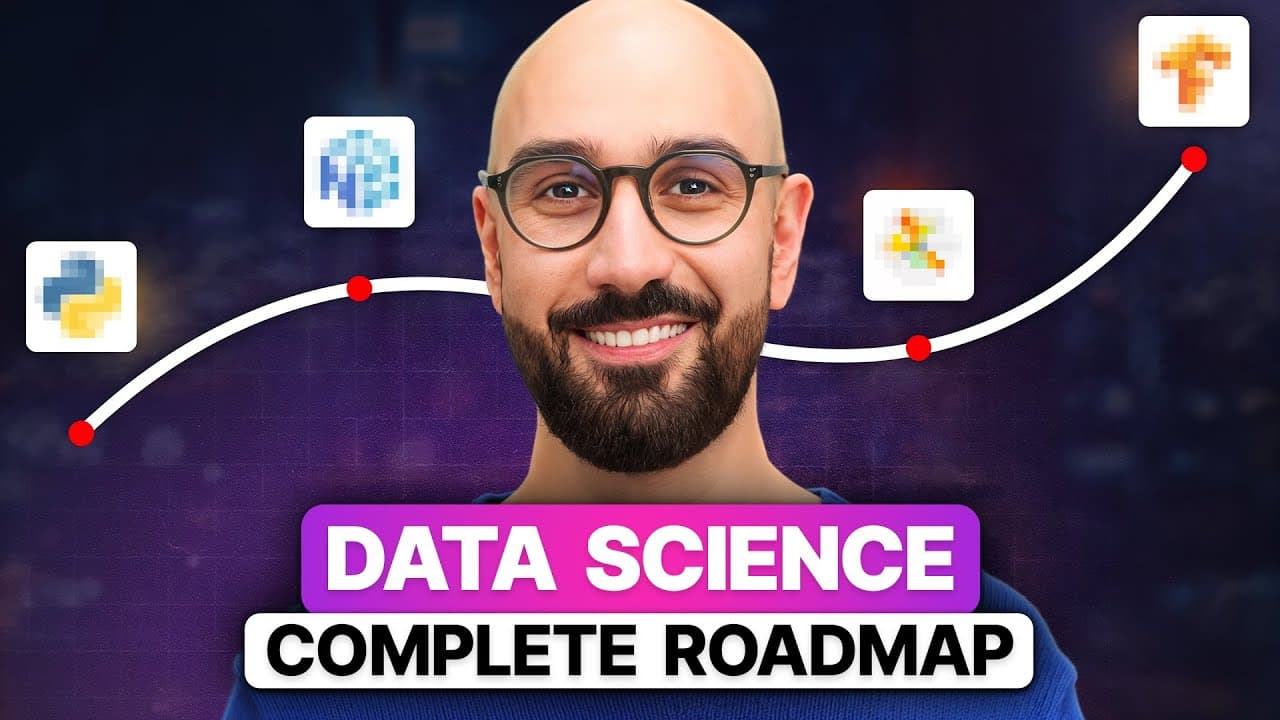
The path starts with core programming and analytics skills, then builds up through Python and SQL, math, data handling, visualization, machine learning, and deep learning. Specialize in NLP or computer vision and learn big data tools to handle large datasets, aiming for an entry level data science role within about a year. Daily practice accelerates progress.
Transcript
if you want to become a data scientist there are nine essential skills you need to master let's dive in and check them out one by one data science is all about analyzing and interpreting complex data to provide actionable insights as a data scientist you'll need to get good at a bunch of different skills from programming and math to data handling a... Read More
Key Insights
- Data science requires mastering nine core skills, starting with programming languages like Python and R and moving through data handling to visualization and modeling.
- Git is a version control system used to track changes and collaborate, and the 80/20 rule applies to its usage, focusing on the most impactful features.
- SQL is essential for accessing and analyzing data, with a typical grasp timeline of about one to two months.
- A strong foundation in mathematics and statistics, including linear algebra, calculus, probability, and statistics, is crucial for interpreting data correctly.
- Effective data pre processing and visualization rely on Python libraries such as pandas, numpy, matplotlib, and seaborn, plus BI tools like Tableau or Power BI for dashboards.
- Machine learning fundamentals divide into supervised and unsupervised learning, with emphasis on understanding these categories and common tools like TensorFlow, PyTorch, and scikit learn.
- Deep learning builds on neural networks and requires practice with CNNs and RNNs, using TensorFlow and PyTorch to implement projects.
- Specialization in NLP or computer vision is common after the basics, allowing focus on language data or visual data and related applications.
- Big data skills with Hadoop and Spark enable handling and analyzing very large datasets, extending capabilities beyond small-scale projects.
Install to Summarize YouTube Videos and Get Transcripts
Explore YouTube Video Summarizer or Get YouTube Transcript Extractor
Questions & Answers
Q: How to start the data science learning journey and what are the first skills to focus on
Begin by building a strong foundation in Python and SQL, as they are the core tools used to manipulate data and query databases. Dedicate time to learning basic programming concepts, join introductory tutorials, and complete small projects that apply data extraction, cleaning, and basic analysis. This establishes a practical baseline for more advanced topics.
Q: What role does mathematics play in data science and which topics matter most
Mathematics provides the theoretical backbone for data analysis and modeling. Focus on linear algebra to understand matrices and vector spaces, calculus for optimization, probability for uncertainty and inference, and statistics for hypothesis testing and decision making. A solid grasp of these topics improves model interpretation and evaluation.
Q: Why is Git recommended for data science projects and how should you start using it
Git helps track changes, collaborate with others, and manage project history, which is essential for reproducibility and teamwork. Start by learning basic commands like init, clone, add, commit, and push, then practice branching and merging on small projects. A simple workflow keeps your code organized and shareable.
Q: How long does it typically take to get proficient in SQL for data roles
SQL proficiency usually develops over one to two months with consistent practice. Begin with basic queries, joins, aggregations, and filtering, then progress to subqueries, window functions, and performance considerations. Real-world practice with sample datasets helps you apply queries to extract meaningful insights.
Q: What is the recommended path for learning machine learning fundamentals
Study supervised and unsupervised learning to understand how models learn from labeled versus unlabeled data. Learn about common algorithms, evaluation metrics, and model selection. Practice with user friendly libraries like scikit learn before moving to TensorFlow or PyTorch for building more complex models.
Q: When should you consider deep learning in your data science journey
Deep learning is typically pursued after gaining a solid grounding in machine learning basics. It involves neural networks with many layers and specialized architectures like CNNs and RNNs. Start with fundamentals, then experiment with simple projects using TensorFlow or PyTorch to build intuition before tackling large-scale tasks.
Q: What specialization options exist after core data science training
Common specializations include natural language processing and computer vision. NLP focuses on text and language data for tasks like sentiment analysis and translation, while computer vision deals with images and videos for object detection and recognition. Choose based on interest, project availability, and career goals.
Q: How do big data tools fit into the data science roadmap and when to use them
Big data tools like Hadoop and Spark are introduced for handling very large datasets that exceed local compute capacity. They enable distributed processing and scalable analytics. Use them when data scale requires parallel processing or when you need to run analytics on massive datasets to uncover patterns not visible in smaller samples.
Summary & Key Takeaways
-
This guide outlines a 12 to 20 month roadmap to data science, starting with Python and SQL, then advancing through mathematics, data handling, visualization, machine learning, and deep learning. It also covers specialization options such as NLP and computer vision and introduces big data tools to manage large datasets.
-
The plan emphasizes a steady pace, recommending 3 to 5 hours per day and highlighting the importance of a solid foundation in programming, statistics, and data manipulation before moving into modeling and deployment.
-
A practical resource bundle includes a free PDF roadmap, tutorials, and courses, with suggested timelines for each skill to keep learners on track and prepared for interviews.
Read in Other Languages (beta)
Share This Summary 📚
Summarize YouTube Videos and Get Video Transcripts with 1-Click
Try YouTube Summary with ChatGPT & Claude or YouTube Transcript Generator
Explore More Summaries from Programming with Mosh 📚


Summarize YouTube Videos and Get Video Transcripts with 1-Click
Try YouTube Summary with ChatGPT & Claude or YouTube Transcript Generator