How Does an Enterprise Data Warehouse Work?
TL;DR
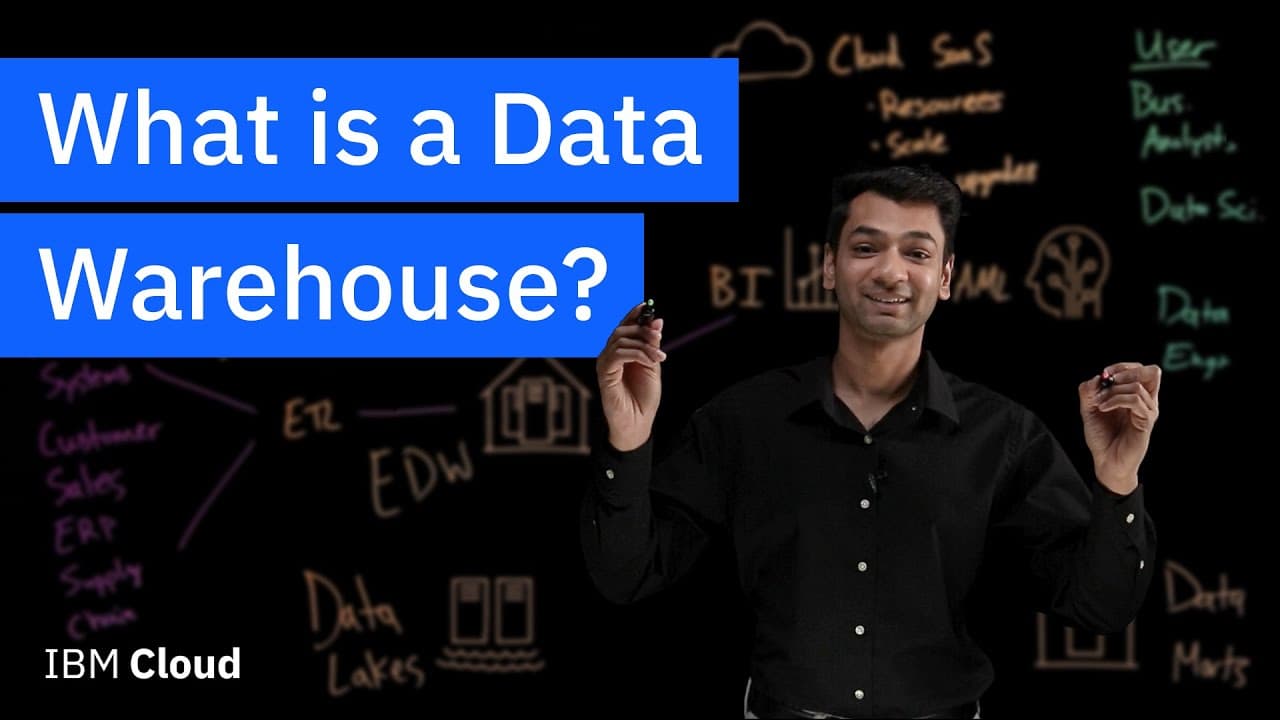
An enterprise data warehouse combines clean, organized business data from multiple source systems into a single source of truth for analytics and decision-making. ETL tools extract, transform, and load raw data into analytics-ready datasets, which business analysts, data scientists, and data engineers can access through warehouse tools, business intelligence platforms, predictive analytics, or machine learning systems.
Transcript
Hey, what's up, everyone? My name is Luv Aggarwal and I'm a Data Platform Solution Engineer for IBM. Data warehouses. Their prevalence across enterprises has grown significantly over the past 20+ years. But with multiple modern advancements, the numerous options out there are now much more complex. So, let's talk about what an enterprise data ... Read More
Key Insights
- An enterprise data warehouse is a large collection of clean, organized business data that supports decision-making across multiple knowledge domains. It serves as a single source of truth by bringing information from different source systems into one analytics-focused environment.
- A data lake is designed to receive raw structured and unstructured data quickly so it can be cleaned and organized later. A data warehouse is more purpose-specific because its contents have already been prepared and optimized for business analysis.
- A data mart is a subset of a data warehouse focused on a particular business domain. A finance data mart, for example, provides a narrower collection of relevant information within the broader organizational warehouse.
- ETL is the process used to extract, transform, and load data from source systems into a warehouse. The transformation stage converts raw information into clean, high-quality data that is ready and optimized for analytics.
- Data warehouse sources can include transactional systems and relational databases covering customer information from CRM systems, sales activity, ERP records, and supply chain operations. Combining these sources creates a broader organizational view.
- Data warehouse users include business analysts, data scientists, and data engineers. They can analyze prepared datasets with built-in warehouse capabilities or connect business intelligence, predictive analytics, and machine learning platforms.
- An on-premises warehouse can run on commodity hardware with MPP or SMP architecture, or as a purpose-built appliance. It provides stack control, local network speeds, high availability, and strict governance, but requires upfront investment, continuing support, and maintenance.
- A hybrid data warehouse combines on-premises and cloud environments. It can support analytics for cloud-born data while keeping mission-critical workloads on-premises, and the two environments can work together for backup and disaster recovery.
Install to Summarize YouTube Videos and Get Transcripts
Explore YouTube Video Summarizer or Get YouTube Transcript Extractor
Questions & Answers
Q: What is an enterprise data warehouse?
An enterprise data warehouse is a large collection of clean, organized business data that is ready for analysis and organizational decision-making. It combines information from multiple source systems and knowledge domains into a single source of truth. Raw data is transformed into high-quality, analytics-optimized datasets before business analysts, data scientists, and data engineers use it.
Q: How is a data warehouse different from a data lake?
A data lake is a place to load many kinds of raw data quickly, including structured and unstructured information, with cleaning and organization performed later. A data warehouse is more purpose-specific and contains organized, clean business data prepared for analytics. Its information has already been transformed into high-quality datasets intended to help an organization make decisions.
Q: What is the difference between a data warehouse and a data mart?
A data warehouse combines organized business data across multiple organizational knowledge domains and acts as a single source of truth. A data mart is a more focused subset of that warehouse, created for a particular business domain. For example, a finance data mart can provide information specifically relevant to finance within the broader enterprise data warehouse.
Q: How does ETL prepare data for a data warehouse?
ETL tools extract data from multiple source systems, transform the raw information into clean and consistent business data, and load the results into the warehouse. This process produces high-quality datasets optimized for analytics. The resulting information can then be exposed to users for analysis, predictive analytics, and machine learning instead of remaining in its original raw form.
Q: What data sources can feed an enterprise data warehouse?
An enterprise data warehouse can receive information from multiple source systems, including transactional systems and relational databases. These systems may represent a wide range of business domains. Examples identified in the source include customer data from CRM systems, sales data, ERP system information, and supply chain data, all of which can be transformed for analysis.
Q: Who uses data from an enterprise data warehouse?
Business analysts, data scientists, and data engineers are among the users of enterprise data warehouse datasets. After information has been cleaned, transformed, and loaded, these users can apply the warehouse's built-in analytics tools. They can also connect business intelligence, predictive analytics, and machine learning platforms to examine the prepared data and support organizational decisions.
Q: What are the benefits and limitations of an on-premises data warehouse?
An on-premises data warehouse provides complete control over the technology stack, access to local network speeds, high-availability options, and support for strict governance and regulatory compliance. It may also avoid bandwidth challenges associated with cloud environments. Its tradeoffs include an upfront investment and responsibility for continuing support and maintenance of the warehouse infrastructure.
Q: When should an organization use cloud or hybrid data warehousing?
A cloud warehouse can be useful when an organization wants a managed SaaS offering, easier scaling, automatic upgrades, and more resources available for higher-value analytics work instead of system management. A hybrid approach can support analytics for cloud-born sources while mission-critical workloads remain on-premises. Hybrid environments can also operate together for disaster recovery and backup scenarios.
Summary & Key Takeaways
-
An enterprise data warehouse is a large collection of organized, clean business data designed to support organizational decisions. Unlike a data lake, which can quickly hold raw structured and unstructured data for later preparation, a warehouse contains transformed, high-quality data. A data mart is a domain-specific subset of a warehouse.
-
Data warehouses collect information from source systems spanning multiple business domains, including CRM customer data, sales data, ERP information, and supply chain data. ETL tools extract, transform, and load this information into analytics-optimized datasets. Business analysts, data scientists, and data engineers can then use the prepared data for analysis and machine learning.
-
Organizations can deploy data warehouses on-premises, through managed cloud offerings, or with a hybrid approach. On-premises systems provide control, local network access, governance, and high availability but require investment and maintenance. Cloud systems simplify scaling and upgrades, while hybrid deployments support cloud-born use cases, mission-critical on-premises workloads, backup, and disaster recovery.
Read in Other Languages (beta)
Share This Summary 📚
Summarize YouTube Videos and Get Video Transcripts with 1-Click
Try YouTube Summary with ChatGPT & Claude or YouTube Transcript Generator
Explore More Summaries from IBM Technology 📚





Summarize YouTube Videos and Get Video Transcripts with 1-Click
Try YouTube Summary with ChatGPT & Claude or YouTube Transcript Generator