How to stop losing customers across six stages
TL;DR
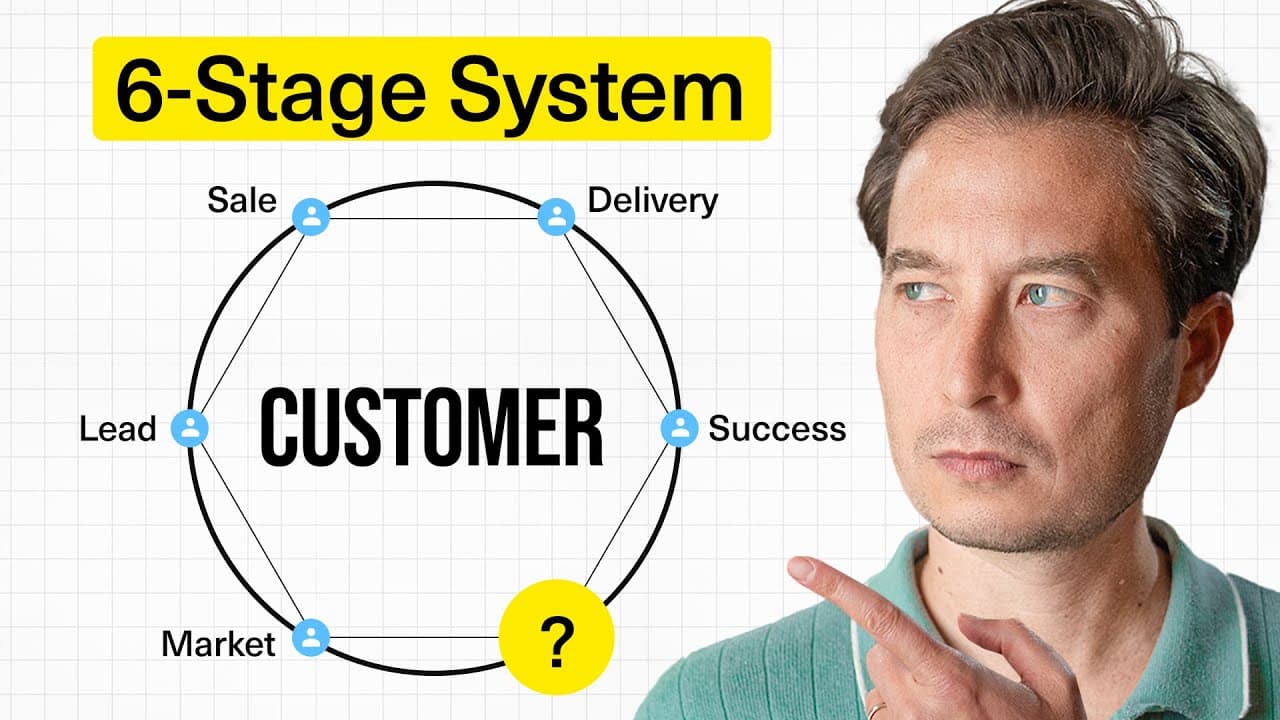
The answer is to map the complete six stage customer journey and fix leakage at each step. Start by outlining the journey and identifying gaps, then assign accountability across marketing, sales, and delivery. Use AI tools for quick, concrete improvements and measure the five Rs to turn customers into revenue generators.
Transcript
How many customers did you lose last week? You don't know, do you? Here's an even more important question. How many customers almost bought from you but didn't? Still don't know? One more for you. How many of your successful customers told someone else about you and your business this month? If you can't answer these questions with precise numbers,... Read More
Key Insights
- The customer journey has six stages, not three.
- Segregating marketing and lead to sale clarifies ownership and may reveal bottlenecks.
- Remarketing of existing leads is a powerful source of additional revenue.
- Understanding the constraint in the sales funnel helps prioritize improvements.
- Delivery and success fall under post acquisition, not just fulfillment.
- The five Rs provide a practical, measurable set of metrics for customer success.
- A customer journey map can be created with AI and used to align teams.
- Resale opportunities include upselling and cross selling to additional customer groups.
- More videos from this channel:
- More from this channel: Tiago Forte
Install to Summarize YouTube Videos and Get Transcripts
Explore YouTube Video Summarizer or Get YouTube Transcript Extractor
Questions & Answers
Q: What is the first practical step to start fixing stages 1 and 2 in a business.
The first practical step is to outline the customer journey for your business and break it into the two stages of market to lead and lead to sale. This helps you see gaps that are otherwise hidden. Then use AI to generate benchmarks and assess performance against them, which makes gaps concrete and actionable.
Q: How can AI help when addressing the six stage framework.
AI helps by outlining the customer journey, generating benchmarks, and suggesting concrete improvements for each stage. It can accelerate mapping, enable rapid iteration with leadership, and provide data driven prompts that keep the team focused on measurable outcomes like conversion, retention, and revenue yields.
Q: Why is the traditional marketing, sales, delivery model considered incomplete.
The traditional model is incomplete because it overlooks the post acquisition stages of delivery and success, which include ensuring the customer achieves the promised transformation and then leveraging that success for retention, referrals, and resale. This expanded view explains irregular growth and helps fix root causes beyond lead generation.
Q: What are the five Rs of customer success as outlined in the video.
The five Rs are results, retention, reviews, referrals, and resale. Results focus on actual business transformation; retention measures ongoing relationships; reviews gather testimonials; referrals encourage word of mouth; resale targets upselling and cross selling to expand value from existing customers.
Q: How should a company start implementing the six stage journey with a team.
Start by outlining the six stage journey, then share it with the leadership team to gain buy in. Put someone in charge of customer success and organize a cross functional meeting with operations, sales, and success. Begin implementing the mapping exercise and track progress against the five Rs to drive improvements.
Q: What role does “mapping your customer journey” play in improving growth.
Mapping the journey creates a clear visual of where leakage occurs, clarifies ownership across departments, and provides a basis for targeted fixes. It lets teams see how early marketing decisions affect later delivery and success, enabling a coherent flywheel rather than a disconnected funnel.
Q: How can you use the concept of a flywheel in customer growth.
The flywheel concept emphasizes momentum that builds on itself. By aligning marketing, sales, delivery, and success around a shared journey and outcomes, customer momentum feeds more referrals, better retention, and greater resale. This creates sustainable growth as improvements compound over time.
Q: What practical steps follow the journey mapping to start seeing results.
After mapping, assign clear KPI ownership for each stage, use AI prompts to generate improvements, and begin implementing changes in small, testable cycles. Focus on improving the five Rs, gather feedback from customers, and use the lessons to refine the journey and scale successful practices across the organization.
Summary & Key Takeaways
-
The six stage customer journey framework reveals gaps beyond the common three stage model and identifies where leakage occurs. Mapping the journey clarifies ownership and enables targeted fixes across marketing, sales, delivery, and success.
-
AI can accelerate the mapping and optimization process by generating benchmarks and helping implement changes quickly, without months of work.
-
A structured five R framework (results, retention, reviews, referrals, resale) guides measurement and improvement to create sustained revenue growth.
Read in Other Languages (beta)
Share This Summary 📚
Summarize YouTube Videos and Get Video Transcripts with 1-Click
Try YouTube Summary with ChatGPT & Claude or YouTube Transcript Generator
Explore More Summaries from Tiago Forte 📚



Summarize YouTube Videos and Get Video Transcripts with 1-Click
Try YouTube Summary with ChatGPT & Claude or YouTube Transcript Generator