How to Build a Master Prompt for Better AI Output
TL;DR
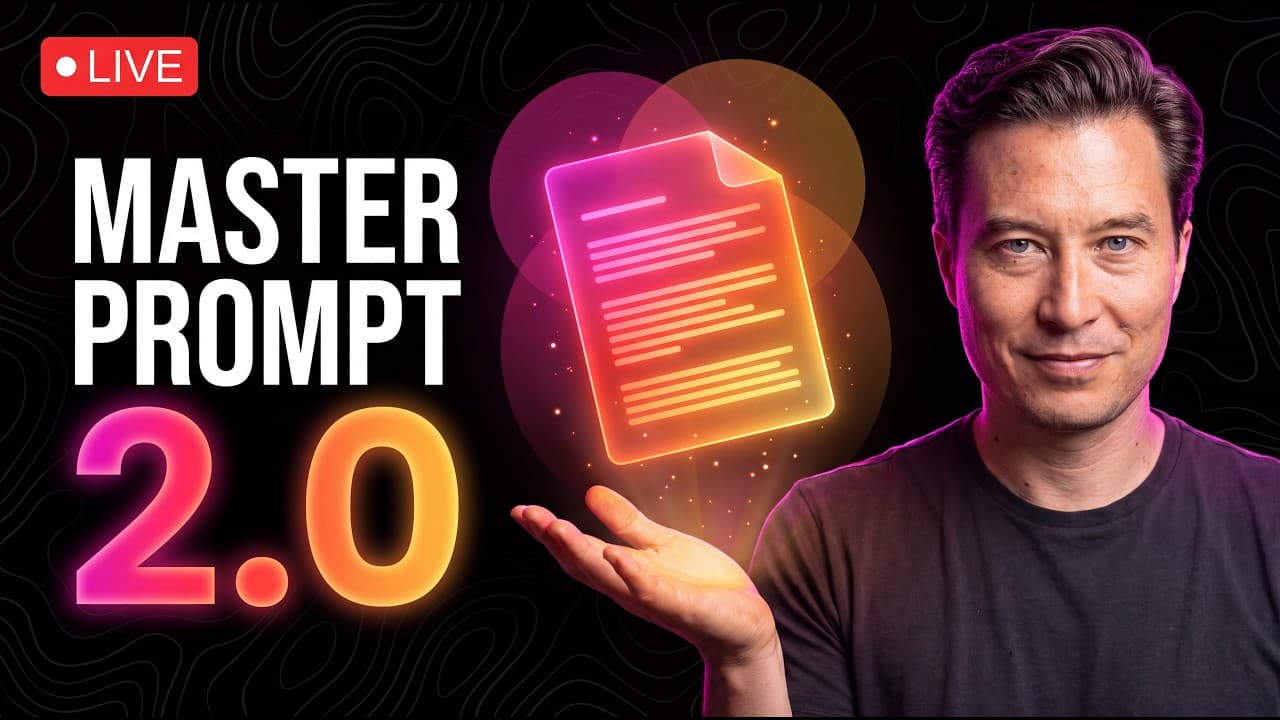
Better AI output comes from supplying carefully curated personal context, not merely choosing the most capable model or generating more tokens. A master prompt acts as the AI’s manual for working with you, placing your preferences and knowledge inside a structured context architecture so responses become more personalized while supporting human judgment, control, efficacy, and mastery.
Transcript
All right. Looks like we are crossing five hundred people present, which is pretty amazing, pretty crazy. And I think we'll go ahead and get started. Um, this is being recorded. That's always the most common question. It-- the, the recording, the full recording will be available on YouTube, on our YouTube channel, will be posted in Circle, will be ... Read More
Key Insights
- A master prompt is the AI’s user manual for working with a specific person, rather than a manual teaching that person how to operate AI. It creates a personalized foundation that can improve interactions regardless of the user’s situation or preferred AI tool.
- Context architecture is the structured arrangement of information that shapes an AI response. Context is not merely a large, disorganized collection of data, because its layers and overall structure can be modified and redesigned to influence the quality and personalization of results.
- Personal context management is the human skill of collecting, curating, and supplying relevant information to AI. The session argues that this skill has become a central productivity bottleneck because current models are already capable enough for most ordinary tasks.
- Unique personal context is a way to escape mediocre AI output. Notes, expertise, experience, and tacit knowledge provide a combination of information that only the individual possesses, giving the model material that differs from the average patterns represented across internet-derived knowledge.
- Context-maxxing is an approach that prioritizes cultivating relevant context instead of maximizing the sheer number of tokens or tasks produced by AI. It places most human time and attention on selecting the knowledge that will fuel and shape the model’s thinking.
- Cognitive agency is the capacity to think and act with generative AI in ways that support control, efficacy, and mastery. The cited context-maxxing framework argues that intentional collaboration can strengthen this agency, while indiscriminately outsourcing thought and judgment can degrade it.
- The context window is everything available to shape an AI response during an interaction. It can include prompts, instructions, attachments, connected tools, and product features, functioning like working memory or computer RAM within the conversation.
- AI can only use information available inside its context window at the relevant moment. Training on broad human knowledge does not guarantee recall of every useful detail in the right form, so users must deliberately provide the specific context needed for a task.
- More videos from this channel:
- More from this channel: Tiago Forte
Install to Summarize YouTube Videos and Get Transcripts
Explore YouTube Video Summarizer or Get YouTube Transcript Extractor
Questions & Answers
Q: What is a master prompt for AI?
A master prompt is a personalized manual that tells AI how to work with a particular user. It can describe the user’s preferences, situation, knowledge, and desired ways of collaborating. Rather than teaching the person how to use AI, it gives the AI instructions for serving that person, turning a generic default experience into a more consistently personalized one.
Q: How do you build a first master prompt?
The session recommends designing a master prompt around the information AI needs to work effectively with you, then placing it in the personal preferences, user preferences, or custom instructions layer. A self-contained builder prompt can conduct an interview and produce a fully formed first draft. That result is described as a minimum viable master prompt that can be installed and refined.
Q: Why does personal context improve AI output?
Personal context gives AI material it would not otherwise have, including your notes, expertise, experiential knowledge, tacit knowledge, preferences, and situation. Although a model may be trained on extensive internet content, it cannot automatically recall every relevant detail in the right way. Supplying distinctive context helps its response reflect your knowledge instead of drifting toward an average answer.
Q: What is personal context management?
Personal context management is the practice of collecting, curating, and providing your own context to AI. The session presents it as a newly important human skill because time, attention, individual intelligence, and even model capability are no longer the only major constraints. The quality and arrangement of the information supplied to the model increasingly determine the usefulness of its results.
Q: What is context-maxxing in AI use?
Context-maxxing is an approach that centers the user’s context rather than pursuing maximum token volume. It directs time, attention, and effort toward curating the information that fuels and shapes AI thinking. Users intentionally decide what environment they want to think within, what knowledge to provide, and how AI should amplify their domain knowledge without replacing human judgment.
Q: How is context-maxxing different from token-maxxing?
Token-maxxing focuses on using as many tokens as possible and having AI perform a high volume of work. Context-maxxing focuses instead on the relevance, uniqueness, and structure of the information supplied. The distinction is between emphasizing raw production and deliberately shaping the model’s working material so its output better reflects the user’s knowledge, intentions, and standards.
Q: What is an AI context window?
The context window is the complete set of information available to shape an AI response. It includes prompts, instructions, attachments, connected tools, and features introduced by the model provider. The session compares it to human working memory or computer RAM. If information is not available within that window, the AI has no awareness, understanding, or access to it during the interaction.
Q: How can AI use support cognitive agency?
AI use can support cognitive agency when the person actively controls the interaction, chooses the information environment, supplies relevant domain knowledge, and retains responsibility for judgment. Cognitive agency is defined here as the capacity to think and act with generative AI in ways that support control, efficacy, and mastery. Context-maxxing is presented as the path that strengthens those qualities.
Summary & Key Takeaways
-
A master prompt is a personalized manual that tells AI how to work with its user. It belongs in the personal preferences, user preferences, or custom instructions layer of the context architecture. Its purpose is to replace a generic default experience with one shaped by the user’s needs, knowledge, preferences, and situation.
-
The emerging productivity bottleneck is personal context management, not simply time, attention, intelligence, or model capability. Strong results depend on collecting, curating, and supplying useful context. Personal notes, expertise, experiential knowledge, and tacit knowledge give AI distinctive material that can move its responses away from the average of internet-derived patterns.
-
Context-maxxing centers human context instead of maximizing token volume. It asks users to design the information environment in which they think with AI, select the material that shapes its responses, and preserve their role in judgment. This approach is presented as a path toward greater cognitive agency, confidence, ambition, efficacy, control, and mastery.
Read in Other Languages (beta)
Share This Summary 📚
Summarize YouTube Videos and Get Video Transcripts with 1-Click
Try YouTube Summary with ChatGPT & Claude or YouTube Transcript Generator
Explore More Summaries from Tiago Forte 📚

Summarize YouTube Videos and Get Video Transcripts with 1-Click
Try YouTube Summary with ChatGPT & Claude or YouTube Transcript Generator