How to implement a dynamic array in Java
TL;DR
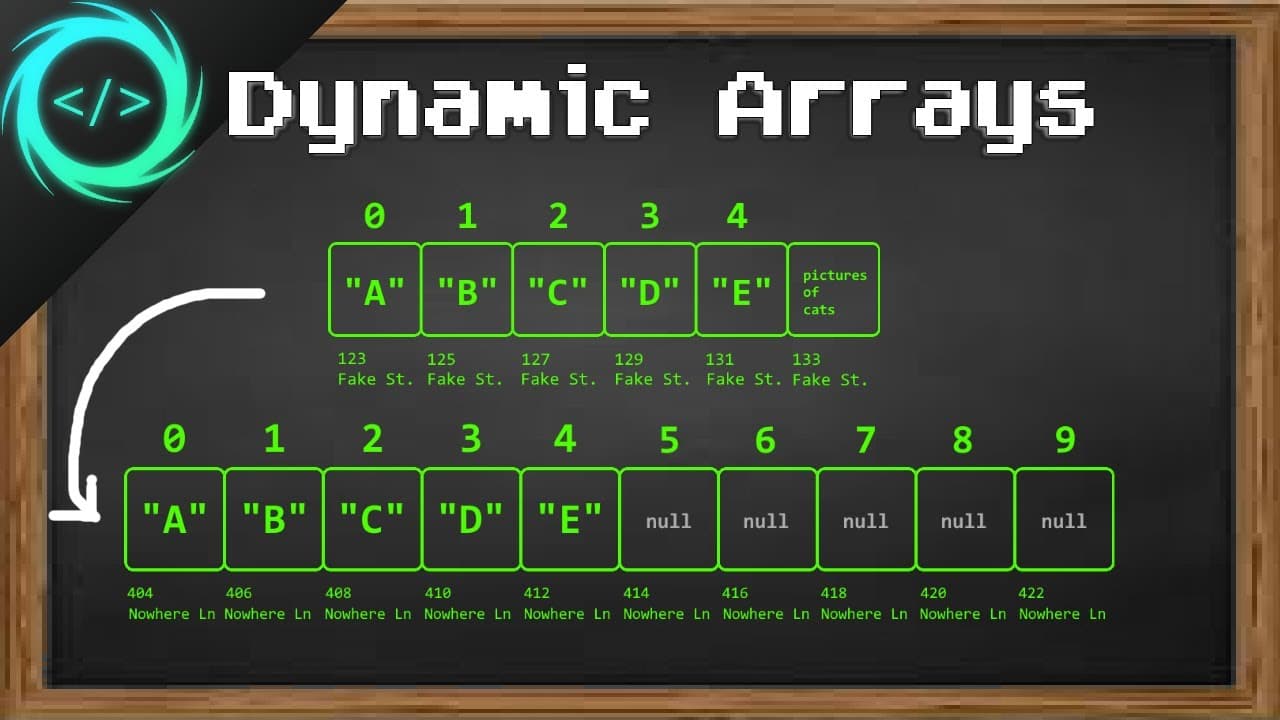
A dynamic array resizes by creating a larger internal array and copying elements. It supports O(1) random access, but can be wasteful of memory and requires shifting elements for insertions and deletions near the front. The video builds a dynamic array in Java and explains growth strategy and basic operations.
Transcript
what the heck is a dynamic array a dynamic array is an array with a resizable capacity if we need extra room for elements we can increase the capacity which we cannot normally do with a standard typical fixed size array dynamic arrays are also known as array lists in Java vectors in C++ arrays in JavaScript and list in Python here's an example of a... Read More
Key Insights
- Dynamic arrays resize by creating a new, larger inner array and copying elements over.
- The capacity increase factor is typically between 1.5 and 2, depending on the language.
- Random access to elements is O(1) because elements are stored contiguously.
- Insertion and deletion near the end are efficient since they often avoid shifting.
- Shifting is required for insertions or deletions near index zero.
- Dynamic arrays waste memory due to reserved but unused capacity.
- Expanding or shrinking the array is costly due to copying all elements.
- The video uses a Java example to show add, insert, delete, and search operations.
- More videos from this channel:
- More from this channel: Bro Code
Install to Summarize YouTube Videos and Get Transcripts
Explore YouTube Video Summarizer or Get YouTube Transcript Extractor
Questions & Answers
Q: How does a dynamic array handle growth when it reaches capacity?
When the inner array reaches capacity, the dynamic array creates a new, larger inner array and copies all existing elements into it. This growth process allows continued addition of elements without fixed limits, trading some time for write operations during growth for improved amortized performance over many insertions.
Q: What is the typical growth strategy for dynamic arrays and why?
The typical growth strategy is to increase capacity by a factor of 1.5 to 2, depending on the language and implementation. This approach balances the cost of copying elements during growth with the benefit of fewer resize operations, aiming to keep amortized insertion time efficient while avoiding excessive memory waste.
Q: Why do dynamic arrays offer O(1) random access?
Dynamic arrays offer O(1) random access because their elements are stored contiguously in memory, like a normal array. Each element can be retrieved directly by its index without traversing previous elements, which leads to constant time access regardless of the dataset size.
Q: What is a major advantage of appending elements to the end of a dynamic array?
A major advantage is that inserting at the end often does not require shifting existing elements, which keeps the operation fast. If there is available capacity, you can place the new element at size and then increment the size, avoiding the overhead of moving other elements.
Q: What causes the need for shifting elements in a dynamic array?
Shifting is required when inserting or deleting elements near the front of the array. To insert at a given index, elements from that index onward must be moved to the right to make space. Similarly, when deleting, elements to the right must be moved left to fill the gap.
Q: What are the downsides of dynamic arrays compared to linked lists?
Dynamic arrays can waste more memory due to reserved capacity that may be unused, whereas linked lists allocate only needed nodes. They also incur time costs for growth due to copying and for certain operations that require shifting elements, especially near the front of the array.
Q: What operations are demonstrated by the video in the Java example?
The video demonstrates adding elements, inserting at a specific index, deleting elements, searching for elements to obtain their index, and converting the array to a string for display. It shows how to manage size and capacity internally and how to grow the inner storage when needed.
Q: Is shrinking the dynamic array discussed, and what does it involve?
Shrinking is mentioned as a possible operation, where the inner array is resized to a smaller capacity and elements are copied over to the new storage. This process mirrors expansion but in reverse and is used to reclaim unused memory when the number of elements decreases significantly.
Summary & Key Takeaways
-
A dynamic array uses an inner fixed size array and grows when capacity is reached, typically by creating a new array with larger capacity and copying elements over. This approach lets the data structure offer random access and contiguous storage, while incurring cost during growth and potential memory waste.
-
When elements are added beyond the current capacity, the dynamic array expands, often by a factor between 1.5 and 2, and existing elements are copied to the new storage. Shrinking can occur by reversing the process, though it is not as commonly emphasized in examples.
-
The video demonstrates implementing a basic dynamic array in Java, including add, insert, delete, search, and a toString method, and highlights differences from static arrays such as resizing and memory management.
Read in Other Languages (beta)
Share This Summary 📚
Summarize YouTube Videos and Get Video Transcripts with 1-Click
Try YouTube Summary with ChatGPT & Claude or YouTube Transcript Generator
Explore More Summaries from Bro Code 📚




Summarize YouTube Videos and Get Video Transcripts with 1-Click
Try YouTube Summary with ChatGPT & Claude or YouTube Transcript Generator