What Are Data Structures and Algorithms in Java?
TL;DR
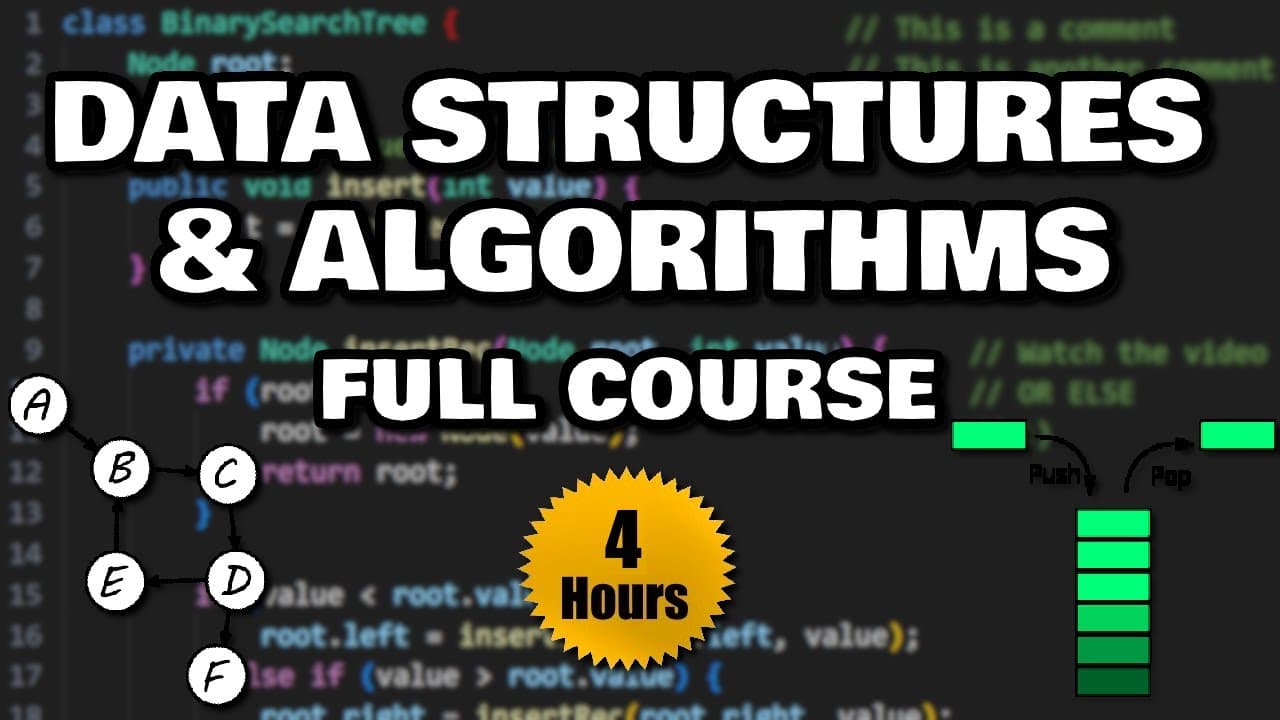
A data structure is a named location used to store and organize data, and an algorithm is a collection of steps to solve a problem. Learning both produces code that is time and memory efficient, and the topics come up constantly in coding job interviews. The course covers stacks, queues, linked lists, big O notation, searching, sorting, graphs, and trees.
Transcript
hey y'all what's going on everybody it's you bro hope you're doing well and in this video we're going to discuss data structures and algorithms so sit back relax and enjoy the show if you wouldn't mind please like comment and subscribe one like equals one prayer for the youtube algorithm here's a few of the topics that we're going to cover in the s... Read More
Key Insights
- A data structure is a named location that can be used to store and organize data. Different data structures store and organize data in different ways, and each one has its own pros and cons depending on the problem being solved.
- An algorithm is a collection of steps to solve a problem, the steps to a solution. A real life example is baking a pizza: heat the oven, knead the dough, add the toppings, and the problem of being hungry is solved.
- There are two main reasons to learn data structures and algorithms: you write code that is both time and memory efficient, and commonly asked questions in coding job interviews involve these topics, such as reversing a doubly linked list.
- A stack is a LIFO data structure, an acronym for last in first out. It stores objects into a sort of vertical tower, like a stack of books or a stack of CDs, where the most recently added item sits on top.
- Stacks have five unique methods: push to add an object to the top, pop to remove the topmost object, peek to look at the top object without removing it, empty to check whether the stack holds anything, and search to find an object.
- Pop returns the object it removes, so the top item can be assigned to a variable such as a string. Peek is the method to use when you only need to view the topmost object, because pop deletes it from the stack.
- The search method of a stack returns the position of an object counting from the top, starting at 1 rather than 0. If the object is not in the stack, search returns negative 1.
- Stacks can run out of memory. Pushing roughly a billion objects onto a stack in Java triggers an out of memory error due to the Java heap space, and popping from an already empty stack throws an EmptyStackException.
Install to Summarize YouTube Videos and Get Transcripts
Explore YouTube Video Summarizer or Get YouTube Transcript Extractor
Questions & Answers
Q: What is a data structure?
A data structure is, simply put, a named location that can be used to store and organize data. Two familiar examples make the idea concrete. A family tree is a hierarchy of family relationships, and a tree is a data structure that organizes that data. An array is a collection of elements stored at contiguous memory locations, which is another example. Different data structures store and organize data in different ways, and each of them has its own pros and cons, so part of the skill is choosing the right one for a given problem.
Q: What is an algorithm in computer science?
An algorithm is a collection of steps to solve a problem, in other words the steps to a solution. A real life illustration is being hungry and needing a pizza. The problem is hunger, and an algorithm to bake a pizza could be: first heat the oven, second knead the dough, third add the toppings, after which the problem of being hungry is eventually solved. In programming, a linear search is a familiar algorithm: given an array of elements, you examine the elements one by one to find a value. That makes linear search an example of a searching algorithm.
Q: Why should you learn data structures and algorithms?
There are two stated reasons. First, you will write code that is both time and memory efficient, because different data structures store and organize data in different ways and each carries its own pros and cons. Second, commonly asked questions in coding job interviews involve data structures and algorithms. The example given is being asked whether you know how to reverse a doubly linked list, a question many candidates cannot answer, which is exactly why working through a series on the topic is worthwhile before interviewing.
Q: How does a stack data structure work?
A stack is a LIFO data structure, where LIFO is an acronym for last in first out. It stores objects into a sort of vertical tower, like a stack of books or a stack of CDs. You use the push method to add objects to the top of the stack and the pop method to remove objects from the top. Because of this arrangement, reaching an object at the bottom requires popping everything above it first. In the video's example, Minecraft sits at the bottom under Skyrim, Doom, Borderlands, and Final Fantasy VII, so all four must be popped before Minecraft is accessible.
Q: What are the five methods available to a stack?
Stacks have five unique methods. Push adds an item onto the top of the stack. Pop removes an item from the top and returns it, so the removed object can be assigned to a variable. Peek lets you look at the item at the top of the stack without removing it. Empty checks whether the stack currently holds any objects, returning true when the stack is empty and false once items have been pushed. Search looks through the stack for a given item and reports where it sits.
Q: What does the stack search method return?
The search method takes the object you are looking for as an argument and returns its position counting down from the top of the stack. The very first item in a stack has a position of 1, not 0, which surprises people who expect zero based indexing. In the example, Final Fantasy VII at the top is 1, Borderlands is 2, Doom is 3, Skyrim is 4, and Minecraft at the bottom is 5. If you search for an object that is not in the stack, such as Fallout 76, search returns negative 1.
Q: When should you use peek instead of pop?
Use peek whenever you only need to see what the topmost object is without changing the stack. Pop removes the top object from the stack, so calling it just to inspect the contents destroys data you may still need. Peek returns the same object but leaves it in place, which you can verify by printing the stack immediately after peeking: the top item is still there. Pop is the right choice when you actually want to take the object, since it returns the removed object and can be assigned to a variable such as a string.
Q: What are stacks used for in real software?
Several practical uses are given. Stacks power undo and redo features in text editors, such as edit then undo typing or redo typing. They let you move back or forward through browser history using the back and forward buttons in the top left corner of most web browsers. They are used in backtracking algorithms, for example navigating a maze or searching through file directories. Stacks also underpin function calls: whenever a function is called, a frame is added to what is known as the call stack.
Q: What is the difference between a stack and a queue?
A stack is a LIFO data structure, last in first out, so the most recently pushed object is the first one removed, like taking a book off the top of a vertical tower. A queue is a FIFO data structure, first in first out, not to be confused with FIFA. A queue behaves like a line of people, first come first serve, so whoever arrives first gets helped first. A queue is a linear data structure and a collection designed for holding elements prior to processing, such as customers waiting to buy concert tickets from a cashier.
Summary & Key Takeaways
-
The course opens by defining its two core terms. A data structure is a named location used to store and organize data, illustrated by a family tree showing a hierarchy of family relationships and by an array, which is a collection of elements stored at contiguous memory locations. An algorithm is a collection of steps that solves a problem.
-
A linear search is given as the first algorithm example: given an array of elements, you examine the elements one by one to find a value. It is classified as a searching algorithm. The stated payoff for studying this material is code that is both time and memory efficient, plus readiness for coding job interview questions.
-
The stack section builds a working example in Java, though the concept transfers to Python, C++, and C sharp with only syntax differences. A stack of strings holding video game names is declared and instantiated, then filled using push with Minecraft at the bottom, followed by Skyrim, Doom, Borderlands, and Final Fantasy VII.
-
Working with the stack demonstrates each method. Printing the stack shows all objects without removing them, pop removes and returns the top item, peek reveals the top item while leaving it in place, empty returns true before pushes and false after, and search returns a 1 based position or negative 1 when absent.
-
Real uses of stacks include undo and redo features in text editors, moving back and forward through browser history, backtracking algorithms for navigating a maze or searching file directories, and function calls, where calling a function adds a frame to the call stack.
-
Queues are introduced next as a FIFO data structure, first in first out. A line of people is the example: it is first come first serve, so whoever arrives first is helped first. A queue is a linear collection designed for holding elements prior to processing, such as customers buying concert tickets.
Read in Other Languages (beta)
Share This Summary 📚
Summarize YouTube Videos and Get Video Transcripts with 1-Click
Try YouTube Summary with ChatGPT & Claude or YouTube Transcript Generator
Explore More Summaries from Bro Code 📚

Summarize YouTube Videos and Get Video Transcripts with 1-Click
Try YouTube Summary with ChatGPT & Claude or YouTube Transcript Generator