How to Define and Call Functions in Python
TL;DR
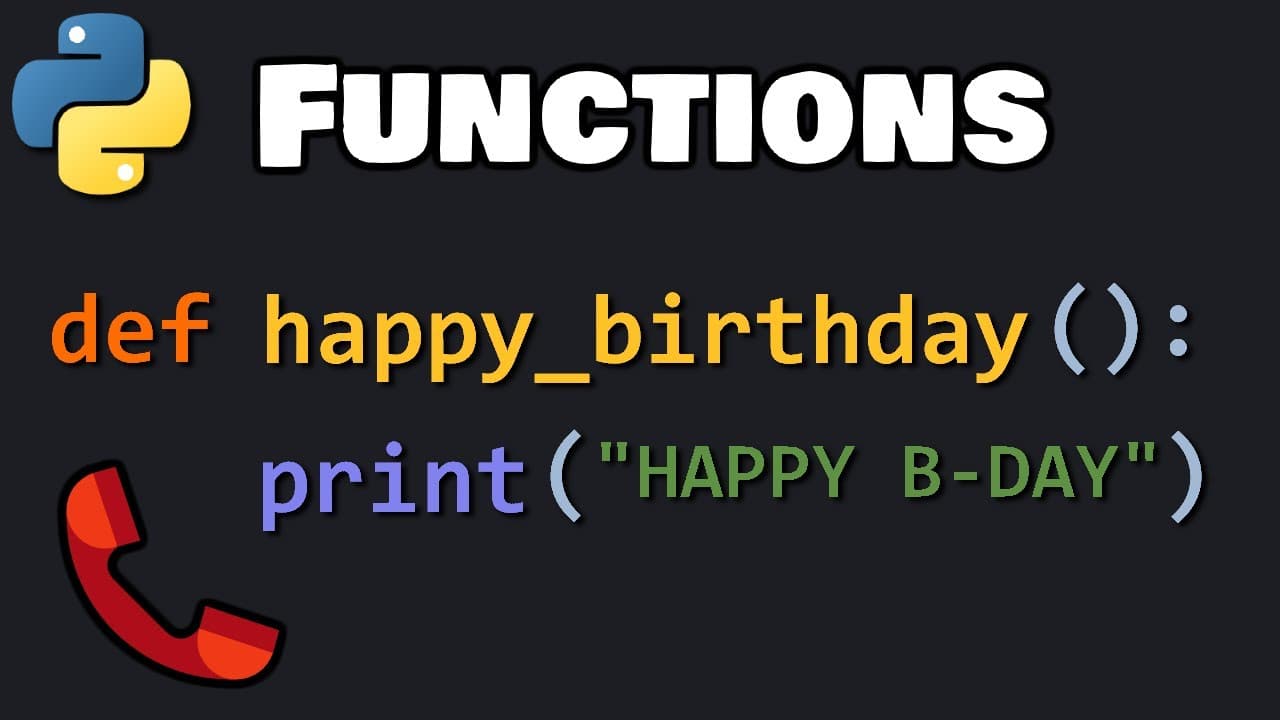
A function is a block of reusable code that you define with def, a unique name, a set of parentheses, a colon, and indented code underneath. You invoke it by typing the function name followed by parentheses. Data sent in parentheses are arguments, which need a matching set of parameters in the same order, and return sends a result back to the caller.
Transcript
hey everybody today I need to explain functions think of a function as a block of reusable code to invoke a function you place a set of parentheses after the function name to invoke it here's a scenario I need to sing Happy Birthday three times I know it's a weird example but it makes a lot of sense just trust me on this if I need to sing Happy Bir... Read More
Key Insights
- A function is a block of reusable code that you invoke by typing the function name followed by a set of parentheses. The narrator compares the parentheses to a pair of telephones talking to each other: you call a function to invoke it.
- Defining a function requires four parts: the keyword
def, a unique function name, a set of parentheses, and a colon. Any code that belongs to the function must be indented underneath the definition line. - Functions replace both code duplication and loops for repeated work. Singing Happy Birthday three times could be done by copying the verse or placing it in a loop, but writing it once inside a function and calling it three times avoids repeating code.
- Arguments are any data you send to a function by placing it inside the parentheses at the call site. You can pass either literal values or variables, such as sending a first name to a
happy_birthdayfunction. - A parameter is like a temporary variable used within a function. Adding a
nameparameter lets the function body use an f-string placeholder so the greeting prints 'happy birthday to bro' instead of a hardcoded 'you'. - The number of arguments must match the number of parameters. Passing a name and an age to a function defined with only one parameter raises an error until a second parameter, age, is added to the definition.
- The position of parameters and arguments matters. Swapping the order to age then name while still passing name first produces 'happy birthday to 20, you are bro years old', showing values bind by position rather than by meaning.
- The
returnstatement ends a function and sends a result back to the caller. After a function resolves, the call itself becomes whatever was returned, soadd(1, 2)becomes 3 and can be assigned to a variable such as z and printed.
Install to Summarize YouTube Videos and Get Transcripts
Explore YouTube Video Summarizer or Get YouTube Transcript Extractor
Questions & Answers
Q: How to define a function in Python
To define a function you type the keyword def, then a unique function name, then a set of parentheses, then a colon. Any code that belongs to the function is indented underneath that definition line. For example, defining a happy birthday function means writing def followed by the name happy_birthday, parentheses, a colon, and then the indented print statements that make up the song verse. Once defined, the code inside does not run until you invoke the function.
Q: How do you call or invoke a function in Python?
To invoke a function you type the function's name and then add a set of parentheses after it. That is all it takes. Each time you invoke the function, the code inside it executes once, so calling happy_birthday three times executes the song verse three times. The narrator suggests thinking of the parentheses as a pair of telephones talking to each other: you call a function to invoke it, essentially telling it to execute its code.
Q: What is the difference between arguments and parameters in Python?
Arguments are the data you send to a function, placed within the set of parentheses at the point where you invoke it. You can send values or variables directly. Parameters are the matching names listed in the function definition, and a parameter acts kind of like a temporary variable used within the function. Every argument you pass needs a matching parameter to receive it, and the two sets must line up in both count and order.
Q: Why does Python throw an error when I pass two arguments to a function?
The error happens when you pass more arguments than the function has parameters. In the video, the happy birthday function was set up to take only one parameter, name, but the call sent both a name and an age. That mismatch produces an error. The fix is to add a matching parameter to the function definition, so the function accepts two parameters, name and age, matching the two arguments being sent in.
Q: Does the order of parameters matter in a Python function?
Yes, the position of parameters does matter, and the same goes for the arguments. When the parameters were switched from name and age to age and name while the call still passed the name first, the output became 'happy birthday to 20, you are bro years old' instead of the intended greeting. Values bind to parameters by position, not by meaning, so swapping the order swaps which value each parameter receives.
Q: What does the return statement do in a Python function?
Return is a statement used to end a function and send a result back to the caller. In the example, an add function takes parameters x and y, sets z equal to x plus y, and then returns z rather than printing it. The returned value can then be assigned to a variable and printed. A useful way to picture it is that after the function finishes, the function call itself becomes whatever was returned, so add(1, 2) becomes 3.
Q: How do you write a function that returns a formatted full name?
The create_name function takes two parameters, first and last. Inside the function, first is reassigned to first.capitalize() and last is reassigned to last.capitalize(), then the function returns first plus a space plus last. Calling it with lowercase arguments such as 'spongebob' and 'squarepants' returns the single concatenated string with both names capitalized, which can be stored in a full_name variable and printed.
Q: How do you format a currency amount inside an f-string in Python?
In the display_invoice example, the amount placeholder inside the f-string is preceded by the unit of currency, a dollar sign, and given the format specifier .2f, written as ${amount:.2f}. That specifier displays the number with two decimal places. Calling display_invoice with the username BroCode, the amount 42.50, and a due date prints 'Hello BroCode' followed by 'Your bill of $42.50 is due:' and the due date.
Summary & Key Takeaways
-
A function is a block of reusable code. Without one, repeating a Happy Birthday verse three times means either copying the code three times or wrapping it in a loop. Defining a
happy_birthdayfunction lets you write the verse once and then call it three times by name. -
Arguments are the data you place inside the parentheses when invoking a function, and parameters are the matching temporary variables inside the function definition. The count must match: passing two arguments to a one-parameter function produces an error, and the order of parameters determines which value lands where.
-
The
returnstatement ends a function and sends a result back to the caller. Functions like add, subtract, multiply, and divide computezfrom parametersxandyand return it, so the invoked function effectively becomes the returned value, which can be assigned to a variable and printed.
Read in Other Languages (beta)
Share This Summary 📚
Summarize YouTube Videos and Get Video Transcripts with 1-Click
Try YouTube Summary with ChatGPT & Claude or YouTube Transcript Generator
Explore More Summaries from Bro Code 📚

Summarize YouTube Videos and Get Video Transcripts with 1-Click
Try YouTube Summary with ChatGPT & Claude or YouTube Transcript Generator