What Is Reasoning Distillation in AI Training?
TL;DR
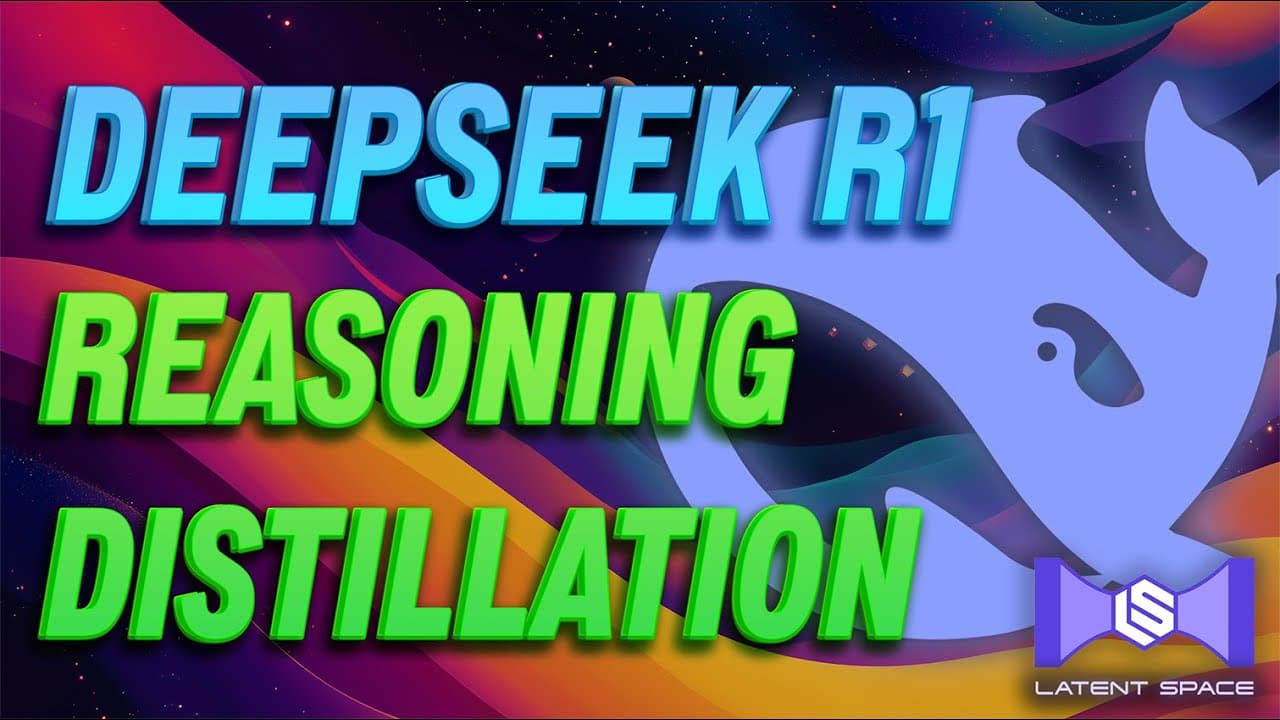
Reasoning distillation uses a large teacher model to generate data and guidance, then a smaller model is trained on that data to achieve strong reasoning. Bespoke Labs achieved a 48 hour sprint from data setup to public release, using Curator to prepare data in minutes and verify it before training. The result beats several baselines and approaches a known Distill model in performance.
Transcript
hey everyone welcome to the laden space podcast this is cesio partner and CTO deible and enjoy my SX founder of smalli hello and this is another one of our like really short sort of news-based episodes that we're trying out to do and it's with mahesan Team from bespoke Labs welcome thank you yeah thank you maybe we'll go one by one and identify voi... Read More
Key Insights
- Distillation starts with a large teacher model generating data and guidance for a smaller student model.
- The team used Curator to accelerate data curation, reducing setup time to minutes and data readiness to about 1.5 hours.
- Reasoning traces from the teacher model are central to the data and training, enabling longer, more detailed responses in the student model.
- Open source reasoning traces have been historically scarce, but DeepSeek R1 provides them to support distillation workflows.
- The 48 hour sprint included data verification, model training, and a public announcement, illustrating rapid execution in AI development.
- The approach integrates both data quality and model tuning to achieve performance gains near strong baselines.
- The discussion contrasts traditional search driven reasoning with emergent reasoning through training on reasoning traces.
- The narrative reflects excitement about the discovery that training can induce effective search behavior without explicit search algorithms.
Install to Summarize YouTube Videos and Get Transcripts
Explore YouTube Video Summarizer or Get YouTube Transcript Extractor
Questions & Answers
Q: What is reasoning distillation and how does it differ from standard model fine tuning?
Reasoning distillation is where a large teacher model generates data and reasoning traces that are then used to train a smaller student model. Unlike standard fine tuning which trains on direct input-output pairs, distillation leverages the teacher s internal reasoning patterns and synthetic data to guide the student toward more capable, chain of thought based responses. This can produce longer, structured answers and improved problem solving, especially in math and code tasks.
Q: How did Bespoke Labs accelerate the distillation process to 48 hours?
Bespoke Labs accelerated the process by using Curator to quickly prepare data and then performing rapid data verification followed by a training run the same night. Within about 1.5 hours the data was ready, enabling the team to start training and testing quickly. The sprint culminated in a public announcement the following morning, illustrating a fast, iterative development cycle.
Q: What role did data curators and synthetic annotators play in this project?
Synthetic annotators, powered by an advanced teacher model, produced the training data that the student model learned from. The annotator quality directly influenced the usefulness of the synthetic data for fine tuning. Curator served as the toolchain to manage, verify, and assemble this data efficiently, enabling rapid experimentation and iteration during the sprint.
Q: What are reasoning traces and why are they valuable in distillation?
Reasoning traces are the step by step thoughts or intermediate conclusions produced by a model during problem solving. They are valuable because they reveal the model s reasoning process, which can be used to train a student to emulate that reasoning. In distillation, using reasoning traces helps the student develop the ability to perform long, structured reasoning similarly to the teacher, improving performance on complex tasks like math and code.
Q: How did the team compare their model to Sky T1 and o1-preview?
The team evaluated their Distill model against Sky T1 and o1-preview on reasoning benchmarks, particularly in math and code, and found that their model outperformed Sky T1 and approached the performance of DeepSeek R1 Distill Qwen 32B while using far fewer examples. This showed the value of reasoning distillation in achieving strong benchmarks.
Q: Why is the open source availability of reasoning traces a point of discussion here?
Open source reasoning traces are discussed because they enable researchers to understand and replicate the reasoning process behind model outputs. The speakers note that OpenAI does not provide these traces, which makes it harder for others to study and reproduce reasoning-based improvements. Access to traces in R1 and related work allows the community to explore and improve distillation techniques.
Q: What is the general takeaway about emergent properties from the sprint, according to the speakers?
The speakers emphasized that learning can enable emergent properties like effective search behavior in models without explicit search algorithms. By training on reasoning outcomes and traces, the model can learn to explore and backtrack internally, producing creative and robust problem solving. This challenges assumptions about the need for complex external search mechanisms.
Q: What challenges or caveats are mentioned regarding distillation versus traditional methods?
The discussion acknowledges that while distillation can yield strong results, there are debates about the exact role of planning methods such as MCTS or prm in reasoning. The conversations suggest that in some cases the model learns to search internally, but there is ongoing discussion about how much the teacher’s logs and structure influence the student s capabilities, and how that translates across tasks.
Summary & Key Takeaways
-
Bespoke Labs used Curator to rapidly prepare and verify data for distillation, enabling a quick sprint from setup to release. The team highlighted the importance of synthetic annotator quality and reasoning traces in data creation.
-
The project compared against Sky T1 and o1-preview benchmarks, showing strong reasoning and math/code performance, driven by Distill data and open model insights.
-
The narrative emphasizes that reasoning distillation can leverage existing teacher models to improve student models with minimal data and fast iteration, highlighting practical workflow choices and outcomes.
Read in Other Languages (beta)
Share This Summary 📚
Summarize YouTube Videos and Get Video Transcripts with 1-Click
Try YouTube Summary with ChatGPT & Claude or YouTube Transcript Generator
Explore More Summaries from Latent Space 📚

Summarize YouTube Videos and Get Video Transcripts with 1-Click
Try YouTube Summary with ChatGPT & Claude or YouTube Transcript Generator