Why Is Utah's Great Salt Lake Disappearing?
TL;DR
Utah's Great Salt Lake is shrinking because growing human water demands divert its river inflows while rising temperatures increase evaporation. Recent record snowfall produced a modest recovery, but lasting protection requires major human intervention to restore the lake's water supply and prevent toxic dust, ecological collapse, and extensive economic damage.
Transcript
In early January of 2023, a group of researchers from Brigham Y Young University in Utah published a report with an ominous warning. If nothing was done soon, they cautioned. The Great Salt Lake, the largest sailing lake in the Western Hemisphere directly adjacent to Salt Lake City, was on track to completely disappear within only the next 5 years ... Read More
Key Insights
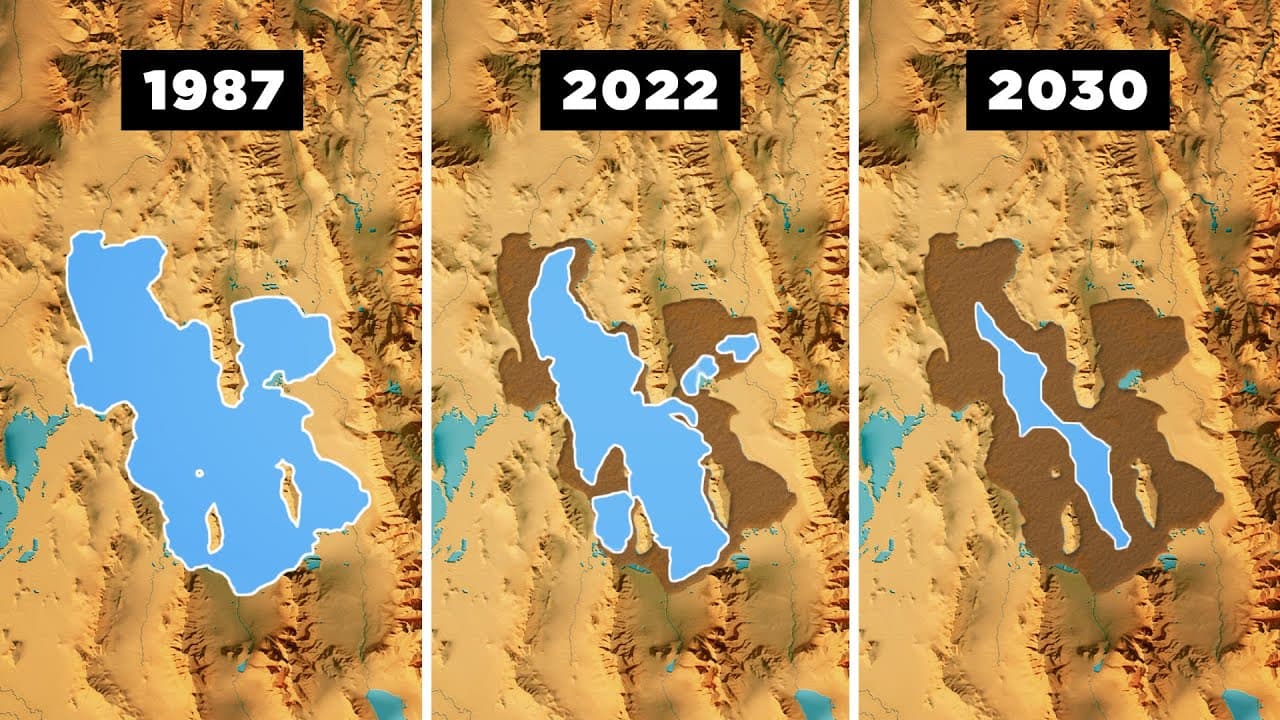
- The Great Salt Lake declined from roughly 3,300 square miles at its 1987 historical high to about 950 square miles in early 2023, a reduction exceeding 71% that exposed a dry lake bed larger than the island of Maui.
- The lake's modest recent recovery resulted from record snowfall over the two winters following the early 2023 warning, but scientists still consider its long-term decline highly likely without massive human intervention to change regional water use.
- The Great Salt Lake is a terminal saline lake with no natural outlet, so evaporation removes water while leaving minerals behind. Its historical balance depended on spring snowmelt replacing approximately two feet of water lost during the warm summer season.
- The Bear, Weber, and Jordan rivers provide virtually all of the Great Salt Lake's water, with their flows originating from winter snow in the Wasatch Mountains and increasing during spring as accumulated mountain snow melts.
- The lake's decline is driven by two major pressures: rapid population growth has increased water demands across the Wasatch Front, while climate change has raised temperatures and pushed evaporation beyond historical norms.
- The Wasatch Front grew from around 500,000 residents in 1950 to more than 2.8 million in 2025, placing far greater demands on the fragile hydrological system that supports both its cities and the Great Salt Lake.
- The exposed lake bed creates a public health risk because arsenic-laced toxic dust could blow into Salt Lake City and beyond Utah into Nevada, Idaho, Wyoming, Colorado, and Arizona if the lake continues disappearing.
- The lake supports one of North America's most important ecosystems for millions of migrating birds, while its collapse could also damage Utah's real estate, ski, tourism, and mining industries and create risks for the global food industry.
Install to Summarize YouTube Videos and Get Transcripts
Explore YouTube Video Summarizer or Get YouTube Transcript Extractor
Questions & Answers
Q: Why is the Great Salt Lake shrinking?
The Great Salt Lake is shrinking because people divert water from the Bear, Weber, and Jordan rivers before it reaches the lake, while climate change raises temperatures and increases evaporation. Dams, canals, and pipelines built along these rivers supply agriculture, industries, and growing cities. This combination disrupts the fragile historical balance in which spring snowmelt replaced water lost during summer.
Q: How much has the Great Salt Lake declined since 1987?
The Great Salt Lake covered roughly 3,300 square miles when it reached its historical high in 1987. By early 2023, its remaining surface area had fallen to about 950 square miles. That represents a decline of more than 71% and left an exposed lake bed larger than Maui, demonstrating the scale and persistence of the lake's contraction.
Q: Could the Great Salt Lake completely disappear?
Researchers from Brigham Young University warned in early 2023 that the lake could disappear by 2028 if no action were taken. Record snowfall during the following two winters brought a modest recovery, making that original timeline less certain. Scientists nevertheless warn that complete disappearance remains possible within a lifetime unless major human intervention reverses the lake's long-term decline.
Q: What would happen if the Great Salt Lake dried up?
A dry Great Salt Lake could expose arsenic-laced lake bed material that winds would carry as toxic dust across Utah and into surrounding states. Its disappearance could make Salt Lake City and other parts of Utah increasingly uninhabitable, collapse habitat used by millions of migrating birds, damage several major Utah industries, and create risks for the global food industry.
Q: How does snowmelt sustain the Great Salt Lake?
Heavy winter snowfall accumulates in the Wasatch Mountains east of the populated oasis. During spring, melting snow feeds the Bear, Weber, and Jordan rivers, which provide virtually all the water entering the Great Salt Lake. Historically, this inflow replaced about two feet of lake water lost through summer evaporation, maintaining a fragile balance between replenishment and natural water loss.
Q: Why is the Great Salt Lake saltier than the ocean?
The Great Salt Lake is a terminal endorheic lake, meaning it has no natural outlet through which water and dissolved minerals can flow away. Rivers carry minerals from the mountains into the lake, but water leaves naturally only through evaporation. Evaporation removes the water while leaving those minerals behind, causing them to accumulate and making the lake saltier than the ocean.
Q: How has population growth affected the Great Salt Lake?
Population growth has sharply increased demand for the same regional water system that feeds the lake. The Wasatch Front expanded from around 500,000 residents in 1950 to more than 2.8 million in 2025. Water diverted for municipalities, agriculture, and industry consequently reduces river inflows, depriving the Great Salt Lake of the spring replenishment required to offset evaporation.
Q: Why is the Great Salt Lake important to Utah?
The Great Salt Lake helps sustain a large oasis of life and urban settlement within the deserts of western North America. Its ecosystem supports millions of migrating birds, while its continued existence is connected to Utah's real estate, ski, tourism, and mining industries. Its disappearance would therefore combine ecological destruction, economic losses, toxic dust exposure, and declining regional habitability.
Summary & Key Takeaways
-
The Great Salt Lake lost more than 71% of its surface area between its 1987 historical high and early 2023. Record snowfall during the next two winters produced a modest recovery, but scientists still expect long-term decline without major intervention because Utah continues consuming excessive water while the climate warms.
-
The lake depends almost entirely on the Bear, Weber, and Jordan rivers, which receive melting snow from the Wasatch Mountains. Dams, canals, and pipelines increasingly divert these flows toward agriculture, industry, and growing cities, preventing the terminal lake from replacing water that it continually loses through natural evaporation.
-
Complete collapse could expose arsenic-laced lake bed dust, threaten human habitability across the Wasatch Front, damage tourism, skiing, mining, and real estate, and destroy habitat supporting millions of migrating birds. The transcript presents restoring sufficient river inflows as essential to preventing a major environmental and economic disaster.
Read in Other Languages (beta)
Share This Summary 📚
Summarize YouTube Videos and Get Video Transcripts with 1-Click
Try YouTube Summary with ChatGPT & Claude or YouTube Transcript Generator
Explore More Summaries from RealLifeLore 📚

Summarize YouTube Videos and Get Video Transcripts with 1-Click
Try YouTube Summary with ChatGPT & Claude or YouTube Transcript Generator