How Do Bitwise AND, OR, and NOT Work in C?
TL;DR
Bitwise operators manipulate individual bits, while logical operators evaluate whether entire values are true or false. Bitwise AND produces 1 only when both corresponding bits are 1, bitwise OR produces 0 only when both bits are 0, and bitwise NOT complements every bit. Consequently, 1 & 2 evaluates to 0, whereas 1 && 2 evaluates to true because both values are nonzero.
Transcript
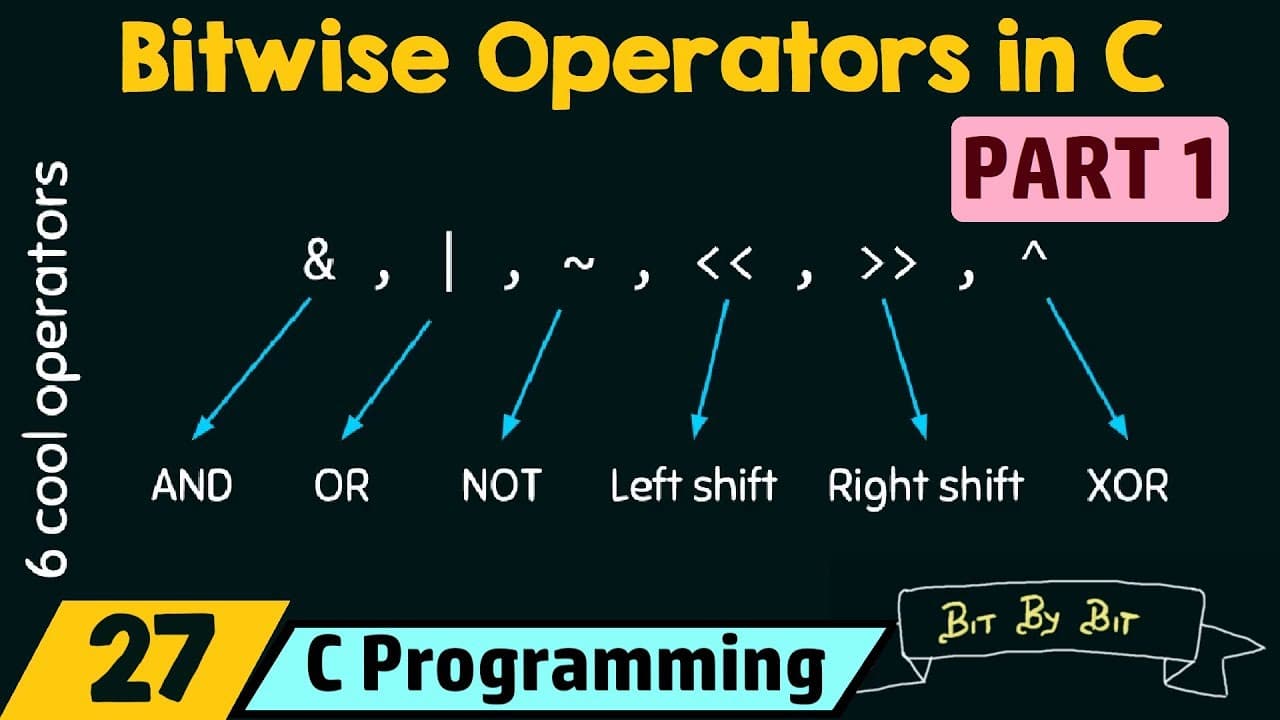
In this lecture we are going to talk about Bitwise operators in C. This is Part-1 of the Bitwise operators. What is the outline of this lecture? Here we are going to introduce the concept of bitwise operators. What are Bitwise operators. Then we are going to talk about Bitwise OR, AND and NOT operators. Then we will have a discussion about the diff... Read More
Key Insights
- Bitwise operators manipulate numbers one bit at a time. The operators introduced are bitwise AND, bitwise OR, bitwise NOT, left shift, right shift, and XOR, although the lecture's detailed examples focus on the first three operators.
- Bitwise AND is a binary operator that requires two operands. It compares each pair of corresponding bits and produces a result bit of 1 only when both input bits are 1; every other bit combination produces 0.
- The expression 7 & 4 produces 4 in the lecture's example. Comparing 0111 with 0100 bit by bit gives 0100 because only the bit position containing 1 in both operands remains set in the result.
- Bitwise OR is a binary operator that compares corresponding bits from two numbers. Its result is 0 only when both input bits are 0; if either or both corresponding bits are 1, the resulting bit is 1.
- The bitwise OR of 7 and 4 produces 7 in the demonstrated calculation. Applying OR to 0111 and 0100 gives 0111, which is equivalent to 7 in decimal according to the lecture.
- Bitwise NOT is a unary operator that requires one operand. It complements every bit individually, converting each 1 to 0 and each 0 to 1. The lecture illustrates this transformation by changing 0111 into 1000.
- Bitwise operators and logical operators evaluate values differently. A bitwise operation processes corresponding bits, whereas a logical operation interprets a nonzero value as true and evaluates the truth of the operands rather than comparing their individual bits.
- The expressions 1 & 2 and 1 && 2 produce different conditional results. The bitwise expression compares 0000 0001 with 0000 0010 and yields 0, while the logical expression treats both nonzero operands as true and yields true, represented as 1.
Install to Summarize YouTube Videos and Get Transcripts
Explore YouTube Video Summarizer or Get YouTube Transcript Extractor
Questions & Answers
Q: What are bitwise operators in C?
Bitwise operators in C perform manipulation one bit at a time. The lecture identifies six types: bitwise AND, bitwise OR, bitwise NOT, left shift, right shift, and XOR. AND and OR compare corresponding bits from two operands, while NOT complements the bits of one operand. The lecture focuses on these three operations and contrasts bitwise processing with logical evaluation.
Q: How does the bitwise AND operator work in C?
The bitwise AND operator is a binary operator, so it requires two operands. It compares corresponding bits from the two numbers and places 1 in a result position only when both input bits at that position are 1. All other combinations produce 0. For example, AND applied to 0111 and 0100 produces 0100, making 7 & 4 equal to 4.
Q: How does the bitwise OR operator work in C?
The bitwise OR operator is a binary operator that compares two numbers bit by bit. A result bit is 0 only when both corresponding input bits are 0. Every other combination produces 1. In the lecture's example, applying bitwise OR to 0111 and 0100 produces 0111, so the bitwise OR of decimal 7 and decimal 4 equals 7.
Q: How does the bitwise NOT operator work in C?
The bitwise NOT operator is unary, meaning that it requires only one operand. It complements each bit of that operand individually: every 1 becomes 0, and every 0 becomes 1. The lecture demonstrates the operation using 0111, whose bits become 1000 after complementation. It then identifies 1000 as decimal 8 for the presented example.
Q: What is the difference between bitwise AND and logical AND?
Bitwise AND compares corresponding bits within two operands and produces a new bit pattern. Logical AND instead treats each complete operand as either true or false, with any nonzero value treated as true. Therefore, bitwise AND applied to 1 and 2 yields 0, but logical AND applied to those same values yields true because both operands are nonzero.
Q: Why does 1 & 2 evaluate to 0 in C?
The bitwise expression 1 & 2 evaluates to 0 because the corresponding 1 bits do not occupy the same positions. The lecture represents 1 as 0000 0001 and 2 as 0000 0010. Comparing these patterns with AND produces 0000 0000, since no position contains 1 in both operands. In an if condition, that zero result is treated as false.
Q: Why does 1 && 2 evaluate to true in C?
The logical expression 1 && 2 evaluates to true because logical AND considers the truth value of each complete operand. The lecture states that any value other than 0 is treated as true. Since both 1 and 2 are nonzero, the expression becomes true AND true, which is true and is represented by the result 1 in the example.
Q: Which bitwise operators are introduced in the lecture?
The lecture introduces six bitwise operators available in C: bitwise AND, bitwise OR, bitwise NOT, left shift, right shift, and bitwise XOR. It then explains AND, OR, and NOT through truth rules and binary examples. Left shift, right shift, and XOR appear in the introductory list, but their detailed operation is not covered in this part of the lecture.
Summary & Key Takeaways
-
C provides bitwise AND, OR, NOT, left shift, right shift, and XOR operators for manipulating values bit by bit. AND, OR, and XOR operate on two operands, while NOT operates on one operand. The lecture concentrates on AND, OR, and NOT before comparing bitwise evaluation with logical evaluation in conditional expressions.
-
Bitwise AND compares corresponding bits and produces 1 only when both bits are 1. With 7 represented as 0111 and 4 represented as 0100, the operation produces 0100, which equals 4. Bitwise OR produces 0 only when both corresponding bits are 0, so 7 OR 4 produces 0111, or 7.
-
Bitwise NOT complements every bit in its single operand, changing each 1 to 0 and each 0 to 1. The lecture illustrates this by complementing 0111 to obtain 1000. Bitwise and logical operators differ because bitwise operators process corresponding bits, while logical operators treat any nonzero value as true.
Read in Other Languages (beta)
Share This Summary 📚
Summarize YouTube Videos and Get Video Transcripts with 1-Click
Try YouTube Summary with ChatGPT & Claude or YouTube Transcript Generator
Explore More Summaries from Neso Academy 📚





Summarize YouTube Videos and Get Video Transcripts with 1-Click
Try YouTube Summary with ChatGPT & Claude or YouTube Transcript Generator