What makes diffusion turn prompts into videos?
TL;DR
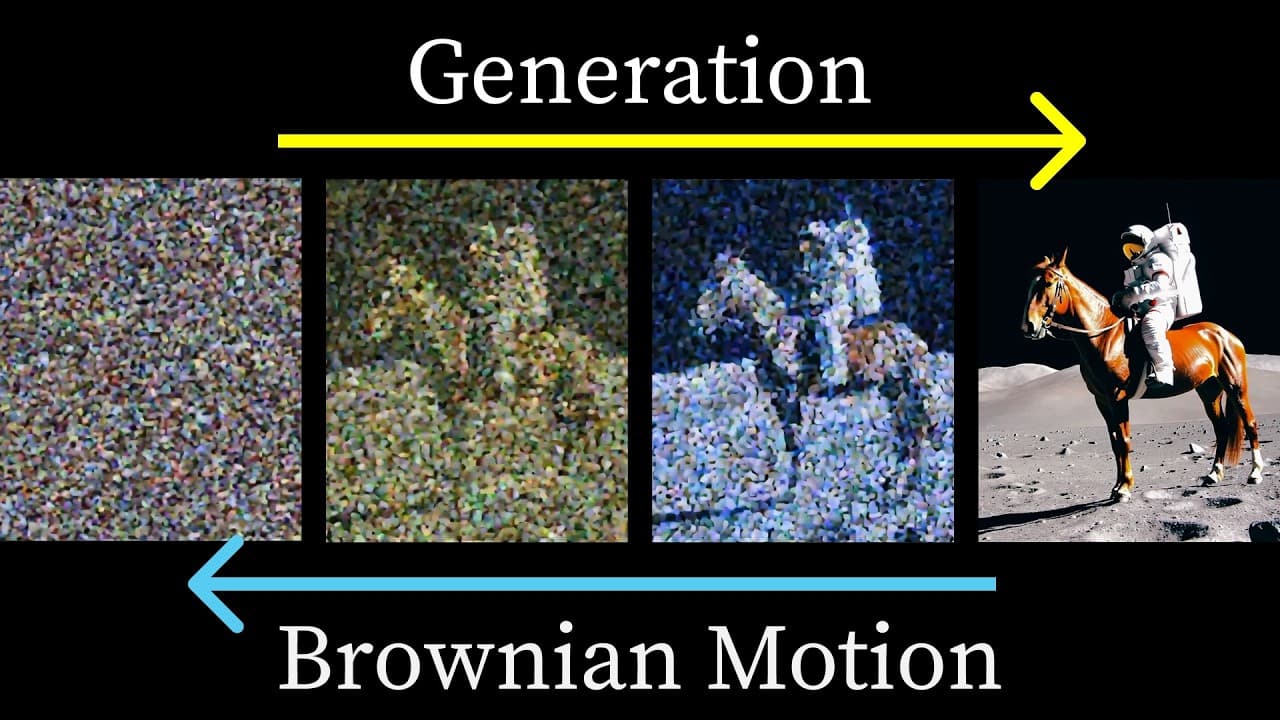
Diffusion models learn to remove noise from images and videos, transforming random noise into structured outputs guided by prompts. CLIP creates a shared space between text and visuals, enabling conditioning and steering of generation. The video also explains sampling methods, diffusion iterations, and real open source examples like WAN 2.1.
Transcript
Over the last few years, AI systems have become astonishingly good at turning text props into videos. At the core of how these models operate is a deep connection to physics. This generation of image and video models works using a process known as diffusion, which is remarkably equivalent to the Brownian motion we see as particles diffuse, but with... Read More
Key Insights
- Diffusion models operate by reversing noise in a high dimensional space to generate content.
- CLIP is a contrastive learning framework that aligns image and text embeddings in a shared space.
- Diffusion sampling introduces random noise at each generation step, which surprisingly improves output quality.
- The embedding space allows arithmetic on concepts, enabling operations like adding or subtracting features.
- DDPM sampling is a practical approach that yields sharper results than naive one-step reversal.
- Conditioning guides diffusion outputs toward prompts by aligning text and visual representations.
- Negative prompts influence generation by steering away from unwanted features during guidance.
- The combination of CLIP and diffusion models enables flexible control over video generation.
Install to Summarize YouTube Videos and Get Transcripts
Explore YouTube Video Summarizer or Get YouTube Transcript Extractor
Questions & Answers
Q: How do diffusion models generate video from a random start
Diffusion models begin with random noise and use a neural network to predict less noisy versions of the input at each step. This predicted image is then combined with added noise before the next step, and the process repeats for many iterations, gradually revealing a coherent video that matches the prompt.
Q: What role does CLIP play in diffusion based generation
CLIP creates a shared embedding space for text and images by training a language model and a vision model to produce similar vector representations for related pairs. This space allows the generation process to be guided by textual prompts, aligning them with visual outputs through cosine similarity.
Q: Why is random noise added during generation
Adding random noise at each generation step helps diversify the intermediate outputs and stabilizes the learning process. This practice, part of the DDPM sampling approach, leads to higher quality images by preventing the model from collapsing into blurry or repetitive structures.
Q: What is meant by a shared embedding space in CLIP
A shared embedding space is where image and text representations live in the same high dimensional vector space. Similar content generates similar vectors, enabling the model to compute cosine similarity between text and image vectors and judge how well they match, which is essential for conditioning generation on language.
Q: How does conditioning influence diffusion outputs
Conditioning uses the alignment between text prompts and visual representations in the embedding space to steer the diffusion process. By guiding the model toward directions corresponding to the prompt, the generated video reflects the described content more accurately.
Q: What is DDPM sampling and why is it important
DDPM sampling refers to denoising diffusion probabilistic models where noise is gradually removed in a controlled way, with occasional added noise during generation. This technique is important because it yields sharper, more realistic outputs than simpler iterative methods.
Q: What are negative prompts used for in diffusion models
Negative prompts are used to steer the generation away from unwanted features by constraining the model during guidance. This helps improve fidelity to the desired content and reduces artifacts by telling the model what to avoid.
Q: Can you name an open source diffusion model mentioned
WAN 2.1 is an open source diffusion model cited in the video, used to demonstrate how prompts can affect a generated astronaut scene and other variations. The example illustrates practical, real world applications of diffusion in video generation.
Summary & Key Takeaways
-
Diffusion models start from noise and iteratively refine it to match a prompt, guided by learned representations from CLIP and related techniques.
-
The CLIP framework builds a shared embedding space for text and images, enabling matching and conditioning of generations through cosine similarity in high dimensional space.
-
Open source diffusion implementations, such as WAN 2.1, demonstrate how prompts influence video outputs and how sampling methods affect quality and structure.
Read in Other Languages (beta)
Share This Summary 📚
Summarize YouTube Videos and Get Video Transcripts with 1-Click
Try YouTube Summary with ChatGPT & Claude or YouTube Transcript Generator
Explore More Summaries from 3Blue1Brown 📚
Summarize YouTube Videos and Get Video Transcripts with 1-Click
Try YouTube Summary with ChatGPT & Claude or YouTube Transcript Generator