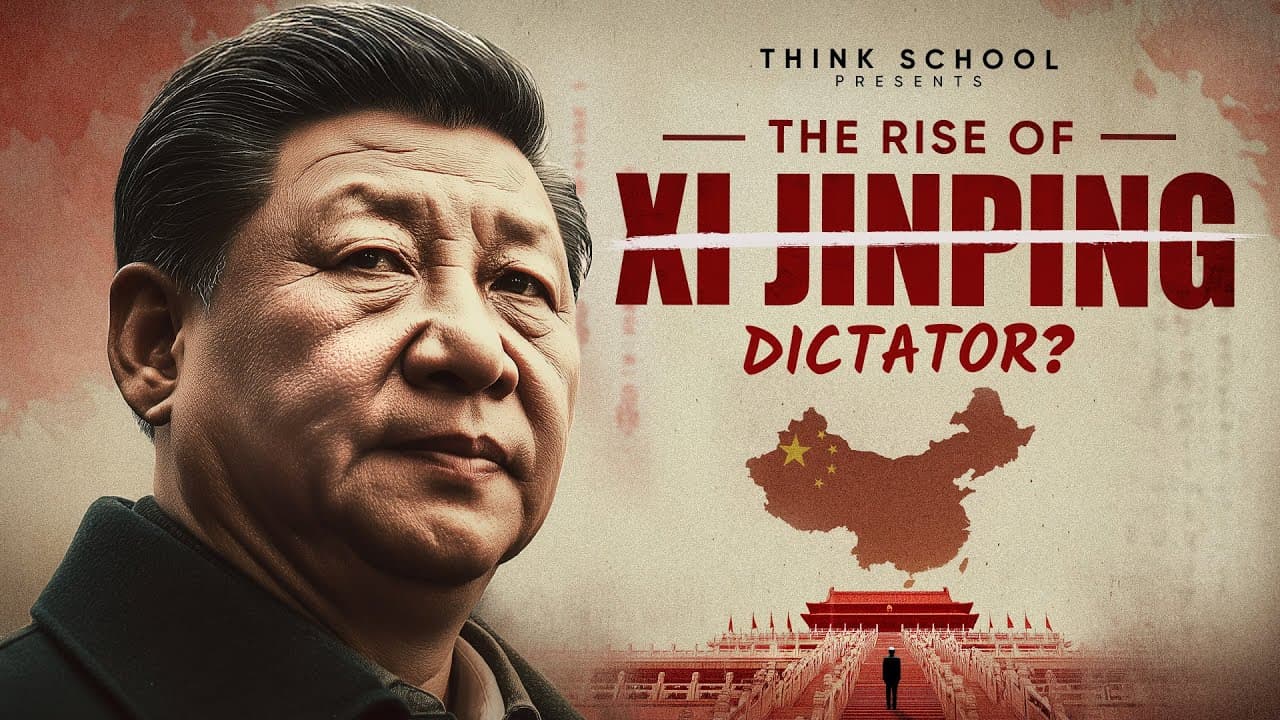
How did Xi Jinping rise to China's top leader?
TL;DR
Xi climbed through the Communist Party by embracing hardship and proving loyalty, turning rejection into information to reshape his path. He built grassroots power, leveraged education and elite networks, then moved from rural governance into central authority as Deng Xiaoping liberalized China. His strategy combined patience, persistence, and deep party integration.
Transcript
Chinese parliament formally elects Ping as the country's new president. Once in a decade change of guard at the top. What is handed over to Xi Jinping and Lee Koang is a country full of prompts. [Applause] The year was 1968 and globally it was a moment of revolution. Students marched in Paris. Martin Luther King Jr. had been assassinated. And while... Read More
Key Insights
- Xi is the son of a former revolutionary who faced political downfall but still sought a path back into the party through persistence and service.
- The key to Xi's ascent is mastering the Communist Party structure and learning that real power flows from inside the system, not from street-level rebellion.
- Rejection by the party becomes information for Xi, guiding him to adapt his strategy and gain acceptance through incremental alignment with party goals.
- Xi builds legitimacy by working in rural areas, gaining credibility with peasants and local officials alike, transforming hardship into political capital.
- Education at Singua University is used as a gateway to elite networks, enabling future alliances with future leaders and access to central power.
- Deng Xiaoping’s reforms create openings that Xi exploits, showing how shifts in national policy can alter an ambitious politician’s trajectory.
- Xi’s willingness to relocate from Beijing to a remote province signals a willingness to sacrifice prestige for practical governance and deeper understanding of national needs.
- The overall arc demonstrates that in China, real power often accrues through steady integration with the party and strategic placement at key governance nodes.
Install to Summarize YouTube Videos and Get Transcripts
Explore YouTube Video Summarizer or Get YouTube Transcript Extractor
Questions & Answers
Q: A real search query question about the video (e.g. 'How to...', 'What is...', 'Why does...', 'When should...'). Question 1
Xi Jinping rises through the Communist Party by turning personal setback into political information, using it to refine his strategy and prove his loyalty. His method includes enduring hardship in rural settings, rebuilding party connections, and leveraging elite education to access central networks. This process culminates in his leadership role after Deng Xiaoping era reforms create new opportunities.
Q: Question 2
The speaker describes how power in China is deeply linked to the party machinery rather than open rebellion. Xi understands that clout comes from inside the system, so he works within party structures, earns trust, and consolidates influence through grassroots support. This internal strategy differentiates him from rivals who chase Beijing power alone.
Q: Question 3
Early life adversity is framed as training for political survival. By surviving Mao era chaos and famine, Xi internalizes the importance of loyalty, patience, and strategic alignment with party goals. These experiences translate into a methodical, long horizon approach to rising within the party hierarchy.
Q: Question 4
Education serves as a bridge to power rather than a purely academic pursuit. By reentering Singua University, Xi reconnected with the political elite and cultivated networks that later facilitate access to central leadership circles. The move demonstrates the role of educational access in political ascent within the Chinese system.
Q: Question 5
The narrative highlights how Deng Xiaoping’s reforms opened space for Xi to ascend. By aligning with liberal economic shifts while maintaining party integrity, Xi positions himself to benefit from a changing national agenda. This demonstrates how leadership trajectories ride on national policy currents as well as personal strategy.
Q: Question 6
Xi’s decision to relocate from central power hubs to rural governance is presented as a calculated risk that yields political dividends. In a low-profile setting, he builds legitimacy through visible governance, solves local problems, and earns durable support from villagers and party members, thereby strengthening his long-term prospects.
Q: Question 7
The video portrays the rise as a masterclass in strategic patience. Rather than rushing to the top, Xi accrues power over time by accumulating experience, shaping perceptions, and forging key alliances, all while maintaining a clear focus on party objectives and long-term national goals.
Q: Question 8
Overall, the story argues that political success in China hinges on mastering the party’s internal dynamics. Xi’s ascent is depicted as a sequence of disciplined, calculated moves inside the system, leveraging both grassroots legitimacy and elite connections to reach the pinnacle of power.
Summary & Key Takeaways
-
Xi rises from exile to party leadership, using deliberate perseverance and ground-level governance to build legitimacy.
-
He leverages education and elite connections to reenter the power circle, while aligning with Deng Xiaoping era reforms.
-
The path combines internal party strategy, regional governance, and strategic positioning within the system to reach top leadership.
Read in Other Languages (beta)
Share This Summary 📚
Summarize YouTube Videos and Get Video Transcripts with 1-Click
Try YouTube Summary with ChatGPT & Claude or YouTube Transcript Generator
Explore More Summaries from Think School 📚






Summarize YouTube Videos and Get Video Transcripts with 1-Click
Try YouTube Summary with ChatGPT & Claude or YouTube Transcript Generator