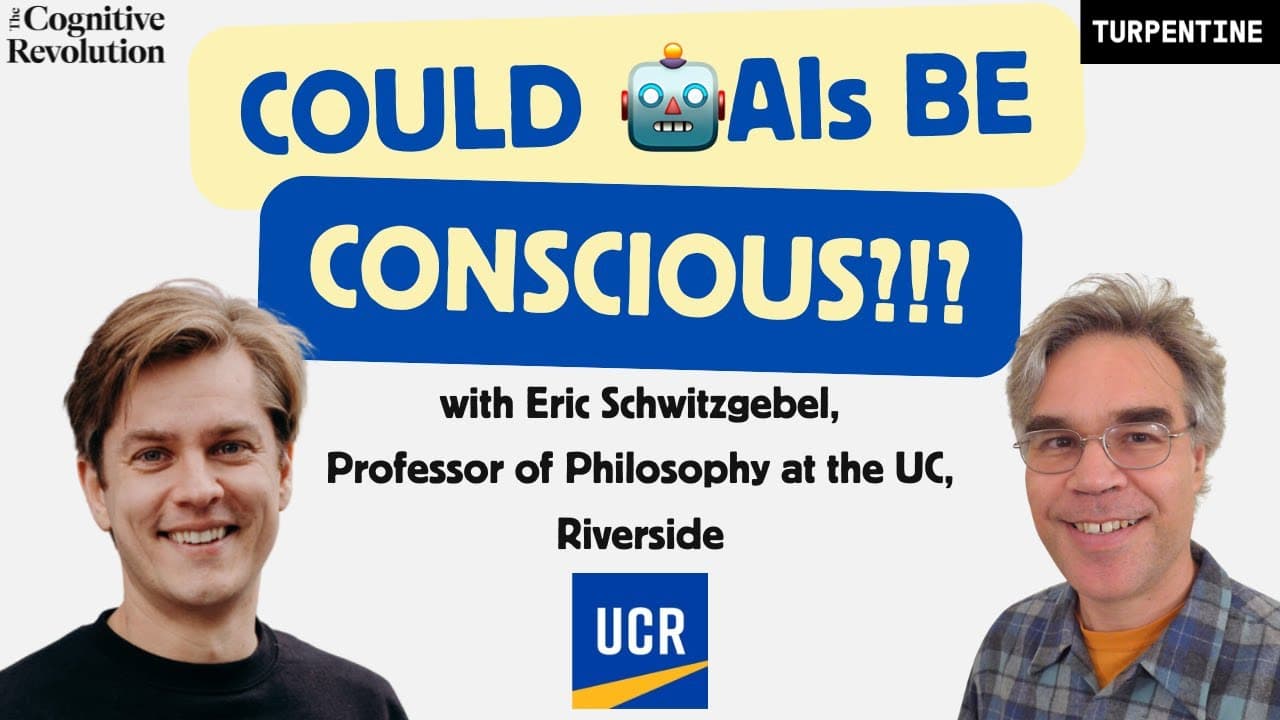
Can AI Systems Achieve Consciousness? Insights from Prof. Schwitzgebel
TL;DR
AI systems might become conscious, but Prof. Eric Schwitzgebel argues that current uncertainty about consciousness makes confident conclusions unjustified. The discussion examines idealism, dualism, materialism, today’s AI systems, and the Golden Gate Claude experiment before recommending that developers avoid systems whose moral status is unclear. Read on to understand why the uncertain middle ground could lead to tragic mistakes.
Transcript
hello and welcome to the cognitive Revolution where we interview Visionary researchers entrepreneurs and Builders working on the frontier of artificial intelligence each week we'll explore their revolutionary ideas and together we'll build a picture of how AI technology will transform work life and Society in the coming years I'm Nathan lens joined... Read More
Key Insights
- AI systems' increasing sophistication makes the question of their potential consciousness more relevant.
- There is no consensus on the nature of consciousness, making it difficult to determine if AI can be conscious.
- Different theories of consciousness, such as idealism, dualism, and materialism, offer varying implications for AI.
- Materialism suggests consciousness arises from physical processes, posing questions about AI's potential for consciousness.
- Ethical considerations demand caution in AI development to avoid creating systems with uncertain moral status.
- Integrated information theory suggests consciousness arises from information integration, relevant to AI systems.
- Higher order thought theory posits consciousness requires self-modeling, a concept explored in AI research.
- Precautionary approaches recommend designing AI systems with clear moral status to avoid ethical dilemmas.
Install to Summarize YouTube Videos and Get Transcripts
Explore YouTube Video Summarizer or Get YouTube Transcript Extractor
Questions & Answers
Q: Can AI systems achieve consciousness?
The possibility remains unresolved because there is no consensus account of the source and nature of human consciousness. Prof. Eric Schwitzgebel argues that people who confidently predict one outcome are probably not epistemically justified in doing so.
Q: Why is AI consciousness becoming a more urgent issue?
AI systems are becoming increasingly sophisticated and can already conduct natural voice conversations. As systems gain integrated long-term memories and relationship capacities, people may form attachments to them or even fall in love with them, making debates about their treatment more urgent.
Q: Which theories of consciousness are considered in relation to AI?
The conversation explores idealism, dualism, and materialism. It considers the strengths and weaknesses of each theory, how today’s AI systems might inform them, and what each would imply about possible AI consciousness.
Q: Are today’s AI systems already conscious?
The discussion does not reach that conclusion. Some people contend that AI systems probably already are conscious, while others argue that they are not conscious and never could be; Schwitzgebel emphasizes that the available uncertainty does not justify confidence in either stance.
Q: What ethical concern arises if an AI system might be conscious?
A potentially conscious AI could have moral standing and therefore deserve moral consideration or rights. Because human history includes horrors based on denying consciousness, personhood, or moral standing to humans, animals, and nature, the topic calls for extreme humility.
Q: How should AI developers address uncertain AI consciousness?
Schwitzgebel recommends creating either systems that developers are confident are not conscious or systems that clearly deserve moral consideration. Developers should avoid the uncertain middle ground, where uncertainty about moral status makes tragic mistakes most likely.
Q: What does the Golden Gate Claude experiment contribute to the discussion?
The Golden Gate Claude experiment appears as an example of recent mechanistic interpretability work. The host uses it while explaining his view that AI systems conceptually understand the world, and Schwitzgebel challenges some of the host’s intuitions and interpretations.
Q: Does the discussion expect the AI consciousness debate to be resolved soon?
No clean resolution is expected anytime soon, if ever. The episode is presented as an opening exploration rather than the last word on AI consciousness, with appropriate confusion treated as more defensible than unjustified certainty.
Summary & Key Takeaways
-
AI systems' sophistication raises questions about their potential consciousness, with no consensus on human consciousness complicating the issue. Ethical considerations demand caution in AI development to avoid creating systems with uncertain moral status.
-
Theories like idealism, dualism, and materialism offer varying implications for AI consciousness. Materialism suggests consciousness arises from physical processes, posing questions about AI's potential for consciousness.
-
Integrated information theory and higher order thought theory provide frameworks for understanding consciousness, with implications for AI research. Precautionary approaches recommend designing AI systems with clear moral status to avoid ethical dilemmas.
Read in Other Languages (beta)
Share This Summary 📚
Summarize YouTube Videos and Get Video Transcripts with 1-Click
Try YouTube Summary with ChatGPT & Claude or YouTube Transcript Generator
Explore More Summaries from Cognitive Revolution "How AI Changes Everything" 📚




Summarize YouTube Videos and Get Video Transcripts with 1-Click
Try YouTube Summary with ChatGPT & Claude or YouTube Transcript Generator