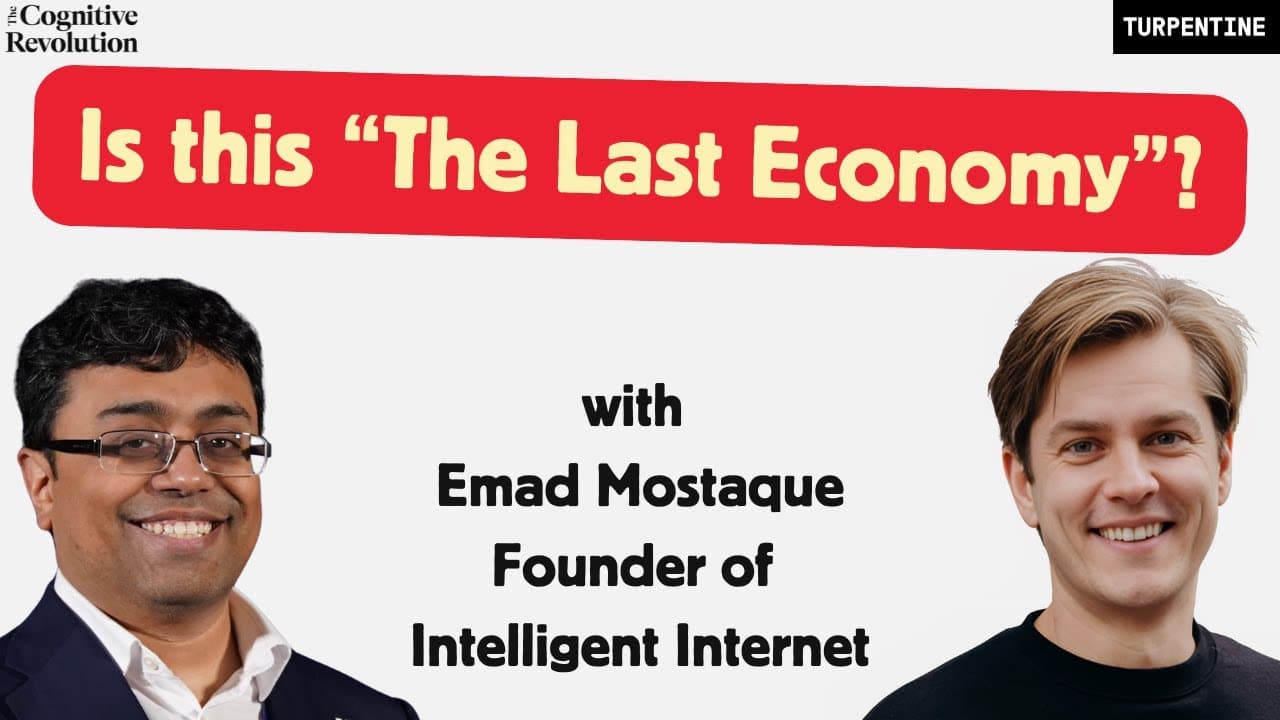
How Will AI Transform Our Economy in the Next 1000 Days?
TL;DR
AI is set to revolutionize the economy by replacing human labor with automation, potentially leading to significant job losses and economic inequality. Emad Mostaque proposes 'intelligence theory' as a framework to navigate these changes, focusing on creating abundance and ensuring a collectively-owned AI infrastructure benefits everyone, not just capital owners.
Transcript
Hello and welcome back to the cognitive revolution. Today my guest is Ahmad Mustach, famously the founder of stability AI and currently the founder of intelligent internet and author of the provocative new book, The Last Economy, a guide to the age of intelligent economics. Immad has long been one of my favorite thinkers in the AI space. Very few p... Read More
Key Insights
- AI is expected to significantly disrupt the economy by replacing human labor with AI-driven tasks.
- Emad Mostaque proposes 'intelligence theory' as a new economic framework to address AI's impact.
- Human society has historically been built on the premise of scarcity, but AI introduces a shift towards abundance.
- The abundance trap refers to the potential poverty for human workers as AI creates economic abundance.
- Mostaque suggests a dual currency system to differentiate between rivalrous and non-rivalrous goods.
- AI's impact could lead to digital feudalism, fragmentation, or symbiosis, depending on societal choices.
- Mostaque emphasizes the need for open-source AI to prevent monopolistic control by a few corporations.
- He proposes a new social contract and monetary system to ensure AI benefits are distributed equitably.
- More videos with Emad Mostaque:
Install to Summarize YouTube Videos and Get Transcripts
Explore YouTube Video Summarizer or Get YouTube Transcript Extractor
Questions & Answers
Q: How will AI impact the economy in the next 1000 days?
AI is expected to significantly disrupt the economy by replacing human labor with AI-driven tasks, leading to potential job displacement and economic inequality. Emad Mostaque argues that AI will create an abundance of intelligence, but if not managed properly, it could result in poverty for human workers as AI takes over various sectors, including healthcare and transportation.
Q: What is 'intelligence theory' in the context of AI?
Intelligence theory, proposed by Emad Mostaque, is a new economic framework designed to address the challenges posed by AI's impact on the economy. It focuses on abundance, network effects, and resilience, suggesting that traditional economic models based on scarcity need to be reimagined to accommodate the shift towards AI-driven abundance.
Q: What is the 'abundance trap' mentioned in the discussion?
The abundance trap refers to the paradox where AI creates economic abundance by providing cheaper and more efficient services, but also leads to potential poverty for human workers who are displaced by AI. This concept highlights the need for new economic models and policies to ensure that the benefits of AI are distributed equitably across society.
Q: How does Emad Mostaque propose to prevent digital feudalism?
Emad Mostaque suggests preventing digital feudalism by advocating for a collectively-owned AI infrastructure and open-source AI models. This approach aims to ensure that AI benefits are distributed equitably and not monopolized by a few corporations, aligning AI development with human flourishing and societal well-being.
Q: What are the potential futures shaped by AI according to Emad Mostaque?
Emad Mostaque outlines three potential futures shaped by AI: digital feudalism, where a few corporations control AI benefits; fragmentation, with AI development diverging across regions; and symbiosis, where AI is integrated into society to enhance human flourishing. He advocates for symbiosis, supported by open-source AI and a new social contract.
Q: What role does open-source AI play in Emad Mostaque's vision?
Open-source AI is crucial in Emad Mostaque's vision as it prevents monopolistic control by a few corporations and ensures transparency and collective ownership of AI infrastructure. By making AI models open-source, society can align AI development with human values and distribute AI benefits equitably, fostering innovation and collaboration.
Q: How does Emad Mostaque suggest reimagining the monetary system?
Emad Mostaque suggests reimagining the monetary system by introducing a dual currency system that differentiates between rivalrous and non-rivalrous goods. This approach aims to better reflect the value of intangible assets like intelligence and network effects, ensuring that the economic system aligns with the realities of an AI-driven world.
Q: What is the significance of the 'metabolic rift' in AI economics?
The metabolic rift highlights the disparity between AI's ability to create economic abundance without consuming resources like humans do. This concept underscores the need for new economic models that account for AI's unique characteristics, such as its lack of consumption needs, and address the resulting economic and social challenges.
Summary & Key Takeaways
-
Emad Mostaque discusses the transformative impact of AI on the economy, highlighting the potential for significant job displacement as AI-driven tasks replace human labor. He introduces 'intelligence theory,' a framework aimed at addressing these challenges by focusing on abundance, network effects, and resilience. Mostaque advocates for a collectively-owned AI infrastructure to ensure that AI benefits humanity rather than just capital owners.
-
The conversation explores the concept of the abundance trap, where AI creates economic abundance but also potential poverty for human workers. Mostaque suggests a dual currency system to differentiate between rivalrous and non-rivalrous goods and emphasizes the importance of open-source AI to prevent monopolistic control by a few corporations.
-
Mostaque outlines three potential futures shaped by AI: digital feudalism, fragmentation, or symbiosis. He advocates for a new social contract and monetary system to ensure AI benefits are equitably distributed, aligning AI development with human flourishing and preventing the emergence of digital feudalism.
Read in Other Languages (beta)
Share This Summary 📚
Summarize YouTube Videos and Get Video Transcripts with 1-Click
Try YouTube Summary with ChatGPT & Claude or YouTube Transcript Generator
Explore More Summaries from Cognitive Revolution "How AI Changes Everything" 📚



Summarize YouTube Videos and Get Video Transcripts with 1-Click
Try YouTube Summary with ChatGPT & Claude or YouTube Transcript Generator