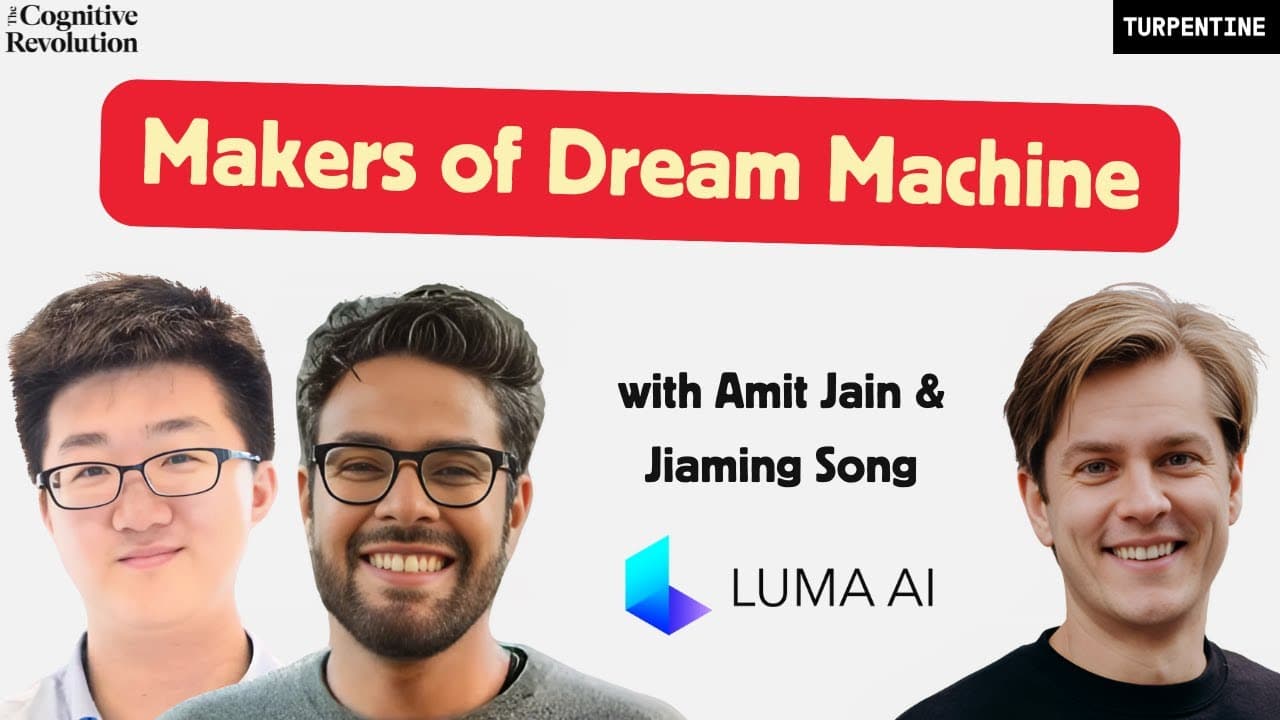
How Is Luma Labs Advancing Dream Machine and Ray 2? Amit Jain and Jiaming Song on The Cognitive Revolution
TL;DR
Luma Labs advances AI video generation through careful dataset curation, efficient learning algorithms, and close study of training dynamics. CEO Amit Jain and chief scientist Jiaming Song explain how base models learn new camera-motion concepts, while product scaffolding validates harder capabilities before they are internalized in later model generations. Their discussion connects Dream Machine and Ray 2 to multimodal AGI and traces major diffusion-model advances, making the full conversation worth exploring.
Transcript
Hello and welcome back to the cognitive revolution. Today I'm speaking with Amit Jan and Jaming Song, CEO and chief scientist at Luma Labs, makers of the dream machine and the new Ray 2 video generation model. I'm also joined for this episode by my friend Steven Parker, creative director at Wayark and one of the few creators that has logged a prope... Read More
Key Insights
- Luma Labs focuses on training models to create visuals that are out-of-distribution, meaning they lack relevant training data.
- Video models are seen as critical to achieving artificial general intelligence (AGI) by Luma Labs.
- The company emphasizes dataset curation and efficient learning algorithms to enhance model training.
- Luma Labs develops new model capabilities through a process of scaffolding and validation of customer demand.
- Model interpretability is compared to archaeology, piecing together what models have learned.
- Diffusion models use unsupervised learning on web-scale datasets, gradually adding noise to images and training models to remove it.
- Recent innovations in diffusion models include distillation techniques and consistency models for efficiency gains.
- Luma Labs aims to build multimodal intelligence, integrating video, audio, and language understanding.
Install to Summarize YouTube Videos and Get Transcripts
Explore YouTube Video Summarizer or Get YouTube Transcript Extractor
Questions & Answers
Q: How does Luma Labs advance AI video generation with Dream Machine and Ray 2?
Luma Labs focuses on dataset curation, efficient learning algorithms, and understanding what its models learn during training. These foundations help its base models learn new concepts, including bolt cam and other camera-motion concepts, in a highly sample-efficient way.
Q: How does Luma Labs create visuals with little or no relevant training data?
The team trains models to produce fantastical and fundamentally out-of-distribution visuals by emphasizing dataset curation and efficient learning. It also studies training dynamics and engineers datasets around the concepts models most need to learn.
Q: Why does Luma Labs consider video models important for AGI?
Amit Jain and Jiaming Song believe video models are on the critical path to AGI. Luma Labs aims to create multimodal AGI by developing intelligence that combines video, audio, and language capabilities.
Q: How does Luma Labs turn customer demand into new model capabilities?
Luma Labs builds scaffolding and other behind-the-scenes systems to unlock capabilities that existing models cannot learn quickly. These systems also validate customer demand, after which the team tries to internalize the validated capabilities in the next model generation.
Q: How does Amit Jain describe AI model interpretability?
Amit Jain compares current interpretability techniques to archaeology because they piece together what models have already learned. He emphasizes studying training dynamics and engineering datasets, while cautioning that AI may not process or represent information in a human-like or generally human-graspable way.
Q: How do diffusion models generate images?
Diffusion models begin with real images, gradually add noise, and train a model to remove that noise one step at a time. The discussion presents this formulation as a way for unsupervised learning to work with web-scale image datasets.
Q: Which diffusion-model techniques improve generation efficiency?
Distillation trains a model to perform multiple denoising steps in one pass, while consistency models seek the same output regardless of where generation begins on the denoising path. The conversation also covers flow matching, which takes a more direct path through latent space, and inductive moment matching, which generates in a small number of optimized steps.
Q: What are Luma Labs’ broader goals beyond video generation?
Luma Labs wants to build multimodal intelligence that integrates video, audio, and language. Its iterative approach combines research advances with product scaffolding, customer-demand validation, and the internalization of useful capabilities into later model generations.
Summary & Key Takeaways
-
Luma Labs is advancing AI video generation by training models to handle out-of-distribution visuals, which lack relevant training data. Their approach includes dataset curation and efficient learning algorithms, aiming to create multimodal AGI by integrating video, audio, and language capabilities.
-
The company employs a process of scaffolding and validation to develop new model capabilities, ensuring that they meet customer demands. Model interpretability is likened to archaeology, as it involves piecing together learned concepts.
-
Recent innovations in diffusion models, such as distillation techniques and consistency models, have improved efficiency. Luma Labs' ultimate goal is to build multimodal intelligence, which combines different forms of media understanding for enhanced AI capabilities.
Read in Other Languages (beta)
Share This Summary 📚
Summarize YouTube Videos and Get Video Transcripts with 1-Click
Try YouTube Summary with ChatGPT & Claude or YouTube Transcript Generator
Explore More Summaries from Cognitive Revolution "How AI Changes Everything" 📚



Summarize YouTube Videos and Get Video Transcripts with 1-Click
Try YouTube Summary with ChatGPT & Claude or YouTube Transcript Generator