How to Automate PCB Design with AI
TL;DR
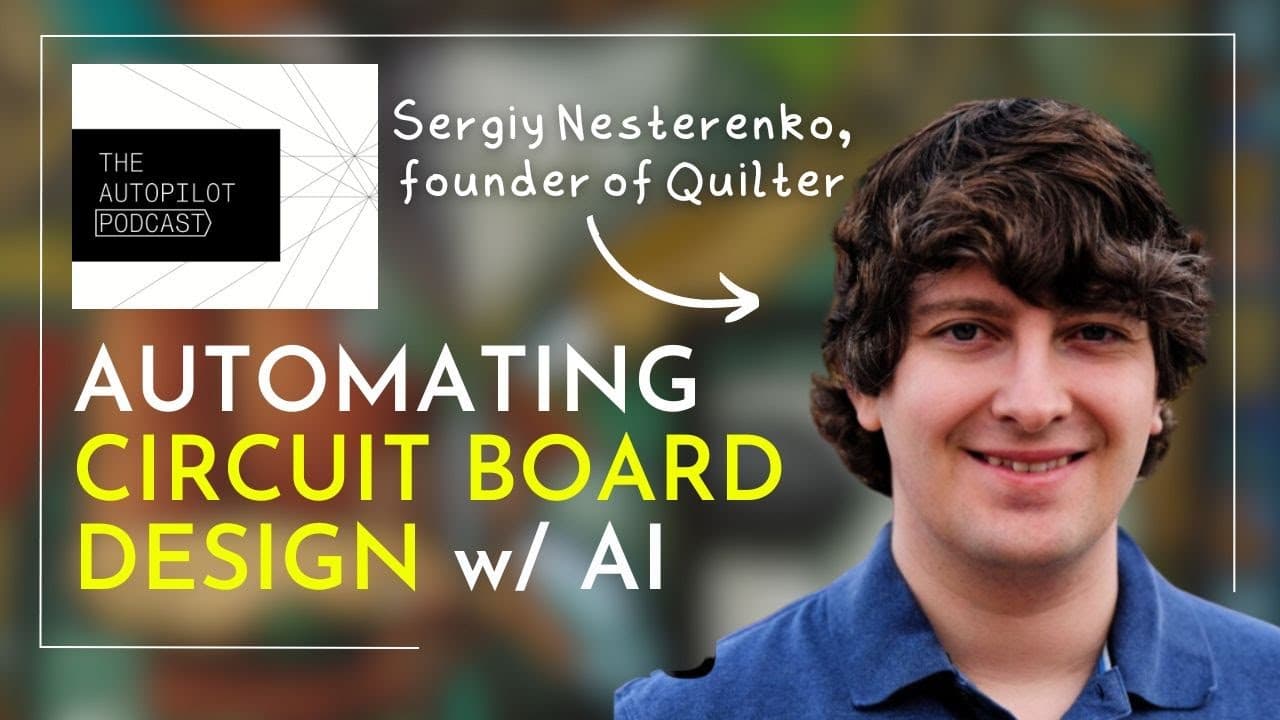
Reinforcement learning can automate PCB design, reducing time from weeks to hours. Quilter, led by Sergiy Nesterenko, uses this AI approach to streamline the complex process of circuit board creation. Although initially limited to simpler designs, the technology promises significant productivity gains and potential industry disruption.
Transcript
hello and welcome to the cognitive Revolution where we interview Visionary researchers entrepreneurs and Builders working on the frontier of artificial intelligence each week we'll explore their revolutionary ideas and together we'll build a picture of how AI technology will transform work life and Society in the coming years I'm Nathan lens joined... Read More
Key Insights
- Reinforcement learning automates PCB design, aiming to eliminate manual layout processes.
- Sergiy Nesterenko's experience at SpaceX inspired Quilter's approach to PCB design automation.
- Quilter's technology currently handles basic designs, but aims for superhuman performance.
- Manual PCB design is labor-intensive, often taking weeks or months to complete.
- The PCB design market faces a significant labor shortage, with high demand for skilled designers.
- Quilter's goal is to reduce PCB design time from weeks to hours, enhancing productivity.
- Reinforcement learning in PCB design does not rely on external data, unlike supervised learning.
- Future advancements in AI-driven PCB design could lead to cost and size reductions in electronics.
Install to Summarize YouTube Videos and Get Transcripts
Explore YouTube Video Summarizer or Get YouTube Transcript Extractor
Questions & Answers
Q: How does Quilter automate PCB design?
Quilter uses reinforcement learning to automate PCB design, eliminating the manual layout process. Designers input constraints and Quilter's AI handles the rest, creating a manufacturable board design. This approach reduces design time from weeks to hours, enhancing productivity and addressing labor shortages.
Q: What inspired the founding of Quilter?
Sergiy Nesterenko founded Quilter after experiencing the challenges of PCB design at SpaceX. The complex and time-consuming nature of manual board design inspired him to develop an AI-driven solution using reinforcement learning to automate and streamline the process.
Q: What are the current limitations of Quilter's technology?
Currently, Quilter's technology is limited to handling relatively simple PCB designs. While it significantly reduces design time, it cannot yet tackle complex designs like computer motherboards. The goal is to eventually achieve superhuman performance across all design complexities.
Q: How does reinforcement learning differ from supervised learning in PCB design?
Reinforcement learning, used by Quilter, does not rely on external data like supervised learning. Instead, it involves creating a 'game' of PCB design, where an AI agent learns by playing and optimizing designs based on physics and manufacturability scores, allowing for exploration of new design spaces.
Q: What is the potential impact of AI on PCB design costs?
AI-driven PCB design, like Quilter's, can lead to cost reductions by optimizing board size and complexity. Traditional designs often include conservative assumptions to avoid redesigns, leading to larger, more expensive boards. AI can produce more efficient designs, reducing material and manufacturing costs.
Q: Why is there a labor shortage in PCB design?
The PCB design industry faces a labor shortage due to a decline in young engineers entering the field. Many opt for careers in software and AI, leaving fewer skilled professionals to handle the complex and time-consuming process of manual PCB design, which Quilter aims to automate.
Q: What are the key challenges in manual PCB design?
Manual PCB design is labor-intensive and prone to errors, often taking weeks or months to complete. Designers must consider complex interactions like cross talk and manufacturability, making the process slow and costly. Quilter's AI aims to address these challenges by automating the design process.
Q: How does Quilter's approach benefit the electronics industry?
Quilter's AI-driven approach to PCB design offers significant productivity gains by reducing design time and labor costs. By automating complex design tasks, it addresses the industry's labor shortage and paves the way for more efficient, cost-effective electronics manufacturing.
Summary & Key Takeaways
-
Reinforcement learning automates PCB design, reducing manual layout work. Quilter, founded by Sergiy Nesterenko, uses AI to streamline circuit board creation, initially focusing on simpler designs. This approach promises significant productivity gains and potential industry disruption.
-
PCB design is traditionally labor-intensive, taking weeks to complete. Quilter's AI aims to reduce this to hours, addressing the labor shortage in the industry. The technology currently handles basic designs but aspires to superhuman performance.
-
Quilter's AI-driven approach to PCB design leverages reinforcement learning, which does not require external data. This method allows for exploration of new design spaces, potentially leading to cost and size reductions in future electronics.
Read in Other Languages (beta)
Share This Summary 📚
Summarize YouTube Videos and Get Video Transcripts with 1-Click
Try YouTube Summary with ChatGPT & Claude or YouTube Transcript Generator
Explore More Summaries from Cognitive Revolution "How AI Changes Everything" 📚






Summarize YouTube Videos and Get Video Transcripts with 1-Click
Try YouTube Summary with ChatGPT & Claude or YouTube Transcript Generator