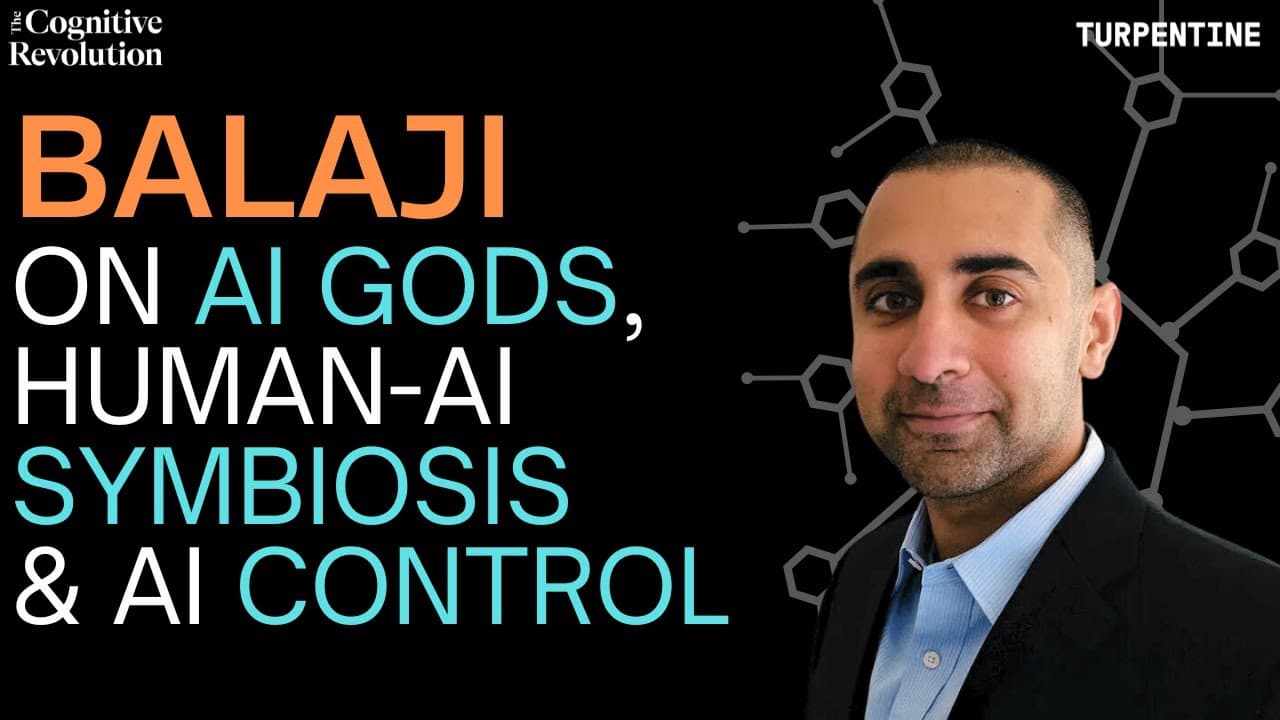
What Is Balaji Srinivasan's Vision for AI Control and Synergy?
TL;DR
Balaji Srinivasan envisions AI as a tool for human augmentation rather than an existential threat. He proposes a 'polytheistic AI' model, where diverse AI systems work together to enhance human capabilities. While AI is expected to promote economic and social transformation, he emphasizes that control and regulation are essential to prevent misuse and ensure these technologies serve humanity's best interests.
Transcript
they don't care about AI safety what they care about is AI Control do I think we eventually get to a configuration like that maybe where you have an AI brain is at the center of civilization and it's coordinating all the people around it and every civilization that makes it is capable of crowdfunding and operating its own AI you know our background... Read More
Key Insights
- AI is expected to amplify human intelligence, serving as a tool for augmentation rather than a standalone superintelligence.
- The concept of polytheistic AI suggests multiple AI systems will coexist, each serving different purposes and communities.
- Human-AI symbiosis has historical roots, as humans have always used tools to enhance their capabilities.
- AI control, rather than AI safety, is a primary concern, as governments may seek to regulate and limit AI development.
- AI systems will likely be integrated into existing power structures, influencing economic and political dynamics.
- Decentralized AI could emerge as a counterbalance to centralized governmental control, fostering innovation.
- The development of AI will impact various sectors differently, with potential disruption in industries like healthcare and law.
- AI's role in society will depend on how it is integrated and regulated, with potential for both positive and negative outcomes.
- More videos with Balaji Srinivasan:
Install to Summarize YouTube Videos and Get Transcripts
Explore YouTube Video Summarizer or Get YouTube Transcript Extractor
Questions & Answers
Q: How will AI impact human intelligence?
AI is expected to amplify human intelligence by serving as a tool for augmentation. This symbiotic relationship will enhance human capabilities, allowing individuals to perform tasks more efficiently and effectively. Historically, humans have used tools to extend their abilities, and AI represents the next step in this evolution, potentially creating a new class of human-AI hybrids with enhanced problem-solving skills.
Q: What is polytheistic AI?
Polytheistic AI refers to the coexistence of multiple AI systems, each serving different purposes and communities. Unlike the concept of a single, dominant AI, polytheistic AI envisions a landscape where diverse AI entities collaborate with humans, reflecting a more decentralized and varied approach to AI development. This model aligns with historical human use of diverse tools for enhancement.
Q: Why is AI control a major concern?
AI control is a major concern because governments may seek to regulate and limit AI development to maintain power structures. Regulation could stifle innovation and prevent AI from reaching its full potential as a tool for human benefit. Balaji Srinivasan argues that control, rather than safety, is the primary focus, as authorities aim to manage the transformative impact of AI on society.
Q: How might decentralized AI counteract government control?
Decentralized AI could counteract government control by fostering innovation and ensuring that AI systems remain tools for human benefit. By operating outside centralized power structures, decentralized AI could promote a more open and collaborative development environment, allowing for diverse applications and minimizing the risk of AI being used as an instrument of control.
Q: What industries might AI disrupt?
AI has the potential to disrupt various industries, particularly those with high regulatory and labor costs, such as healthcare and law. By automating tasks and providing more efficient solutions, AI could lower costs and increase accessibility. However, this disruption may also lead to economic challenges for workers in these sectors, necessitating adaptation and retraining.
Q: How does AI relate to historical tool use?
AI relates to historical tool use as it represents a continuation of humanity's long tradition of using tools to enhance capabilities. Just as fire, clothing, and agriculture transformed human societies by freeing up energy for brain development, AI is expected to augment intelligence and expand the potential for innovation and problem-solving, marking the next step in human evolution.
Q: What are the key challenges in integrating AI into society?
Key challenges in integrating AI into society include managing control and regulation, ensuring equitable access, and addressing potential disruptions in various sectors. Balaji Srinivasan emphasizes the importance of maintaining a balance between innovation and oversight to harness AI's benefits while minimizing risks. The development of decentralized AI may offer solutions to some of these challenges.
Q: What is the potential impact of AI on economic and social transformation?
AI has the potential to drive significant economic and social transformation by enhancing productivity, reducing costs, and creating new opportunities. This transformation could lead to a more equitable distribution of resources and improved quality of life. However, it also poses challenges, such as job displacement and the need for new regulatory frameworks to ensure that AI's benefits are widely shared.
Summary & Key Takeaways
-
AI is not an existential threat but a tool for human augmentation. Balaji Srinivasan discusses the concept of polytheistic AI, where multiple AI systems coexist and collaborate with humans. He argues that AI will amplify human intelligence and drive economic and social transformation, but control and regulation will be key challenges.
-
The concept of polytheistic AI suggests that multiple AI systems will coexist, each serving different purposes and communities. This model contrasts with the idea of a single, dominant AI and aligns more with historical human use of diverse tools for enhancement.
-
AI regulation is a significant concern, as governments may attempt to control AI development and use. Decentralized AI could offer a counterbalance, fostering innovation and ensuring that AI systems remain tools for human benefit rather than instruments of control.
Read in Other Languages (beta)
Share This Summary 📚
Summarize YouTube Videos and Get Video Transcripts with 1-Click
Try YouTube Summary with ChatGPT & Claude or YouTube Transcript Generator
Explore More Summaries from Cognitive Revolution "How AI Changes Everything" 📚



Summarize YouTube Videos and Get Video Transcripts with 1-Click
Try YouTube Summary with ChatGPT & Claude or YouTube Transcript Generator