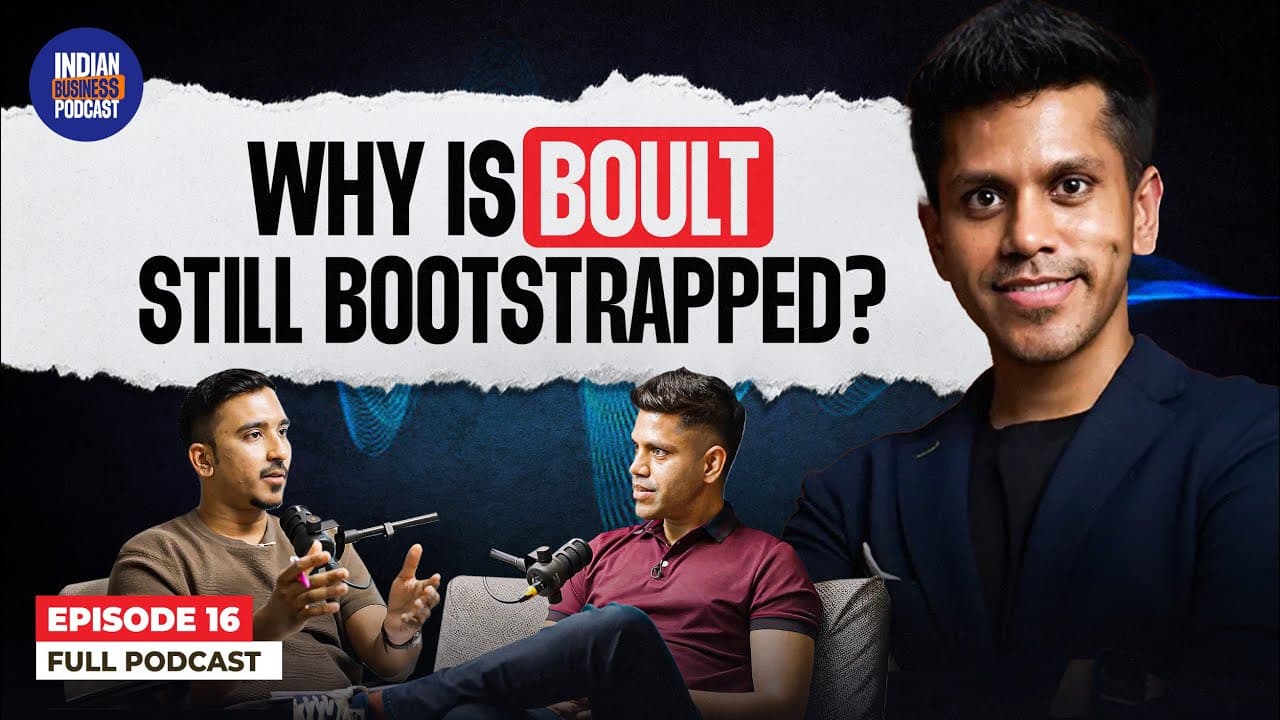
How Did Boult Reach ₹700 Crore Bootstrapped and Dominate the Wearables Market? | Indian Business Podcast EP16
TL;DR
Boult reached ₹700 crore in revenue without external funding by controlling profitability, developing scalable products with longer selling lives, and using e-commerce to reach value-conscious customers. The company entered wireless audio in 2017, competed with heavily funded brands, and targeted the accessible ₹1,000 to ₹5,000 segment. Read on to understand how its product, channel, pricing, and manufacturing choices supported that growth.
Transcript
you are a bootst company and while your competitors had hundreds of crores in capital you chose not to raise capital in fact if I'm not wrong boat was already doing 27 30 cres and noise was also a significant player in the market so my question is what are the strengths and weaknesses of building a bootstrap company boys co-founder Von Gupta design... Read More
Key Insights
- Bootstrapping shaped every decision: Boult's choice not to raise external capital was more than a financing decision. It required close control over spending, product investment, profitability, and expansion. While competitors could deploy hundreds of crores, Boult had to ensure that products and channels could support durable demand rather than depending on capital to absorb repeated losses.
- Funding carries strategic risk: The podcast contrasts Boult's model with the funding enthusiasm encouraged by programs such as Shark Tank. Funding can accelerate growth, but the discussion warns that it can become damaging when used without discipline. Boult's experience shows why founders must consider how capital changes product development, market entry, financial control, and expectations for expansion.
- TWS removed the final cable: Wireless neckbands connected to a device without a wire, but their two earbuds were still joined by a cable. TWS introduced two independent earbuds connected wirelessly to each other and the source device. That distinction explains both the category's name and its appeal as a more mobile, portable, light, and comfortable format.
- Audio includes multiple subcategories: TWS sits within personal audio alongside wireless neckbands, wired earphones, over-ear headphones, and portable speakers. The larger audio domain also includes home, car, and institutional audio solutions. Placing TWS inside this structure clarifies why Boult's opportunity was not the entire audio market, but a rapidly expanding format within personal audio.
- The market mix favors TWS: India's TWS category is described as worth approximately ₹4,000 crore, with Boult holding about a 12% share. TWS represents roughly 55% of the broader audio market. Neckbands contribute about 20% to 25%, speakers about 10%, and over-ear headphones another 7% to 8%, with remaining subcategories making up the balance.
- Smartphone changes created demand: Boult entered in 2017 as Apple removed the headphone jack and other Chinese smartphone companies followed. Phone makers also stopped including wired earphones, so customers increasingly had to purchase separate audio products. This hardware transition created a direct opening for wireless brands rather than merely shifting demand between established earphone suppliers.
- Accessible pricing filled the gap: International wireless products were often priced above ₹5,000, while Boult focused on products between ₹1,000 and ₹5,000. The opportunity combined affordability with recognizable branding, quality, and portability. Boult was therefore not competing only on low price, but on providing a credible wireless option for consumers underserved by more expensive international products.
- Longer product lives reduced pressure: Boult did not follow a cycle of changing products every three months. It built more slowly, designed products for scale, and expected them to sell for longer. This approach reduced the need to fund constant replacement launches and gave each development effort more time to recover its investment through sustained sales.
- Marketplace margins tell only part: Amazon, Flipkart, and other marketplaces generate about 70% to 75% of TWS revenue, even though marketplace charges can reach roughly 25% to 35%. Their advantage is the possibility of organic sales after a product gains traction. That organic demand can reduce advertising expenditure as a percentage of sales and improve net margins.
- D2C can be least profitable: Selling through a brand's own website avoids marketplace commissions, but it does not eliminate acquisition costs. Boult describes D2C as its lowest-margin channel because nearly every customer or order may require advertising. Without the organic discovery that a successful marketplace listing can develop, repeated customer acquisition spending can outweigh the apparent commission savings.
- Online traction develops in stages: A newly launched marketplace product can be deeply unprofitable because competition drives up cost per click, customer acquisition cost, and advertising expenditure. After the product establishes demand, organic revenue can replace part of the paid volume. An individual product may gain traction within weeks or months, although building the overall brand still takes months or years.
- Distribution continues to fragment: Major marketplaces remain central, but quick-commerce services such as Swiggy Instamart, BigBasket, and Blinkit are taking a growing share of demand. Offline retail follows a similar path from initial investment toward maturity and profitability, but establishing it can take years. Boult therefore evaluates channels through their complete economics and development time, not commission rates alone.
Install to Summarize YouTube Videos and Get Transcripts
Explore YouTube Video Summarizer or Get YouTube Transcript Extractor
Questions & Answers
Q: How did Boult reach ₹700 crore in revenue without external funding?
Boult maintained tight control over profitability, spending, product development, and channel expansion. It developed products more slowly, built them for scale, and kept them in the market longer instead of replacing them every three months. Accessible pricing and e-commerce distribution helped it reach value-conscious customers while competing against companies backed by hundreds of crores. This disciplined model allowed Boult to reach ₹700 crore in revenue while remaining bootstrapped.
Q: What does TWS mean, and how does it work?
TWS means true wireless stereo. It uses two independent earbuds that connect wirelessly to each other and to the device supplying the audio. This differs from a wireless neckband, which connects wirelessly to the source but retains a cable between its two earbuds. Removing that final cable made TWS portable, light, comfortable, and highly mobile, helping it become the largest audio category.
Q: Why did Boult enter wireless audio in 2017?
Boult saw an opportunity when Apple began removing headphone jacks and other Chinese smartphone manufacturers followed. Phone companies also stopped bundling wired earphones, which meant consumers increasingly needed to purchase separate audio products. Many international wireless alternatives cost more than ₹5,000. Boult entered with recognizable, good-quality products between ₹1,000 and ₹5,000 to serve customers seeking a more accessible option.
Q: How large is India's TWS market, and what share does Boult hold?
The Indian TWS category is described as an approximately ₹4,000 crore market. Boult holds about a 12% share of that category. TWS accounts for roughly 55% of the broader audio market, compared with about 20% to 25% for neckbands, 10% for speakers, and 7% to 8% for over-ear headphones. These figures explain why TWS became central to Boult's growth strategy.
Q: Why can marketplaces become profitable despite high commissions?
Marketplaces may charge margins of roughly 25% to 35%, and a new product can initially lose money because paid competition raises acquisition costs. Once a listing gains traction, it can begin generating organic sales that do not require the same advertising expenditure. Advertising then falls as a percentage of revenue, improving the product's net margin. The value of a marketplace therefore comes from accumulated organic demand, not simply its headline commission rate.
Q: Why is D2C Boult's lowest-margin channel?
A D2C website avoids paying a marketplace commission, but Boult may still need advertising to acquire nearly every customer or order. Those recurring customer acquisition costs can consume the apparent savings from selling directly. Marketplaces can eventually provide organic sales after a product establishes traction, while a D2C site may remain dependent on paid traffic. For Boult, this makes D2C the lowest-margin channel despite its seemingly cheaper structure.
Q: How does Boult's product strategy support bootstrapped growth?
Boult develops products more slowly and designs them to operate at scale for longer selling periods. It avoids changing a product every three months, which reduces the capital required for constant development and replacement launches. Longer product lives allow sustained demand to support the original investment. This strategy matches a bootstrapped company because it prioritizes durability, controlled spending, and profitability over a rapid cycle of launches.
Q: How do e-commerce, quick commerce, and offline retail differ for Boult?
E-commerce marketplaces account for about 70% to 75% of TWS revenue and can help a product build organic sales after its paid launch phase. Quick-commerce platforms such as Swiggy Instamart, BigBasket, and Blinkit are taking a growing portion of demand previously concentrated on major marketplaces. Offline retail can also progress from early investment toward maturity and profitability, but building a presence may take years. Boult therefore considers both channel economics and the time required to establish demand.
Summary & Key Takeaways
-
Starting with bootstrapped growth: Indian Business Podcast EP16 introduces Boult co-founder Varun Gupta and asks how the company reached ₹700 crore in revenue without raising external capital. Boult entered the market in 2017, when boAt was already generating roughly ₹27 crore to ₹30 crore and Noise was also a significant player. The discussion frames bootstrapping as a philosophy that changes product development, market entry, spending discipline, profitability, and the balance between growth opportunities and financial risk.
-
Defining the audio category: True wireless stereo, or TWS, consists of two independent earbuds that connect wirelessly to each other and to the source device. It followed wired earphones and wireless neckbands, where the two earbuds remained connected by a cable. Personal audio also includes over-ear headphones and portable speakers, while home audio includes soundbars and speakers. TWS became the largest audio category because of its mobility, portability, light weight, comfort, and consumer acceptance.
-
Finding the 2017 opportunity: Boult launched its first product as Apple and other smartphone manufacturers began removing headphone jacks and stopped bundling wired earphones with phones. Consumers increasingly needed to buy separate wireless products. Many international alternatives cost more than ₹5,000, leaving space for an Indian brand offering recognizable, good-quality wireless audio between ₹1,000 and ₹5,000. Boult used this combination of changing phone design, new consumer demand, accessible pricing, product quality, portability, and branding to enter the market.
-
Building products for endurance: Boult competed against companies backed by hundreds of crores without matching their funding. It did not replace a product every three months. Instead, the company developed products more slowly, designed them for scale, and kept them selling for longer periods. This reduced dependence on constant launches and aligned product investment with sustained demand. The approach supported controlled spending, profitability, and tighter brand control while helping the bootstrapped company grow toward ₹700 crore in revenue.
-
Choosing channels by economics: Boult used e-commerce marketplaces to build reach, even though those platforms can charge margins of roughly 25% to 35%. A product may initially be unprofitable because competition increases cost per click, customer acquisition cost, and advertising expenditure. Profitability improves when traction produces organic sales and lowers advertising as a share of revenue. D2C can deliver lower margins because nearly every order may require advertising, while offline retail takes years to establish and quick commerce is capturing growing demand.
Read in Other Languages (beta)
Share This Summary 📚
Summarize YouTube Videos and Get Video Transcripts with 1-Click
Try YouTube Summary with ChatGPT & Claude or YouTube Transcript Generator
Explore More Summaries from Think School 📚






Summarize YouTube Videos and Get Video Transcripts with 1-Click
Try YouTube Summary with ChatGPT & Claude or YouTube Transcript Generator