How did Ukrainian drones disable Engels base with AI swarm
TL;DR
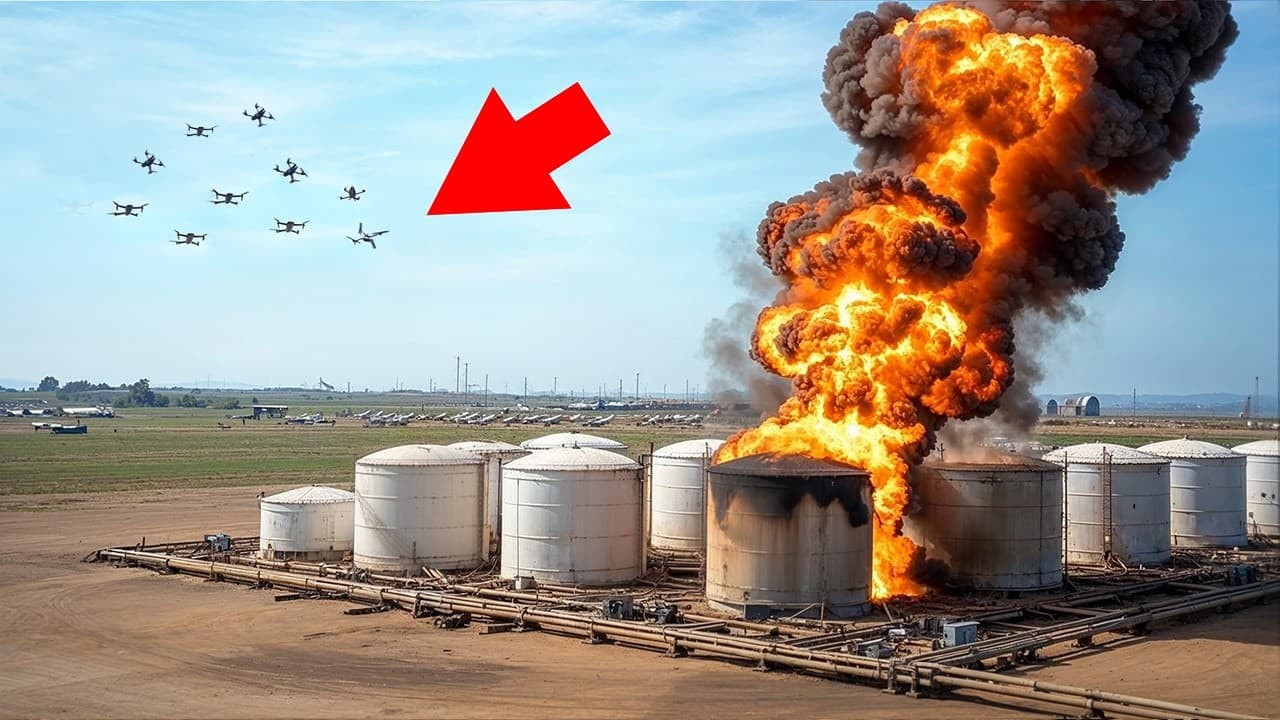
The operation used 17 low cost drones that flew 750 kilometers into Russian airspace and attacked Engels with autonomous final approach. Each drone ran a local AI analysis of fuel depot tanks and executed coordinated strike angles, allowing destruction despite advanced air defense. The result showed distributed autonomous targeting and limited human control during the kill phase.
Transcript
At 0300 local time on June 6, 2025, 17 Ukrainian OSA drones converge on Angles air base like wolves circling prey. They've been flying for 6 hours straight, covering 750 km of hostile territory without GPS, without communication between them, and without any human control for the last 30 minutes. In just a few minutes, their AI systems are about to... Read More
Key Insights
- Drones operated autonomously in the final approach with no human input, using identical onboard reasoning across the swarm.
- AI analysis evaluated tank temperatures to determine which tanks were most dangerous to hit based on vapor pressure and volatility.
- Each drone added its serial number to the approach vector, creating overlapping blast patterns to maximize damage.
- The S400 and Pantsir defenses failed due to radar clutter, low RCS, and range limitations against small drones.
- GPS jamming existed, but the drones relied on magnetic compass and dead reckoning instead of GPS.
- The drones communicated through hijacked SIM cards but still functioned with minimal cellular contact during final descent.
- An onboard collision avoidance system maintained drone separation at low altitude while in loose formation.
- The operation demonstrated that inexpensive, autonomous platforms can outperform complex, expensive systems in certain scenarios.
- More videos from this channel:
- More from this channel: Beyond Military
Install to Summarize YouTube Videos and Get Transcripts
Explore YouTube Video Summarizer or Get YouTube Transcript Extractor
Questions & Answers
Q: What is the basic premise of the Engels base attack by Ukrainian drones?
The event describes 17 low cost Ukrainian drones that swarmed Engels air base after flying 750 kilometers. They operated without GPS or human control in the final minutes and used AI driven analysis to identify and target a Kristall fuel depot. The operation demonstrated autonomous coordination and precision destruction despite sophisticated air defenses.
Q: How did the drones navigate without GPS for the final approach?
The drones navigated using magnetic compass, accelerometers, and dead reckoning after GPS jamming, with no central command required. They relied on distributed intelligence that ran independent analyses on each drone, allowing the swarm to converge on targets without direct human control during the final phase.
Q: What role did AI play in identifying targets at Engels?
AI processed 640 by 480 pixel thermal images to identify heat signatures, map tank layouts, and assign identifiers to tanks. It compared temperatures to determine which tanks were most volatile, enabling the swarm to prioritize targets and tailor attack vectors for maximum impact.
Q: Why did the S400 and Pantsir defenses fail to stop the attack?
The engagement faced a radar clutter problem and limited detection due to a small drone’s low radar cross section. The missiles required continuous radar illumination and could miss the targets because the drones were too small and moved unpredictably. The result was ineffective engagement despite expensive systems.
Q: How did the drones achieve overlapping attack patterns?
Each drone contributed to a coordinated attack by selecting an approach bearing and maintaining specific altitudes and speeds. Through distributed, identical onboard reasoning, the drones formed an attack matrix that created overlapping blast patterns while avoiding mid air collisions.
Q: What challenges did Russian defenses face regarding GPS jamming?
GPS jamming created electromagnetic bubbles around facilities, misleading receivers. However, the OSA drones did not rely on GPS for the final approach, instead using inertial navigation, magnetic compass, and smart targeting, which allowed continued operation despite jamming.
Q: What is significant about the final autopilot takeover in the drones?
At a predetermined point, the autopilot took full control with no possibility of human abort, aligning all drones toward final targets and detonating their payloads. This showcased fully autonomous weaponization where no real-time human input could intervene during the critical strike phase.
Q: What broader implications does the video suggest about future warfare?
The video argues that AI driven swarms and low cost drones can challenge even advanced air defense networks, changing the calculus of air power. It emphasizes the need to rethink defense measures for dealing with autonomous, distributed threat vectors that can operate with minimal radiated signatures and no centralized command.
Summary & Key Takeaways
-
The attack involved 17 drones flying 750 km to Engels air base, executing a fully autonomous final approach and targeting a Kristall fuel depot.
-
The drones used AI driven analysis on tank temperatures and configurations to select targets and optimize impact angles.
-
The engagement highlighted vulnerabilities in high value defense systems when faced with small, inexpensive, autonomous swarms.
Read in Other Languages (beta)
Share This Summary 📚
Summarize YouTube Videos and Get Video Transcripts with 1-Click
Try YouTube Summary with ChatGPT & Claude or YouTube Transcript Generator
Explore More Summaries from Beyond Military 📚



Summarize YouTube Videos and Get Video Transcripts with 1-Click
Try YouTube Summary with ChatGPT & Claude or YouTube Transcript Generator