How Cognitive Biases Distort Everyday Decisions
TL;DR
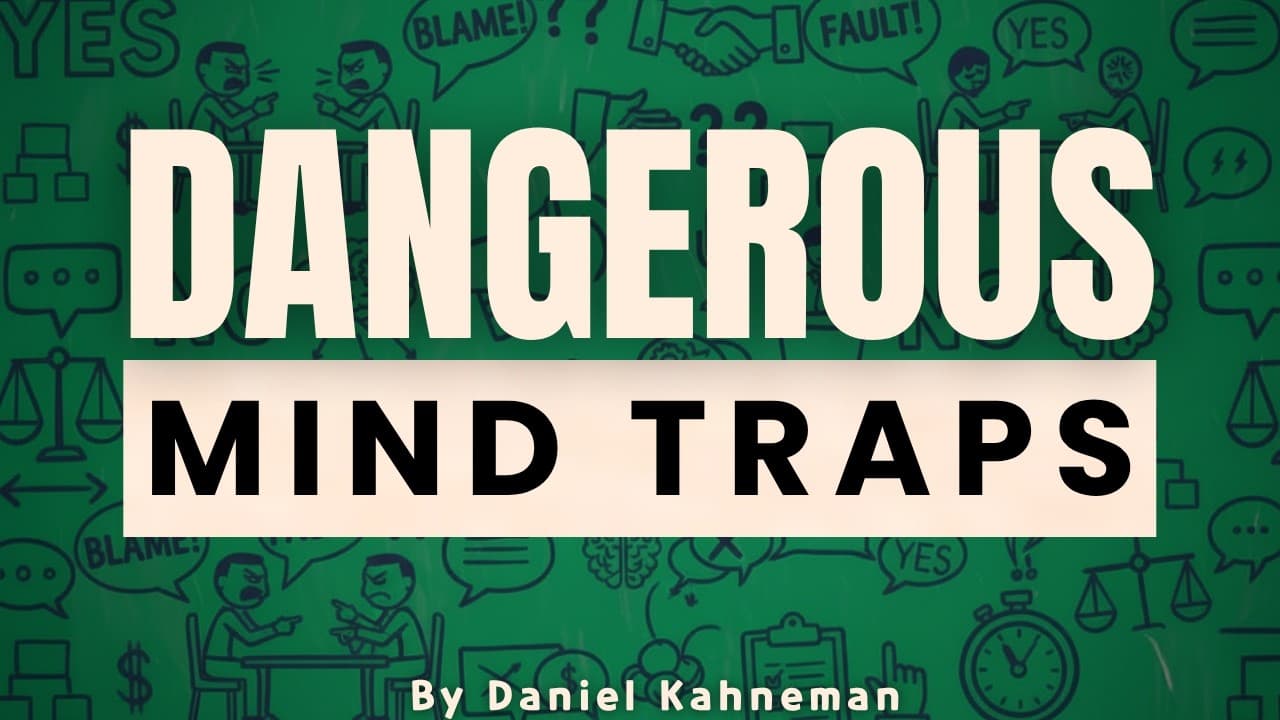
Human decisions are often driven by fast, automatic judgments before deliberate reasoning has time to intervene. Priming, loss aversion, sunk costs, framing, the halo effect, and anchoring can distort choices, but recognizing these patterns and deliberately engaging slower analysis can reduce costly mistakes in purchases, relationships, business decisions, interviews, and everyday life.
Transcript
do you think you make your own decisions is it easy to manipulate you before you answer let me show you something I'll describe the characteristics of two persons for each of them I will say five words while I say the words try to decide who is evil and who is a good person please note the first answer that comes to your mind okay ready the first p... Read More
Key Insights
- System 1 is the mind's automatic mode, operating intuitively, involuntarily, and with little effort. It supports rapid reactions, such as escaping danger, but it can also rush to conclusions before enough information has been considered.
- System 2 is the mind's deliberate mode, requiring focus, computation, analysis, and conscious action. It is better suited to complex problems, yet it is slow and reluctant to engage, allowing automatic judgments to dominate many decisions.
- Priming is the influence of an earlier exposure on subsequent behavior or judgment. In the opening word exercise, identical words produced opposite character assessments because their order changed which initial impression guided the interpretation of everything that followed.
- Positive priming can shape interactions and personal behavior. Expressing gratitude may influence how daily problems are approached, while beginning a negotiation with an explicit request for fairness and honesty may encourage both parties to behave more carefully and ethically.
- Loss aversion is the tendency to experience potential losses more strongly than equivalent gains. An equal chance of winning or losing $10,000 may feel unattractive because the negative emotion associated with losing outweighs the positive emotion associated with winning.
- The sunk cost bias is the tendency to continue an activity because resources have already been spent. Past payments cannot be recovered and do not determine future success, so current benefits and future consequences should guide decisions about projects, relationships, possessions, or events.
- Framing bias is the effect of wording and presentation on decisions. A 10% chance of dying and a 90% chance of living describe the same statistical situation, yet the negative frame can produce a much worse emotional response.
- The halo effect and anchoring allow irrelevant information to influence judgment. Attractiveness may be mistaken for intelligence or competence, while an initial price of $400 can make a later price of $250 seem inexpensive even without an independent assessment of value.
- More videos with Daniel Kahneman:
Install to Summarize YouTube Videos and Get Transcripts
Explore YouTube Video Summarizer or Get YouTube Transcript Extractor
Questions & Answers
Q: What are System 1 and System 2 in decision-making?
System 1 is automatic, intuitive, involuntary, and effortless, so it produces quick reactions and immediate answers. System 2 is slower and requires focus, computation, analysis, and deliberate action. Both are useful, but errors arise when System 1 rushes into a judgment that requires System 2. Deliberate reasoning is especially important for complex, costly, or consequential choices.
Q: How does priming influence everyday decisions?
Priming occurs when exposure to one thing affects a later judgment or behavior. The initial word in a description can establish an impression that shapes how every following word is interpreted. Music, room surroundings, greetings, appearance, and repeated thoughts can work similarly. Because priming operates subconsciously, people may confidently believe they chose independently while overlooking the earlier cue that influenced them.
Q: How can positive priming improve negotiations?
Positive priming can establish fairness and honesty as the standards for a conversation before substantive negotiation begins. The transcript describes opening property discussions by explicitly requesting a fair and ethical agreement and inviting correction of anything unfair. Sellers then reportedly became more careful, disclosed possible future problems, and sometimes advised against a purchase when the property was unsuitable for the buyer's situation.
Q: Why can negative self-talk affect behavior?
Negative self-talk can prime a person for failure by repeatedly associating future action with inadequacy and inability. The transcript argues that thoughts may be especially influential because they involve imagination and emotion. It also cites research in which reading words associated with impolite behavior led people to behave rudely and interrupt a conversation, illustrating how seemingly small cues may influence later conduct.
Q: What is loss aversion, and why does it matter?
Loss aversion is the tendency to feel the pain of losing more strongly than the pleasure of gaining an equal amount. In the example, a person has equal chances of winning or losing $10,000, yet is unlikely to accept the gamble without a higher potential reward. This bias can discourage new projects or businesses by making immediate risks feel more important than long-term benefits.
Q: How can someone avoid the sunk cost bias?
To avoid the sunk cost bias, evaluate a decision according to its future costs, benefits, and likelihood of success, not according to money or effort that cannot be recovered. A paid concert ticket does not make attending while sick beneficial. Likewise, previous investment does not justify continuing a failing business, unsuitable relationship, or keeping unused clothes, furniture, and food that no longer serve a purpose.
Q: What is framing bias in decision-making?
Framing bias occurs when different wording, settings, or presentations change reactions to equivalent information. Being told there is a 10% chance of dying can feel worse than being told there is a 90% chance of living, although both statements describe the same probabilities. Recognizing the effect requires restating options in comparable terms before deciding what the underlying facts actually mean.
Q: How do the halo effect and anchoring distort judgment?
The halo effect causes a favorable trait, such as attractiveness or likability, to influence judgments about unrelated qualities such as intelligence, competence, or qualifications. Anchoring makes an initial reference point shape later evaluation. A jacket first believed to cost $400 may appear cheap at $250 because the original price remains mentally influential, even though the buyer has not independently assessed its value.
Summary & Key Takeaways
-
Human thinking operates through two contrasting systems. System 1 responds automatically, intuitively, involuntarily, and effortlessly, making it useful for immediate reactions. System 2 is slower and handles focus, computation, analysis, and deliberate action. Poor decisions often occur when quick System 1 judgments replace the careful reasoning that a situation actually requires.
-
Priming and framing show how context influences judgment. Early words can determine impressions before later information is considered, while different presentations of identical probabilities can produce different emotional reactions. Environments, greetings, appearance, music, and repeated self-talk may also shape subsequent choices and behavior without their influence being consciously recognized.
-
Loss aversion, sunk costs, the halo effect, and anchoring create predictable errors. People fear losses more strongly than they value equal gains, continue commitments because of unrecoverable investments, confuse attractiveness with competence, and judge prices relative to an initial reference. Slower analysis helps separate relevant evidence from these misleading emotional signals.
Read in Other Languages (beta)
Share This Summary 📚
Summarize YouTube Videos and Get Video Transcripts with 1-Click
Try YouTube Summary with ChatGPT & Claude or YouTube Transcript Generator
Explore More Summaries from LITTLE BIT BETTER 📚
Summarize YouTube Videos and Get Video Transcripts with 1-Click
Try YouTube Summary with ChatGPT & Claude or YouTube Transcript Generator