How to validate a business idea fast before building
TL;DR
The key is to validate with real money quickly, not feedback. Get at least three paying customers within 48 hours to prove demand, otherwise use rejection as data to pivot. Use the four questions eliminate, reduce, raise, create to beat price wars and craft a premium offer that solves all customer problems.
Transcript
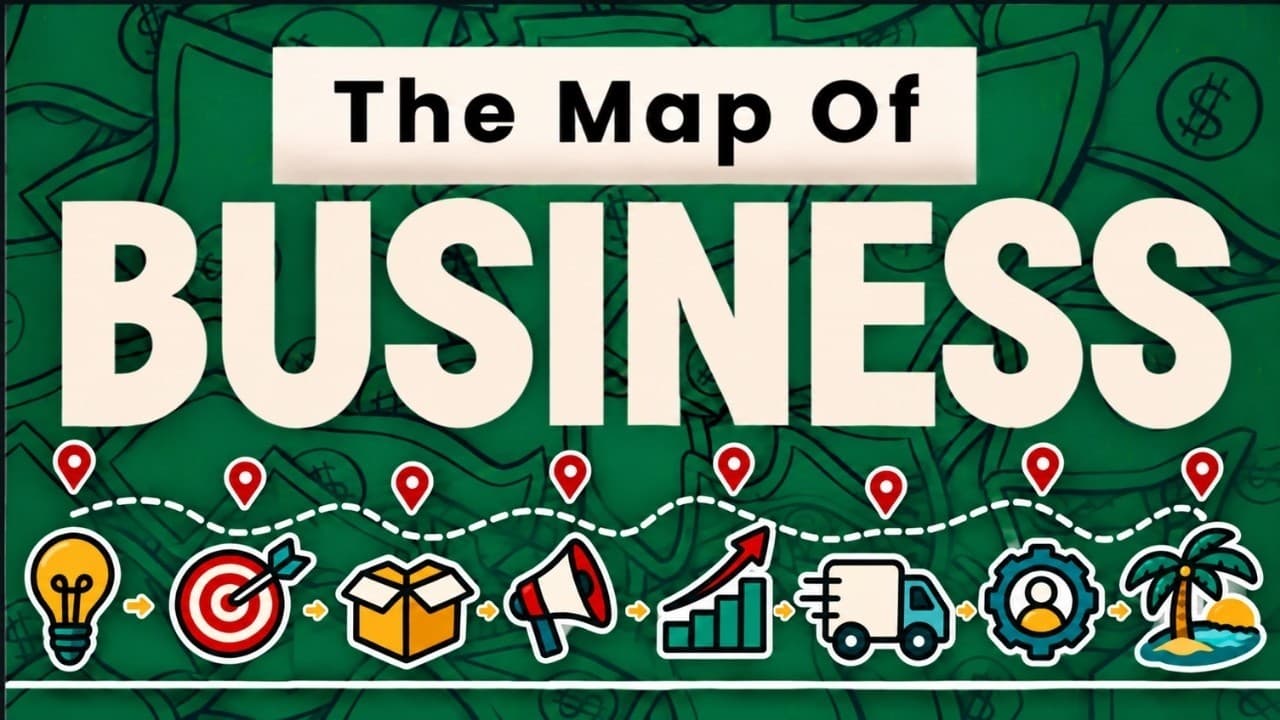
I looked at every business book I have ever read in the last nine years. I threw away the garbage and picked the few good books. And from those I pulled the absolute most important things for a small business. I turned all of it into one simple map. Just eight parts. from your first idea all the way to a business that pays you while you walk in the... Read More
Key Insights
- Idea validation must start before any building or logo design, because a wrong idea wastes time and money.
- The 48 hour money challenge tests real willingness to pay by asking for money rather than feedback within a tight window.
- A no is data, not failure, and can guide pivots to better product-market fit.
- Price wars destroy value; the right move is to redefine the market using elimination, reduction, raising, and creating.
- Eliminate what customers do not value, reduce what costs money, raise what improves value, and create new offerings to outcompete rivals.
- A coffee shop example illustrates how to shift from product focus to customer needs, turning a basic business into a service that competes with much larger spaces.
- A premium offer should sell outcomes, be fast and easy, and stack multiple solutions to address all customer problems.
- Three core steps to a premium offer are focusing on outcomes, enabling quick wins, and stacking features for comprehensive value.
Install to Summarize YouTube Videos and Get Transcripts
Explore YouTube Video Summarizer or Get YouTube Transcript Extractor
Questions & Answers
Q: What is the 48 hour money challenge and how does it validate an idea?
The 48 hour money challenge is a method to validate a business idea by obtaining real payments quickly, not just feedback. The goal is to secure at least three paying customers within two days. This rapid test shows whether people will actually exchange money for the proposed product or service, preventing wasted time on ideas with no real demand.
Q: Why is a no considered data in the validation process?
A no is considered data because it reveals information about customer preferences, price sensitivity, or product-market fit without wasting further resources. By treating a no as actionable feedback, you can pivot, refine the offer, or test different price points, shortening the cycle from idea to market fit.
Q: What are the four questions used in the validation process and what is their purpose?
The four questions are eliminate, reduce, raise, and create. They guide you to simplify the offering, cut unnecessary costs, improve value, and introduce new elements. This framework helps escape price wars and frames your business in a way that delivers more value with fewer resources.
Q: How can a business transition from a price war to a differentiated market position?
To escape a price war, identify a target customer segment that is underserved or overlooked. Then apply eliminate, reduce, raise, and create to tailor the offering to that segment, removing costly features and adding high-value ones that competitors do not provide. This creates a unique value proposition that competitors cannot easily replicate.
Q: What constitutes a premium offer according to the video?
A premium offer is one that makes customers feel they would be foolish to refuse. It should sell outcomes not features, provide fast and easy wins, and stack multiple components to address all related problems. The idea is to make the path to the result shorter and more certain than competing options.
Q: How should you approach price and value when designing an offer for weight loss or similar outcomes?
Focus on the outcome and the speed of achievement rather than vague promises. Show before and after proof, demonstrate rapid early wins, and structure the offer so that the overall value substantially exceeds the price. This approach creates perceived inevitability of results and reduces buyer hesitation.
Q: What practical steps can a new entrepreneur take tonight to validate an idea?
Start by listing all competitor offerings and costs, then apply the four questions to each aspect: remove unnecessary features, simplify processes, enhance what matters most to customers, and introduce new elements that competitors lack. Create a simple test to collect payments quickly, such as a one-page post with a payment link to validate demand.
Q: What is the overall sequence from idea to a sustainable business as described in the video?
Begin with validation to confirm demand through real payments, then focus on positioning to avoid price wars by redefining the market. Build a premium offer that emphasizes outcomes and rapid wins, and finally stack the solution with multiple components to address all customer needs. This sequence leads to a scalable business that can generate income while the founder enjoys flexibility.
Summary & Key Takeaways
-
A fast validation method is to ask for money within 48 hours to test demand, rather than relying on feedback, enabling you to learn whether the market will pay before heavy investment.
-
The four questions eliminate, reduce, raise, and create help reframe a crowded market, cut costs, and deliver higher value, enabling a unique position even in competitive spaces.
-
Building a premium offer involves selling outcomes, speeding up results, and stacking solutions to remove all major customer obstacles, making the offer hard to refuse.
Read in Other Languages (beta)
Share This Summary 📚
Summarize YouTube Videos and Get Video Transcripts with 1-Click
Try YouTube Summary with ChatGPT & Claude or YouTube Transcript Generator
Explore More Summaries from LITTLE BIT BETTER 📚


Summarize YouTube Videos and Get Video Transcripts with 1-Click
Try YouTube Summary with ChatGPT & Claude or YouTube Transcript Generator