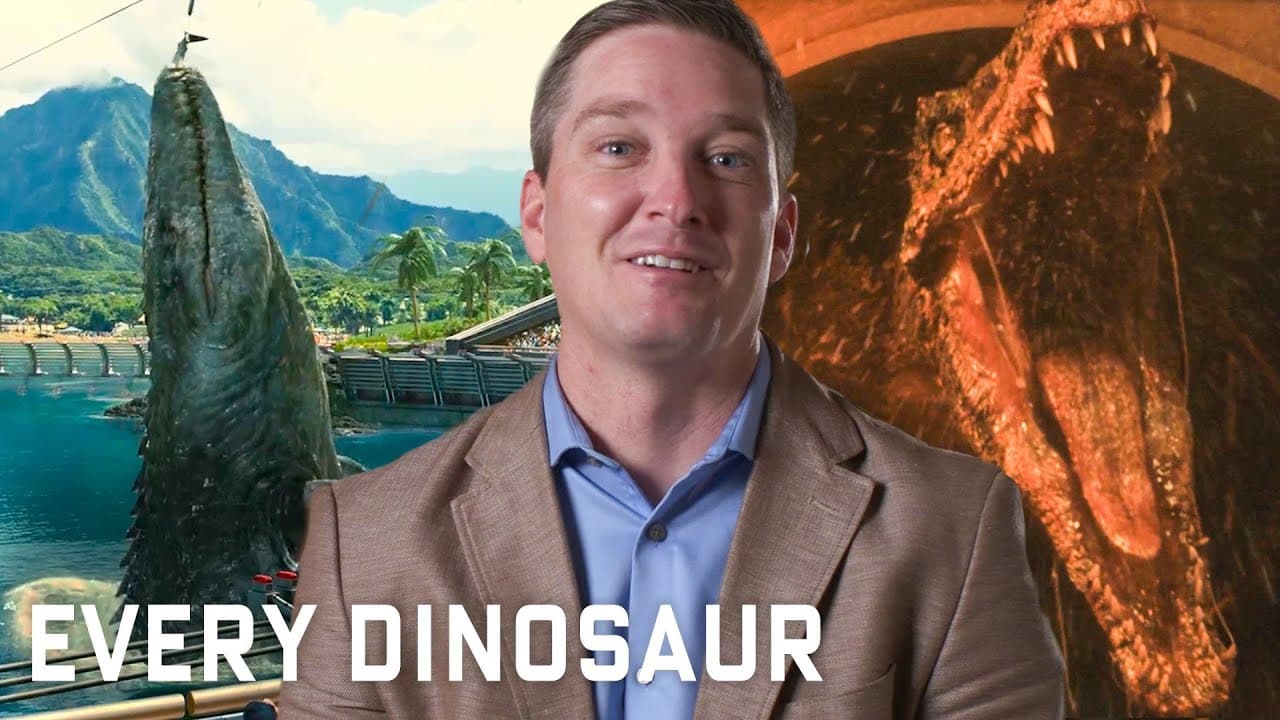
How Accurate Are Jurassic Park's Dinosaurs?
TL;DR
Jurassic Park mixes scientifically grounded dinosaur traits with substantial artistic license. Velociraptor was smaller and probably feathered, Dilophosaurus lacks evidence for venom or a neck frill, and Tyrannosaurus likely could see nearby humans. Other portrayals, including the speed of Gallimimus, the defensive weapons of Stegosaurus and Ankylosaurus, and the semi-aquatic habits of Spinosaurus, align more closely with available evidence.
Transcript
- I'm Nathan Smith, I'm an associate curator in the Dinosaur Institute at the Natural History Museum of Los Angeles County. (dramatic music) I'm here to talk to you about every dinosaur that you can find in the Jurassic Park films. Welcome to Jurassic Park. (dramatic orchestra music) (dinosaur yelling) Brachiosaurus was a member of the Sauropod gro... Read More
Key Insights
- Velociraptor was much smaller than its film counterpart, roughly the size of a very large turkey, and evidence from bony quill knobs indicates that it was probably at least partly feathered. Its exceptional intelligence in the films is treated as artistic license.
- Dilophosaurus has no known evidence of a large expandable frill or poison-spitting ability. Real specimens were much larger than the animal shown in Jurassic Park, suggesting that an authentic Dilophosaurus could have attacked directly with its teeth without first displaying or spraying venom.
- Tyrannosaurus probably had better practical vision than the first film suggests. Although its smell and other senses may have been especially developed, the claim that it could not see humans standing directly before it is considered unlikely by the expert.
- Spinosaurus was adapted more strongly to aquatic life than earlier interpretations recognized. It was probably semi-aquatic, spent time around water, and fed near aquatic environments, including on large fish, but using its back sail for propulsion remains doubtful.
- Pteranodon was a pterosaur, not a dinosaur, despite being a close relative of dinosaurs. The films inaccurately show it lifting people with its hind feet, because it could not support that weight and probably captured prey more like a modern stork.
- Mosasaurus was not a dinosaur, but a marine reptile closely related to lizards. It may have hunted near shorelines because fossils occur in shallow marine settings, while also pursuing animals in the water, including large ammonoids from the Western Interior Seaway.
- Stegosaurus likely used its spike-bearing tail as a defensive weapon to protect itself or its offspring. The function of the large plates along its back remains uncertain, demonstrating that even highly recognizable dinosaur anatomy can still raise unresolved scientific questions.
- Ankylosaurus was a short, stout, quadrupedal dinosaur protected by heavy armor. Its large, robust tail club probably served as a defensive weapon, although the expert notes that not every ankylosaur possessed the distinctive club associated with Ankylosaurus.
Install to Summarize YouTube Videos and Get Transcripts
Explore YouTube Video Summarizer or Get YouTube Transcript Extractor
Questions & Answers
Q: How accurate is the Jurassic Park Velociraptor?
Jurassic Park portrays Velociraptor as much larger and probably more intelligent than the real animal. In reality, it was approximately the size of a very large turkey. It was a fast, fleet-footed dinosaur and may have been more intelligent than some dinosaurs, but its extreme intelligence in the films involves artistic license. Bony quill knobs on its forearm also indicate that it was probably at least partly feathered.
Q: Did Dilophosaurus spit poison or have a neck frill?
There is no evidence that Dilophosaurus spat poison or possessed the large neck frill shown in Jurassic Park. Those features were artistic inventions. Fossil specimens also indicate that the real dinosaur was much larger than the film version. Rather than warning prey with a frill and venom, it probably would have attacked directly and used its teeth, making the authentic animal potentially bigger and more frightening than its cinematic counterpart.
Q: Could Tyrannosaurus rex only see moving objects?
The expert considers it unlikely that Tyrannosaurus would have been unable to see humans standing directly in front of it, as depicted in the first Jurassic Park film. There is evidence that some of its other senses may have been particularly well developed, including its sense of smell. However, strong smell does not support the film's implication that motionless people would become effectively invisible to the animal.
Q: Was Spinosaurus adapted to living in water?
Spinosaurus and other members of Spinosauridae were more adapted to aquatic life than scientists had previously recognized. Spinosaurus was probably semi-aquatic, spent some of its time in water, and did much of its feeding near water, including eating large fish. Its enormous back sail is distinctive, but the idea that the sail helped propel it through water is considered doubtful and may represent artistic license.
Q: Could Pteranodon lift and carry a person?
Pteranodon probably could not lift people with its hind feet as shown during the Jurassic World park attack. It would not have been able to support that much weight, and its feet were probably not used to grasp and attack prey like those of an eagle or hawk. The expert suggests that its method of taking prey was more comparable to that of a modern stork.
Q: Were Pteranodon and Mosasaurus dinosaurs?
Neither Pteranodon nor Mosasaurus was a dinosaur. Pteranodon belonged to Pterosauria, a group of flying reptiles closely related to dinosaurs. Mosasaurus belonged to Mosasauria and was a marine reptile closely related to lizards. Both appear alongside dinosaurs in the Jurassic Park films, but their evolutionary identities and ways of life distinguish them from the genuine dinosaurs featured in the franchise.
Q: What defensive weapons did Stegosaurus and Ankylosaurus have?
Stegosaurus had a series of spikes on its tail, which it probably used as a defensive weapon to protect itself or its offspring. Ankylosaurus was heavily armored, short, stout, and quadrupedal, with a large, robust club at the end of its tail that likely served a defensive role. The expert also notes that not every ankylosaur had a tail club, despite the feature's close association with Ankylosaurus.
Q: Which Jurassic Park dinosaur portrayals are relatively plausible?
Several portrayals reflect plausible traits. Brachiosaurus had longer forelimbs and a vertically held neck suited to browsing high vegetation. Gallimimus was probably among the fastest animals of the Late Cretaceous. Parasaurolophus had an elongated crest that may have supported vocalization or display, while Stegosaurus and Ankylosaurus likely used specialized tails for defense. These elements are more grounded than venom-spitting Dilophosaurus or person-lifting Pteranodon.
Summary & Key Takeaways
-
The Jurassic Park films feature famous plant eaters and predators, but their portrayals vary in accuracy. Brachiosaurus plausibly browsed high vegetation, Gallimimus was likely very fast, and armored dinosaurs had effective defensive weapons. Velociraptor, Dilophosaurus, Tyrannosaurus, and several other animals received exaggerated abilities, appearances, or behavior for dramatic effect.
-
Several anatomical features have plausible scientific functions. Parasaurolophus may have used its elongated crest for vocalization, species recognition, or sexual display, while Stegosaurus likely wielded its spiked tail defensively. Ankylosaurus had heavy armor and a robust tail club, although not every member of the broader ankylosaur group possessed such a club.
-
The franchise also includes prehistoric reptiles that were not dinosaurs. Pteranodon was a flying pterosaur that probably could not lift people with its feet, while Mosasaurus was a marine reptile related to lizards. Spinosaurus and Baryonyx were genuine dinosaurs within Spinosauridae, a group associated with water and feeding near aquatic environments.
Read in Other Languages (beta)
Share This Summary 📚
Summarize YouTube Videos and Get Video Transcripts with 1-Click
Try YouTube Summary with ChatGPT & Claude or YouTube Transcript Generator
Explore More Summaries from WIRED 📚



Summarize YouTube Videos and Get Video Transcripts with 1-Click
Try YouTube Summary with ChatGPT & Claude or YouTube Transcript Generator