How to Become a Polymath in the Digital Age
TL;DR
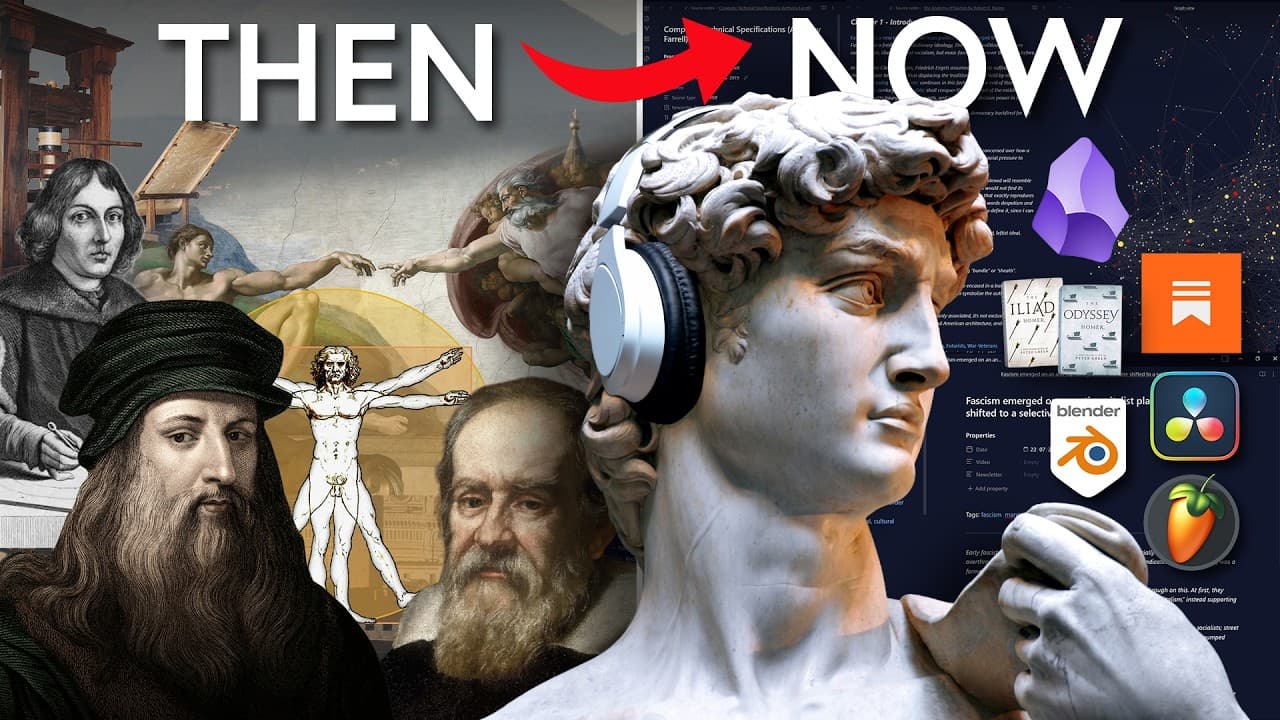
Modern polymaths should use the internet to combine broad curiosity, deep expertise, and practical digital skills. The historical Renaissance shows that intellectual flourishing follows wider access to knowledge, exchanges of ideas, economic opportunity, cultural patronage, and enabling technologies, while success in the information age also requires filtering low-quality material and learning from curated experts.
Transcript
You already know about the Renaissance, man. It's the polymath. It's the archetype of imagination and curiosity and an expertise that stretches wide but deep. I mean, it's amazing. And yet, it's not something you should emulate because there is something better. Trying to be like Da Vinci or Benjamin Franklin or whatever, it doesn't make sense beca... Read More
Key Insights
- The Renaissance polymath was a product of a particular historical environment, so copying figures such as Leonardo da Vinci or Benjamin Franklin is insufficient for the information age. A modern polymath must adapt broad curiosity and substantial expertise to digital technologies, internet access, and contemporary methods of learning.
- The Black Death acted as an accelerant for Renaissance conditions by killing roughly half of Europe’s population, weakening the abundant peasant base, increasing workers’ leverage, disrupting inheritances, and making improved wages, working conditions, and social mobility more realistic within the damaged feudal order.
- Renaissance wealth grew through trade networks, banking innovation, improved shipbuilding, and demand for goods such as spices, cotton, sugar, dyes, and textiles. Those networks transported ideas alongside capital, connecting Europe with mathematics, astronomy, science, medicine, art, and design from Islamic, Byzantine, and Ottoman cultures.
- Cultural patronage joined wealth with art and politics because powerful families, the Catholic Church, and secular figures commissioned artists, sculptors, and architects. Their projects demonstrated ambition and taste, attached patrons’ names to major works, and helped establish political legitimacy and cultural authority within their cities.
- Renaissance humanism emphasized human potential, classical virtues, civic participation, inquiry, and criticism. Its educational model, studia humanitatis, used grammar, rhetoric, history, and philosophy to form well-rounded citizens, while its human-centered outlook remained compatible with Christianity for believers who pursued excellence in service of God.
- The rediscovery of classical writing helped humanism develop as Greek scholars carried manuscripts west after Constantinople fell in 1453, while scholars such as Petrarch searched European libraries and monasteries for Latin works. These texts renewed attention to authors and ideas that Europeans knew about but had not fully appreciated.
- The printing press transformed access to knowledge by allowing scholarly work to be copied reliably and distributed across Europe on a large scale. Wider circulation encouraged criticism and commentary, created a stronger foundation of shared information, supported rising literacy, and allowed readers to interpret printed Bibles without relying entirely on church authority.
- The internet functions as a new Florence by concentrating access to artists, scholars, masters, instruction, and inspiration without requiring people to live in a particular cultural center. Its abundance creates a filtering problem, so curated education and experienced teachers can help self-directed learners identify fundamentals they might otherwise miss.
- More videos from this channel:
- More from this channel: Odysseas
Install to Summarize YouTube Videos and Get Transcripts
Explore YouTube Video Summarizer or Get YouTube Transcript Extractor
Questions & Answers
Q: How can someone become a polymath in the digital age?
A digital-age polymath should combine imagination and curiosity with expertise that extends both widely and deeply, while adapting those qualities to the internet and modern digital tools. The practical opportunity comes from instant access to artists, scholars, masters, and educational material. Because the internet also contains substantial junk, learners must filter sources carefully and sometimes use curated classes or experienced experts to establish fundamentals.
Q: Why is copying Renaissance polymaths not enough today?
Renaissance figures were shaped by an age of humanism, expanding trade, cultural patronage, rediscovered classical learning, and newly scalable printing. The information age operates under different conditions and technologies. Their curiosity, imagination, and range remain instructive, but directly imitating their lives ignores the modern internet, digital tools, and unprecedented access to knowledge that define the environment in which contemporary polymaths must work.
Q: How did the Black Death contribute to the Renaissance?
The Black Death killed roughly half of Europe and disrupted the social and economic foundations of feudalism. A reduced labor supply gave workers greater leverage to seek better wages and conditions, while disrupted inheritances redistributed wealth and made social mobility more realistic. The catastrophe also encouraged people to consider mortality and material improvement on Earth, helping prepare the intellectual setting for humanism.
Q: Why was trade important to the Renaissance?
Trade provided both wealth and an exchange of knowledge. Italian city-states operated as central hubs, banking innovations supported the movement of capital, and improved shipbuilding enabled more reliable long-distance routes with worthwhile cargo capacity. Commercial connections also introduced mathematics and astronomy from Islamic scholars, science and medicine from Byzantines, and aesthetic influences from Ottomans, expanding the intellectual resources available to Europe.
Q: How did patrons support Renaissance culture?
Wealthy families, the Catholic Church, and secular figures commissioned work from artists, sculptors, and architects. Grand projects displayed a patron’s wealth, ambition, and creative taste while attaching the patron’s name to culturally important work. This could produce political legitimacy and civic authority. Competition among independent city-states also encouraged investment in magnificent streets, cathedrals, artists, and scholars as each city pursued greater prestige.
Q: What was Renaissance humanism?
Renaissance humanism was a philosophy emphasizing human potential, classical virtues, active citizenship, inquiry, and criticism. It promoted studia humanitatis, an education based on grammar, rhetoric, history, and philosophy, to develop noble and well-rounded citizens. It also treated truth as something found through the unity of subjects and celebrated humanity’s creative and conquering capacities without necessarily rejecting Christianity or spiritual faith.
Q: How did classical texts shape Renaissance thinking?
Renewed engagement with Greek and Latin texts gave Renaissance thinkers models for human potential, citizenship, virtue, rhetoric, history, and philosophy. After Constantinople fell in 1453, Greek scholars moved west with manuscripts and ideas. Within Europe, scholars such as Petrarch searched libraries and monasteries for neglected Latin classics. Their recovery and fuller appreciation provided essential intellectual material from which Renaissance humanism developed.
Q: Why is the internet compared to Renaissance Florence?
Florence and other Renaissance cities concentrated artists, scholars, wealth, patronage, and opportunities for learning in particular places. The internet performs a comparable role without the same geographic limitation, giving people from anywhere immediate access to inspiration, instruction, and experienced practitioners. Its chief difficulty is abundance rather than scarcity, since learners must separate useful knowledge from junk and locate structured, reliable guidance.
Summary & Key Takeaways
-
The Renaissance emerged through several interacting forces rather than one isolated event. The Black Death weakened Europe’s feudal order, increased workers’ leverage, disrupted inheritances, and encouraged greater attention to material life. This upheaval helped prepare the ground for humanism, although historians cited by the speaker treat the plague as an accelerant rather than the primary cause.
-
Expanding trade generated wealth while carrying mathematics, astronomy, science, medicine, art, and design between cultures. Italian city-states became commercial and cultural hubs, while powerful families, churches, and secular patrons funded ambitious work to gain legitimacy and prestige. Competition among independent cities further encouraged investment in artists, architects, scholars, streets, and cathedrals.
-
Humanism revived classical texts and promoted human potential, civic participation, inquiry, criticism, and education across grammar, rhetoric, history, and philosophy. Gutenberg’s printing press then made scholarly work easier to copy and distribute. The internet now offers a comparable expansion of access, allowing aspiring polymaths to find inspiration and instruction regardless of location.
Read in Other Languages (beta)
Share This Summary 📚
Summarize YouTube Videos and Get Video Transcripts with 1-Click
Try YouTube Summary with ChatGPT & Claude or YouTube Transcript Generator
Explore More Summaries from Odysseas 📚



Summarize YouTube Videos and Get Video Transcripts with 1-Click
Try YouTube Summary with ChatGPT & Claude or YouTube Transcript Generator