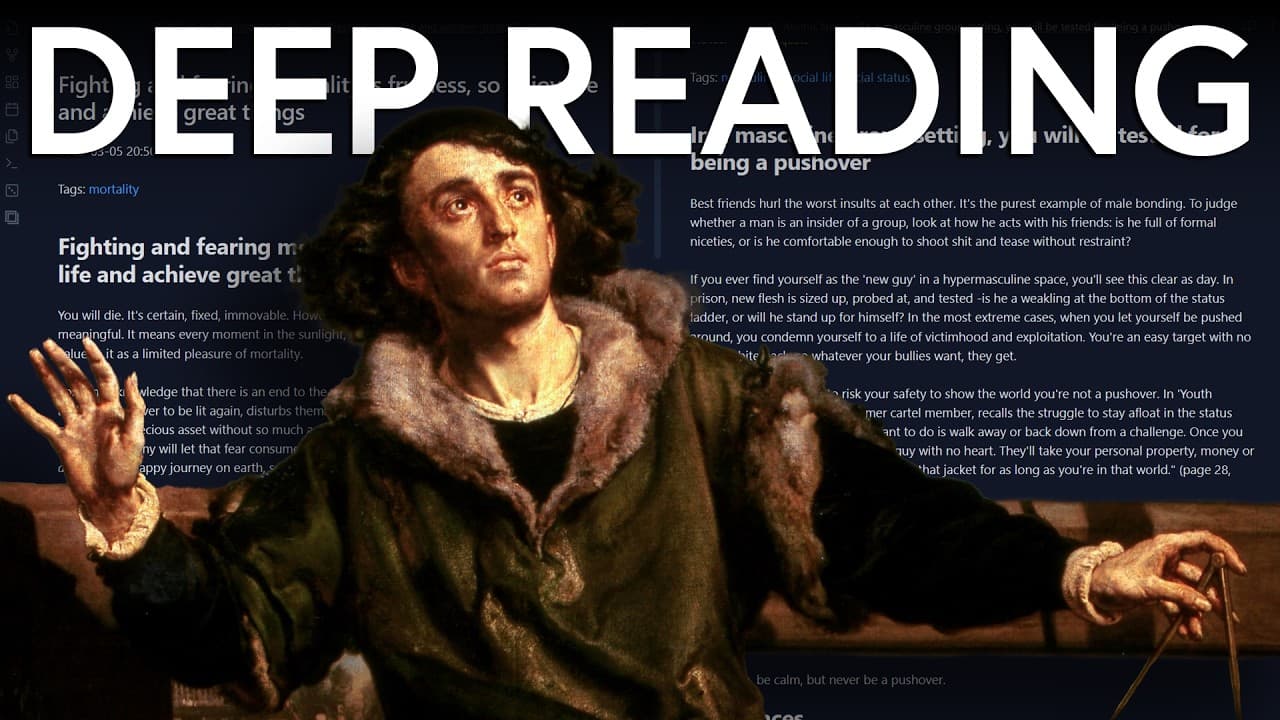
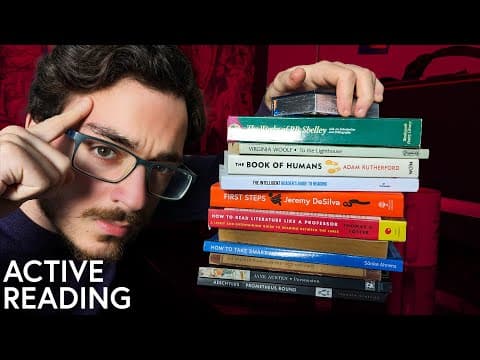
How to analyze books deeply like a Renaissance scholar
TL;DR
The method starts with choosing books that genuinely excite you and align with your goals. It then uses a quick inspection to confirm type and purpose, followed by deliberate note taking, thorough analysis, careful archiving, and finally synthesis to preserve insight and meaning for life. This process aims to make reading purposeful and memorable.
Transcript
people can't read at least not properly piss off of course I can I learned it in school no sure you can read the words of a page we not stupid but who taught us how to read deeply who taught us how to get through hard books without wanting to jump off a bridge who taught us how to truly understand the book's ideas rather than just forgetting them a... Read More
Key Insights
- Book selection should be driven by genuine interest and personal goals, not external hype or trends. It is important to choose topics you want to know more about and the kind of person you want to be. The process is not a fixed six step flow chart but a straightforward framework that can be tailored.
- Inspection is a critical pre-reading step that clarifies the type and purpose of a book, helping to avoid wasted time and set up effective analysis. Look for what the book is about, its main arguments, and the themes it aims to explore.
- Note taking turns reading into an active conversation. Writing in the book transforms passive reading into engagement, aiding memory and insight by creating a dialogue with the text.
- The six stages are Selection, Inspection, Note taking, Analysis, Archiving, Synthesis, with each stage building on the previous to deepen understanding and retention.
- Analysis uses the summary of what the work is about and its aims to prepare for deeper interpretation, revealing how the book contributes to larger conversations in its field.
- Archiving preserves insights for future recall, turning reading into a long term resource rather than a one-off experience.
- Synthesis combines insights from the book with other knowledge to form new understanding and practical applications in writing, thinking, or teaching.
- More videos from this channel:
- More from this channel: Odysseas
Install to Summarize YouTube Videos and Get Transcripts
Explore YouTube Video Summarizer or Get YouTube Transcript Extractor
Questions & Answers
Q: What is the first step in the book analysis system and why does it matter?
The first step is Selection, which matters because choosing the right book prevents starting on a path that leads to frustration or wasted effort. Selecting works that genuinely excite you and align with your personal goals makes reading a meaningful activity rather than a chore, and it sets the foundation for successful later steps.
Q: How should you approach book Inspection according to the video?
Inspection involves quickly determining the book type, whether it is fiction, non fiction, memoir, or commentary, and identifying its main purpose and arguments. By reading a few pages and the concluding segments, you gain a sense of what the book is about and what you should expect, helping you decide if it is worth your time.
Q: Why is note taking described as Flesh and Bones in the system?
Note taking is described as Flesh and Bones because it turns reading into an active conversation. Writing in the book transforms passive exposure into engagement, enabling you to track ideas, questions, and connections. This small effort yields significant returns in understanding and memory.
Q: What does the speaker mean by archiving, in the context of book analysis?
Archiving involves preserving insights and notes from the book so they remain accessible for future reference. This step ensures that the time invested in reading yields a long term resource that can be consulted, linked with other ideas, and retraced when needed in later synthesis or writing.
Q: What is the purpose of synthesis in this framework?
Synthesis is the process of combining insights from the read book with prior knowledge to form new understanding or practical applications. It turns isolated ideas into integrated thinking that can inform writing, decision making, or teaching, making reading a catalyst for growth rather than a collection of isolated facts.
Q: How does the speaker suggest choosing books when you have many interests?
The speaker recommends focusing on what you want to know most and who you want to become, using those answers to guide reading choices. This approach helps manage a broad range of interests by aligning selections with personal goals and the kind of person you aspire to be.
Q: What role does personal interest play in maintaining motivation to read deeply?
Personal interest acts as the primary motivator that sustains effort over time. When you read books that excite you, reading becomes enjoyable and less of a grind, making it easier to persist through challenging passages and to extract meaningful ideas that stay with you.
Q: How does the video address the idea of a perfect system or universal method?
The video argues against claiming there is one perfect system or a universally right method. Instead, it promotes a simple, adaptable framework that can be tailored to individual needs, preferences, and goals, encouraging viewers to tinker and refine the process to suit their own learning style.
Summary & Key Takeaways
-
This section outlines six steps of a reading system: selection, inspection, note taking, analysis, archiving, and synthesis, all designed to help readers engage deeply with books rather than skim for surface meaning. The approach emphasizes personal goals and genuine interest to sustain motivation across readings.
-
The speaker argues against merely following trends, urging readers to pick works that align with who they want to become and what they want to know, supported by practical tactics like inspection and note taking to lock in understanding.
-
The video emphasizes simplicity and customization, noting that the best systems are simple and adaptable, not rigid, and that readers should tinker with the method to fit their own learning style and life goals.
Read in Other Languages (beta)
Share This Summary 📚
Summarize YouTube Videos and Get Video Transcripts with 1-Click
Try YouTube Summary with ChatGPT & Claude or YouTube Transcript Generator
Explore More Summaries from Odysseas 📚



Summarize YouTube Videos and Get Video Transcripts with 1-Click
Try YouTube Summary with ChatGPT & Claude or YouTube Transcript Generator