How to Turn Your Notes Into Usable Knowledge
TL;DR
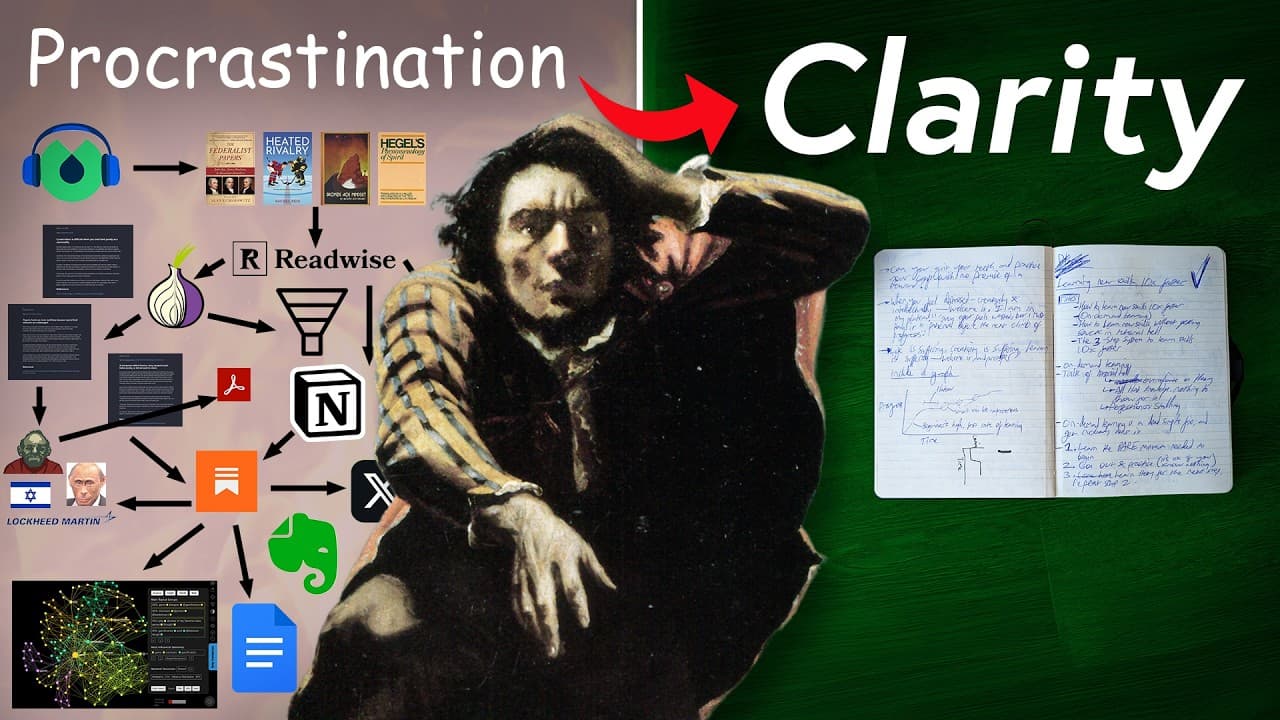
Turn notes into usable knowledge by applying ideas to unfamiliar problems, arguments, essays, and other forms of output. Note-taking remains valuable because writing supports thinking and trains attention, but organized information and conceptual understanding are incomplete without application. Treat note systems as flexible tools, then stress-test what you know through open, dynamic, and improvised thought.
Transcript
I've written over a thousand detailed notes. I filled dozens and dozens of notebooks. I've built what you call a second brain. And yet, one question still haunts me. Am I any smarter? Does any of this really matter? Obsidian, atomic notes, commonplace books, or is it all just self-indulgence? A performance of fake knowledge and fake productivity? Y... Read More
Key Insights
- Note-taking is valuable because writing is a form of thinking, not merely a record of thoughts formed elsewhere. Writing an idea down forces the writer to notice it, interpret its meaning, and work through uncertainty in an active dialogue with the material.
- Digital note systems are useful because they improve organization, security, portability, and customization. Their complexity is optional, since users can maintain simple folders and limited plugins instead of continually expanding the system with elaborate features, properties, or integrations.
- Atomic notes are self-contained units that each address one distinct idea and can connect with other notes. They work well as flexible building blocks for organization, but even a carefully linked collection cannot fully reproduce the dynamic and improvised character of human thought.
- Knowledge has three categories in the presented framework: information, understanding, and application. Information captures what is said, understanding identifies its meaning and significance, and application uses prior knowledge to address new problems, reach conclusions, and navigate unfamiliar contexts.
- Application is the missing final step in many note-taking practices. A person may possess extensive information and strong conceptual understanding yet struggle when required to respond to counterarguments, follow changing logic, or use familiar ideas in an unfamiliar essay question.
- Free thought is the practice of releasing ideas from rigid containers and stress-testing them through unexpected media or situations. It more closely resembles real thinking because it requires openness, improvisation, adaptation, and connections that cannot always be planned through tags or indexes.
- Note systems are means rather than end products. The thinking performed while writing may remain valuable even if the resulting pages are never revisited, although keeping useful notes still makes sense because they can support later organization, reflection, and application.
- Output-first thinking, essays, talking, and debate are presented as techniques for making knowledge more real. They are not total replacements for Obsidian, commonplace books, or other systems, but complementary practices that reveal weaknesses and strengthen the ability to apply ideas.
- More videos from this channel:
- More from this channel: Odysseas
Install to Summarize YouTube Videos and Get Transcripts
Explore YouTube Video Summarizer or Get YouTube Transcript Extractor
Questions & Answers
Q: How can I turn notes into usable knowledge?
Turn notes into usable knowledge by moving beyond collection and explanation into application. Use what you have recorded to solve unfamiliar problems, draw conclusions, answer new questions, or respond to opposing arguments. Output-first thinking, essay writing, talking, and debate give ideas room to move beyond their original containers and expose whether you can use them dynamically.
Q: Why is endless note-taking not enough for learning?
Endless note-taking can preserve information and improve understanding, but it does not necessarily develop application. A highly organized collection may still leave you unprepared to handle counterarguments, changing logic, or unfamiliar questions. Learning becomes more complete when notes support activity that requires improvisation, synthesis, and the use of previous knowledge in a new context.
Q: What are the three categories of knowledge?
The three categories are information, understanding, and application. Information consists of the facts, numbers, data, and words being presented. Understanding is the ability to identify what that information means and why it matters. Application is the ability to use past knowledge to solve new problems, draw conclusions, meet challenges, and think effectively in unfamiliar circumstances.
Q: Why is writing considered a form of thinking?
Writing is considered a form of thinking because recording an idea requires attention, interpretation, and reflection. Note-taking trains the mind to notice ideas that might otherwise pass unnoticed, then creates a dialogue in which the writer asks what those ideas mean. The written page is therefore a byproduct of the thinking process, not its only valuable result.
Q: What are atomic notes, and what are their limits?
Atomic notes are self-contained parcels of insight, with each note focused on one distinct idea. They can connect with other notes to reveal a larger picture and can be organized through links, properties, and indexes. Their limitation is that people do not naturally think in isolated nodes, so atomic structure cannot fully represent dynamic, improvised thought.
Q: How does debate test whether knowledge is applicable?
Debate tests application by requiring a person to respond to counterarguments, follow a changing flow of logic, and adapt ideas under pressure. Someone may discuss a subject for hours and clearly understand its concepts, yet struggle when another person challenges those concepts. That difficulty reveals a gap between possessing knowledge and using it flexibly in real time.
Q: Should I stop using Obsidian or other note systems?
Obsidian, Notion, commonplace books, and similar systems do not need to be abandoned. They remain useful for organizing, securing, carrying, and customizing notes. The better approach is to recognize both their strengths and their rigidity, keep the system as simple as desired, and add application practices that allow recorded ideas to operate outside the system.
Q: What does free thought mean in note-taking?
Free thought means allowing ideas to spread beyond atomic notes, notebooks, or other fixed containers. The idea is tested through an unfamiliar or unexpected medium that demands open, dynamic, and improvised thinking. This does not replace note-taking. It complements it by revealing whether knowledge can survive adaptation and function outside its original organized form.
Summary & Key Takeaways
-
Note-taking systems provide organization, security, portability, and customization, but their deepest value comes from the act of writing itself. Writing helps people notice ideas, examine their meaning, and conduct an internal dialogue. The resulting notes are useful byproducts, not the final purpose of the intellectual work.
-
Knowledge progresses through information, understanding, and application. Information supplies facts and words, while understanding captures their meaning and significance. Application completes the process by using prior knowledge to solve unfamiliar problems, draw conclusions, respond to counterarguments, and combine ideas from different subjects under changing conditions.
-
The proposed remedy is free thought, which releases ideas from isolated notes and tests them through unfamiliar forms of expression. Output-first thinking, essays, talking, and debate are presented as application methods. These practices complement digital note systems and commonplace books rather than requiring users to abandon them completely.
Read in Other Languages (beta)
Share This Summary 📚
Summarize YouTube Videos and Get Video Transcripts with 1-Click
Try YouTube Summary with ChatGPT & Claude or YouTube Transcript Generator
Explore More Summaries from Odysseas 📚



Summarize YouTube Videos and Get Video Transcripts with 1-Click
Try YouTube Summary with ChatGPT & Claude or YouTube Transcript Generator