How to Scale Meta Ad Creative with Two Levers
TL;DR
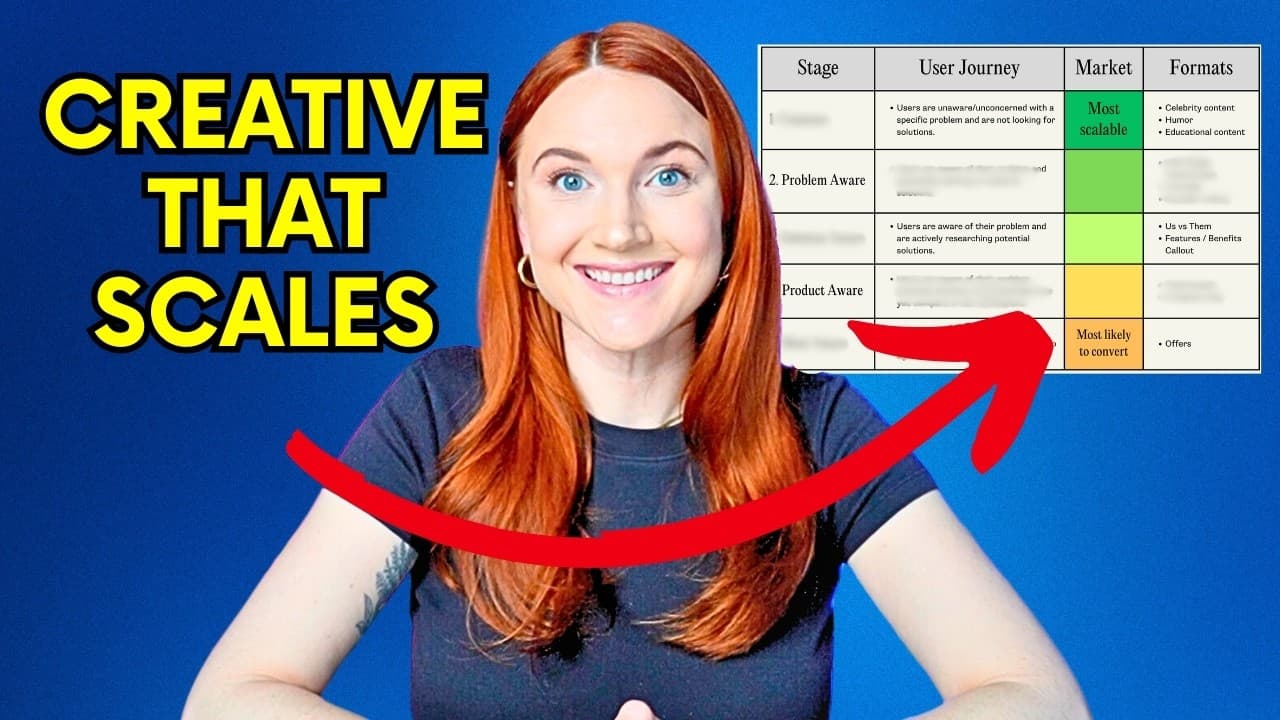
Scalable Meta ad creative comes from adjusting two levers: messaging and format. Align both with the audience’s awareness level, then move beyond brand-led offers toward problem-aware or unaware concepts for broader reach. Problem-focused questions, persona callouts, education, and curiosity can attract colder audiences, although these people require more work to trust the brand and convert.
Transcript
you can make scalable ad creative more easily by just manipulating these two things what's up marketers I was giving a presentation recently in Austin Texas all about meta ad creatives and everyone took out their phone and snapped a picture of this slide which is all about how to make scalable ad creative so maybe you launched an ad creative and re... Read More
Key Insights
- Scalable ad creative is controlled through two main levers: messaging and format. Changing what an ad communicates or how it presents that idea can shift which audience-awareness level it reaches, helping a successful concept appeal beyond people already familiar with the product or brand.
- Audience awareness is a spectrum with gray areas, not a rigid classification system. An ad may combine signals from multiple levels because its headline, imagery, benefits, offer, and format can each assume a different amount of customer knowledge about the problem, solution, product, or brand.
- Most-aware ads are designed for people familiar with the product, brand positioning, and competitive differences. Brand names, product names, prominent offers, and extra purchase information can convert this low-hanging fruit, but such concepts are less scalable when shown to cold audiences.
- Product-aware creative is suited to people who recognize their problem and possible solutions but are only beginning to understand a specific product. Formats such as testimonials or explanations of reasons to try a brand can supply the benefits, features, and differentiation needed to support their decision.
- Solution-aware comparisons work by addressing people who are already considering a category of remedies. An us-versus-them format can demonstrate how one approach differs from another, although changing the comparison and its messaging can also move the same general format toward a more problem-aware audience.
- Problem-aware creative starts with an issue the customer already recognizes instead of assuming interest in a particular product. Questions about sensitive ears, hangovers, or bloating can mirror customers’ own thoughts and introduce solutions they may not have previously considered, giving the concept greater scaling potential.
- Unaware creative has the broadest potential reach because it does not depend on prior knowledge of the problem, solution, product, or brand. It is also the hardest level to convert, so effective concepts rely heavily on education or curiosity to capture attention and develop interest.
- Persona callouts, educational lists, and curiosity-led statements can reach audiences farther up the funnel. Calling out a demographic or identity creates relevance before discussing the product, while an unexpected statement or unfamiliar visual can make viewers pause and seek an explanation.
- More videos from this channel:
- More from this channel: Dara Denney
Install to Summarize YouTube Videos and Get Transcripts
Explore YouTube Video Summarizer or Get YouTube Transcript Extractor
Questions & Answers
Q: How do you make Meta ad creative more scalable?
Make Meta ad creative more scalable by adjusting two levers: its messaging and its format. Choose both according to how much the intended audience already understands about the problem, available solutions, the product, and the brand. Concepts aimed only at existing brand or product awareness may convert readily but have limited cold-audience reach. Problem-aware and unaware approaches can reach more people when they successfully create trust and interest.
Q: What are the five audience-awareness levels for ad creative?
The five audience-awareness levels discussed are most aware, product aware, solution aware, problem aware, and unaware. They form a spectrum rather than five perfectly separated categories. Most-aware people understand the brand and how it compares with competitors, while unaware people may not recognize that they have a relevant problem. Headlines, visuals, offers, benefits, testimonials, and comparisons can place one ad between adjacent levels.
Q: Why can a successful ad stop working when its budget increases?
A successful ad can lose performance during scaling when its concept mainly appeals to a narrow group that already knows the product or brand. Increasing the budget requires reaching more people, including colder audiences with less prior knowledge. Creative built around product names, brand names, or direct offers may capture low-hanging fruit but lack the problem framing, education, or curiosity needed to persuade a broader audience.
Q: What type of creative works for a most-aware audience?
Most-aware creative should serve people who already understand the product, the brand’s positioning, and how it compares with alternatives. It can place an offer front and center, emphasize the brand or product name, and provide additional information that helps interested prospects complete a purchase. These ads target people who are most likely to convert, although they are not necessarily the most scalable concepts for cold traffic.
Q: How should ads target product-aware customers?
Ads for product-aware customers should help people evaluate a specific product after they already understand their problem and possible solutions. Testimonials and formats such as reasons to try a particular brand or product can work at this stage. Supporting benefits and features can clarify the product’s value and marketplace position, while the precise headline and visual treatment determine whether the ad also overlaps with most-aware or solution-aware messaging.
Q: Why are problem-aware ads often more scalable?
Problem-aware ads can scale because they address people who recognize an issue without requiring them to be searching for the advertised product. A direct question or familiar situation can reflect what customers are already thinking, then introduce a solution they had not considered. This expands the potential audience beyond product-aware shoppers. Conversion may require more work because those viewers still need enough information and trust to act.
Q: How can ads reach an unaware audience?
Ads can reach an unaware audience through education and curiosity. Educational concepts can present signs, symptoms, or situations that help people recognize a possible need. Curiosity-led statements can make an ordinary subject seem surprising and encourage viewers to seek an explanation. Demographic or persona callouts can also create immediate relevance among people who were not actively looking for the product, its category, or a solution.
Q: Why should marketers treat awareness levels as a spectrum?
Marketers should treat awareness levels as a spectrum because one ad can contain elements that speak to different degrees of customer knowledge. A testimonial may address a known problem while an unfamiliar device creates curiosity. A product-centered visual may be paired with a broader problem-focused headline. Instead of forcing every concept into one category, marketers can examine how its message and format move it toward a narrower or broader audience.
Summary & Key Takeaways
-
Scalable creative depends on two adjustable elements: messaging and format. Different combinations naturally fit different stages of the marketing journey. Brand names, product names, and offers address highly aware prospects, while problem-focused questions, educational material, curiosity, and demographic callouts can engage progressively broader audiences that know less about the brand or solution.
-
Audience awareness exists on a spectrum rather than in rigid categories. The five discussed levels are most aware, product aware, solution aware, problem aware, and unaware. Individual ads can span adjacent levels because their headline, supporting benefits, visual treatment, testimonial, comparison, or persona framing may each speak to audiences with different levels of prior knowledge.
-
Problem-aware creative often produces strong, scalable concepts because it begins with an issue customers already recognize without assuming they know the product. Unaware creative offers the broadest potential audience but is the hardest to convert. It usually needs education or curiosity to reveal a problem, create interest, and introduce the proposed solution.
Read in Other Languages (beta)
Share This Summary 📚
Summarize YouTube Videos and Get Video Transcripts with 1-Click
Try YouTube Summary with ChatGPT & Claude or YouTube Transcript Generator
Explore More Summaries from Dara Denney 📚


Summarize YouTube Videos and Get Video Transcripts with 1-Click
Try YouTube Summary with ChatGPT & Claude or YouTube Transcript Generator