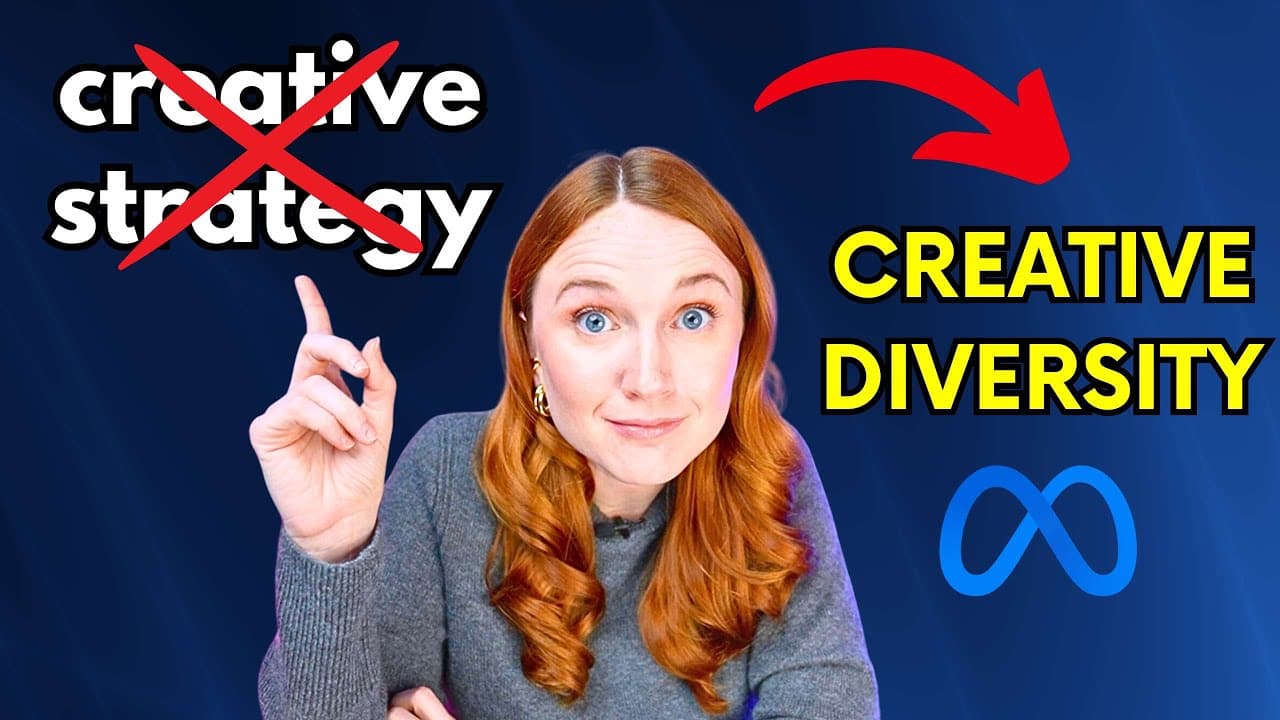
What Is Creative Diversity on Meta Ads?
TL;DR
Providing more than 20 creatives inside an Advantage+ campaign delivers a 29% lower incremental cost per purchase, according to Meta. Winning brands no longer rely on good creative alone; they run a high volume of varied formats, visuals, and messaging so the algorithm can find customers at scale. Run a 'squint test' on your top ads to gauge how diverse yours really are.
Transcript
so how can you tell if you have creative diversity on meta ads this is my hot take on net new versus iterative creative testing what's up marketers for all of the top brands right now and those looking to scale on meta ads creative diversity is the number one Topic at mind it's not good enough to just have good creative anymore we need to have a va... Read More
Key Insights
- Creative diversity is a strategy that prioritizes a variety of ad creative formats, messaging tactics, and visuals, giving Meta's algorithm a wide range of options so it can find customers more effectively, especially at scale.
- Providing more than 20 creatives inside an Advantage+ campaign produces a 29% lower incremental cost per purchase, a Meta statistic the speaker says she has seen play out with the brands she works with.
- The squint test is a simple diagnostic: put your top 10 to 20 ad creatives in a slide deck or Word document, sit back, squint, and check whether they all share similar colors, visuals, and formats.
- Meta offers a more scientific approach with a cheat sheet listing formats, messaging strategies, and visuals to check off, plus an audit template, which the speaker recommends using alongside her squint test.
- Beginner-level creative diversity means producing core formats like images, statics, carousels, and Creator partnership ads, getting at least a few out the door every single month.
- Intermediate level, where most brands actually sit, uses sub-formats within statics and video, such as us-versus-them, feature callouts, headline images, high-fi studio video, creator content, and mashup media.
- Advanced or expert diversity requires intentionally working with varied creators across distinct demographics, targeting different core desires and marketing awareness levels, sustained over time at 50-plus creative tests per month.
- A recommended testing split is 90% net new creatives versus iterative, since every new test already launches at least four variations, and iterations are reserved for top performers or unicorn ads.
Install to Summarize YouTube Videos and Get Transcripts
Explore YouTube Video Summarizer or Get YouTube Transcript Extractor
Questions & Answers
Q: What is creative diversity on Meta Ads?
Creative diversity is a creative strategy that prioritizes having a variety of ad creative formats, messaging tactics, and visuals. From Meta's perspective, giving the algorithm a wide range of options helps it find your customers much more effectively, especially at scale. The brands that succeed are the ones with multiple creative winners across different formats such as images, videos, UGC, and celebrity content, produced at higher volume than ever before.
Q: How much can 20+ creatives lower cost per purchase on Meta?
According to a Meta statistic shared in the video, providing more than 20 creatives inside an Advantage+ campaign gives you a 29% lower incremental cost per purchase, just from having those 20 options available. The speaker says she has absolutely seen this play out with the brands she works with, where the accounts with multiple creative winners across different formats like images, videos, UGC, and celebrity content are the ones succeeding now.
Q: How do you tell if you have creative diversity?
Use the squint test: take your top 10 to 20 ad creatives, put them all into a slide deck or a Word document, sit back, and squint your eyes at them. If everything looks very similar in color profile, visuals, and format, or you are defaulting entirely to UGC or image statics, you lack diversity. The speaker does this for every brand she works with and finds it generates great team discussions, and recommends pairing it with Meta's own cheat sheet and audit template.
Q: What are the three levels of creative diversity?
The three levels are beginner, intermediate, and advanced. Beginner brands produce core formats like images, statics, carousels, and Creator partnership ads, getting a few out monthly. Intermediate, where most brands sit, uses sub-formats such as us-versus-them statics, feature callouts, headline images, high-fi studio video, creator, celebrity, and mashup content. Advanced brands intentionally work with varied creators across distinct demographics and awareness levels over a long period at high volume.
Q: What qualifies a brand as advanced or expert in creative diversity?
At the advanced or expert level, a brand makes an intentional effort to work with a wide variety of creators across distinctly different demographics and celebrities, while focusing on different messaging strategies and angles. They lean into vastly different core desires and even marketing awareness levels to target all types of customers at scale. The speaker only counts a brand as truly expert if it sustains this over a very long period and maintains high volume, meaning roughly 50 or more creative tests per month.
Q: Which brands have great creative diversity on Meta Ads?
The speaker highlights four brands. Loop has excellent diversity with a wide range of creators, new engaging statics, and over 5,000 live ads. Happy Mammoth excels at static content, producing images she had never thought of. Ilia balances video and image content well at high scale in the beauty space. Halara runs 2,500 ads, reuses formats in different colors per product, and uses a wide range of creators to reach demographics from midwestern mom to East coast elite.
Q: What percentage should be net new creatives versus iterative testing?
The speaker recommends making 90% net new creatives versus iterative. She notes this got a sharp reaction at a Meta panel. Her reasoning is that every creative test already launches at least four variations, so some iterative testing is baked in from the start. She also borrows hooks and messaging from past top performers when building variations, which she counts as building on learnings rather than true iteration.
Q: What counts as an iterative creative test?
An iterative creative test means taking the exact same image or video and simply swapping out the hook or the copy, keeping the bare bones of the creative the same. The speaker only runs iterative testing on things that have really crushed it before, such as top performers or unicorn ads, which she will iterate until they die. Because her regular tests already build on past learnings, she avoids pushing failed creatives through iteration and wasting money on ads that just are not worth it.
Summary & Key Takeaways
-
Creative diversity has become the number one topic for top brands scaling on Meta Ads, discussed at a recent Meta panel. Good creative alone is no longer enough; brands now need a high volume of varied formats, messaging, and visuals so Meta's algorithm can find customers at scale.
-
Meta reports that more than 20 creatives in an Advantage+ campaign lowers incremental cost per purchase by 29%. To assess diversity, run the squint test on your top 10 to 20 ads, and combine it with Meta's cheat sheet and audit template for a scientific view.
-
Diversity comes in three levels: beginner core formats, intermediate sub-formats, and advanced work across creators, demographics, and awareness levels at 50-plus tests monthly. The speaker recommends 90% net new creatives, reserving iterative tests for proven unicorn ads until they die.
Read in Other Languages (beta)
Share This Summary 📚
Summarize YouTube Videos and Get Video Transcripts with 1-Click
Try YouTube Summary with ChatGPT & Claude or YouTube Transcript Generator
Explore More Summaries from Dara Denney 📚

Summarize YouTube Videos and Get Video Transcripts with 1-Click
Try YouTube Summary with ChatGPT & Claude or YouTube Transcript Generator